Category Archives: history

Philosophies of Power

Machiavelli observed in Chapter Fifteen of The Prince: “For anyone who wants to act the part of a good man in all circumstances will bring about his own ruin, for those he has to deal with will not all be good. So it is necessary for a ruler, if he wants to hold on to power, to learn how not to be good, and to know when it is and when it is not necessary to use this knowledge.”

Honour or power? Ned Stark’s choice to value honour first is, Hachiavelli has told us, the wrong choice for a ruler. In Cersei Lannister’s eyes it is a poor choice that renders the King’s Hand vulnerable. It is also a fatal weakness for the Lord of Winterfell who falls victim to a conspiracy organized by Cersei, Varys and Petyr Baelish.

It is Baelish who embraces the opportunities in courtly politics. Honour is a weakness and a myth, like the stories of how many swords have been forged into the Iron Throne. Disputes and disorder are opportunities for ambitious men such as Petyr who can see that, yes, some people will fall and others will shy away but men such as Littlefinger will eagerly grab at the opportunities.

Would Machiavelli have agreed with this philosophy? Maybe not. He had the firsthand experience of living through a moment of great change and reversal. The Medici restoration had not only removed him from power but resulted in his imprisonment, torture and barely-tolerated existence under house arrest for some time afterwards. Machiavelli had learned to be wary of the unexpected and unpredictable in politics.

In Chapter Twenty-Five of The Prince, Machiavelli likens Fortune to a river and not a placid, predictable waterway, but a destructive torrent: “one of those torrential rivers that, when they get angry, break their banks, knock down trees and buildings, strip the soil from one place and deposit it somewhere else. Everyone flees before them, everyone gives way in face of their onrush, nobody can resist them at any point. But although they are so powerful, this does not mean men, when the waters recede, cannot make repairs and build banks and barriers so that, if the waters rise again, either they will be safely kept within the sluices or at least their onrush will not be so unregulated and destructive. The same thing happens with fortune.”

So, when others claim that Littlefinger perfectly parallels Machiavelli, I have to differ. So far, Petyr Baelish has not experienced the real reversals of fortune that Machiavelli knew so well in his life prior to writing The Prince. The rest of Baelish’s history in Westeros has yet to be written, of course: quite literally with Martin still completing the final two books in his series. Perhaps he will find that chaos is not so enjoyable when it turns against him in the future. Fans will have to wait and see.

Comments Off on Philosophies of Power

Filed under history, pop culture

This Honourable Fool

(Over the next weeks, I’m posting excerpts from my recent talks on “Game of Thrones and History”. This is the first.)

Niccolò Machiavelli cautioned against too much reliance on honour when he wrote his advicebook, The Prince. In Game of Thrones, honour is a luxury that few can afford. Certainly not Eddard Stark, Lord of Winterfell, especially after his old friend, the king, makes Ned an offer he can’t refuse: to serve as Robert’s chief advisor or “King’s Hand”. But while Robert Baratheon might implicitly trust Ned Stark, that doesn’t mean that the two men see the world in the same way. Robert is all about vengeance and the utter annihilation of anyone he sees as a potential threat. Ned Stark is patently uncomfortable with the scheme that targets women and children as with Robert’s plan to assassinate Danaerys Targaryen, a representative of the old royal family he has supplanted and against whom he holds a grudge.

Ned Stark is the quintessential honourable man in Martin’s world of intrigue and betrayal. In some respects, he parallels the great English historical councillor, statesman and martyr, Sir Thomas More. More had risen high in the service of Henry VII and VIII, from London lawyer and Speaker of the Commons to Chancellor of the Realm. His great position brought him nothing but grief, however, as Henry’s chief goal in life was the getting of a male heir and his queen, Katherine of Aragon, was past the age of childbearing. Her nephew, Emperor Charles V, blocked Henry’s request for a papal divorce. The English king’s ambition turned to a break with the Roman church and adopting some of the newfangled approaches of Protestantism. More was intensely loyal to the church and would not assist in the endeavour or swear loyalty to the new queen he saw as illegitimately supplanting Katherine. More was, in his own words, “The king’s good servant but God’s first.” His honour and his religious sensibilities alienated the king and left him vulnerable. More was arrested, convicted of treason and executed in 1535.

Was Thomas More’s stand worthwhile? For him, personally, it was clearly the right decision. But for his goals of protecting the faith or serving the good of the realm, that was less clear. Henry VIII plundered the church, overturned the traditions of faith and, according to many critics, oppressed his subjects in pursuit of his goals. Ned Stark reconciles with Robert to take up his position as King’s Hand again, but faces another crisis with Robert on his deathbed. As Protector of the Realm, those around Ned urge him to assert his authority and push the queen’s family out.

Renly’s advice is clearly not indifferent: he seeks to supplant his ‘nephew’, Joffrey, as well as bypass his older brother, Stannis. Ned’s honour extends not only to the protection of women and children, but also the line of succession. If Joffrey is not eligible to be king because of his, erm, parentage, Stannis is the next in line. Ned’s idea of honour is incompatible with cutting deals of any sort. Renly’s offer to join forces and seize the day, for the good of the realm, is patently unwelcome.

In Chapter Eighteen of The Prince, Machiavelli observed “we see that in practice, in these days, those rulers who have not thought it important to keep their word have achieved great things, and have known how to employ cunning to confuse and disorientate other men. In the end, they have been able to overcome those who have placed store in integrity.”

Ned Stark’s honour renders him vulnerable to others’ plots. His offer of mercy to Cersei Lannister, warning to flee the court and save her children from Robert’s revenge, seems laughable given how ruthless we know that Cersei and others at the court are in pursuing their own interests. This clip from their confrontation sums up much of Martin’s and Machiavelli’s perspective on politics.

Ned Stark’s emphasis on honour and honesty made him vulnerable to the plotting of Cersei, Petyr Baelish, Varys and other ambitious individuals at the court.

Further Readings:
Marcus Schulzke, “Playing the Game of Thrones: Some Lessons from Machiavelli” Game of Thrones and Philosophy (New York: Wiley, 2012), 33-48.

Comments Off on This Honourable Fool

Filed under history, pop culture

Dialect, Despoilation and Disrepute

I should be working on some of my other writing projects but today I was back at The Old Bailey Online, pouring through some cases I’d noted earlier that had to do with topics of women’s reputation. One such case that I’d searched out and saved, unread, in my workspace had also turned up in another context – my interest in dialects and the representation of the spoken word. I figured that the case had to be interesting, spanning two such divergent aspects, so I finally settled down to read it in detail.

I’m not entirely certain it was a great idea as the case rather disturbing once you delve into the text. The case involves a claim of rape involving an eleven-year-old girl so you may want to hit the back button on your browser now.

The story begins with an indictment from 1735 against Julian Brown, an Italian-born resident of London who was charged with ravishing the young (disturbingly termed by the court as an “infant”) Susan Marshall, eleven years of age. According to Marshall’s own testimony, which opened the case, she had been sent to Brown’s shop to purchase two red herrings when he promised her another for herself should she come back privately. Marshall explained did so and was taken to a back room where he forced himself upon her: Continue reading

2 Comments

Filed under history

Fertility: What Historical Data Can’t Tell You

This story came across my Twitter feed today:

In the linked article at The Atlantic, How Long Can You Wait to Have a Baby?, which is mostly about modern women’s anxieties and experiences regarding getting pregnant in their thirties, I came across a singular, an astonishing factoid that illustrated how history is horribly misused by other researchers:

The widely cited statistic that one in three women ages 35 to 39 will not be pregnant after a year of trying, for instance, is based on an article published in 2004 in the journal Human Reproduction. Rarely mentioned is the source of the data: French birth records from 1670 to 1830. The chance of remaining childless—30 percent—was also calculated based on historical populations.

In other words, millions of women are being told when to get pregnant based on statistics from a time before electricity, antibiotics, or fertility treatment. Most people assume these numbers are based on large, well-conducted studies of modern women, but they are not. When I mention this to friends and associates, by far the most common reaction is: “No … No way. Really?”

Now, I’m going to set aside the whole broad swipe that statistics about childbearing before electricity must be inherently problematic to say that my concern, as a historian, takes a different tangent. I followed up on that lead, found and read the article in question by Henri Leridon, “Can assisted reproduction technology compensate for natural decline in fertility with age? A model assessment” Human Reproduction 19:7 (2004), 1548-1553. Leridon explains that he relies upon a 1961 study for the historical data and reveals some interesting assumptions imbedded into that analysis:

It can be assumed that fertility control did not exist in these populations, or that if it existed it was fairly ineffective (except in a small proportion of the population, such as prostitutes or highly educated women). This situation was called ‘natural fertility’

You know what we say about assumptions, don’t you? They make an ass out of “u” and me, only, in this case, I’m reserving the scorn for the medical researchers hijacking historical material in pursuit of a biologically “natural fertility”. Other historical scholars have long been showing that premodern societies were not artless, especially when it came to childbearing. To the contrary, reproduction was a fraught and tightly managed part of human society, going back millennia. Take a look at Angus McLaren’s magisterial overview from 1992 A History of Contraception: From Antiquity to the Present Day (Oxford: Blackwell, 1992) or any one of a dozen or more works in demography, gender studies and other related fields which demonstrate that early modern Europeans practiced family planning and regularly procured early-term abortions.

This historical data set from early modern France cannot and should not be used to document the “natural fertility” level of women at various ages. Pregnancy and reported childbirths were already being shaped by the traditions of marriage, concepts of legitimacy and socio-economic factors. Even if early modern contraceptives and abortifacents were much less effective than modern medications, we still haven’t tackled the question of agency.

How many of these women in the records desired children? How many had other, underlying conditions that might have interfered with pregnancy? How many were living apart from partners? How many breastfed and how many didn’t? How many struggled with starvation and malnutrition which compromised their ability to reproduce? These are all factors that can greatly alter the outcomes from what one might expect would be a basic biological record and they’re just a few of the elements at play in the complex realities of early modern France.

Colour me appalled that this old and wrong-headed historical conflation of early modern birth records with “natural fertility” data is still powering twenty-first century fertility science. I sure as heck hope some medical researcher is pursuing a much better baseline for “natural fertility” than digging through our historical databases in hopes that olden-days people are just the same as laboratory control groups!

7 Comments

Filed under history

Jades and Bawds

While I’m writing up two other projects (eep!) and house-training a 10-week-old puppy, I amuse myself in the breaks by reading up on the language of insult in early modern England. There’s a thriving literature on the subject: see this bibliography at Early Modern Web.

Of course, reading the literature’s only part of the fun. It’s the primary sources that draw me in as a historian. I often turn to the Old Bailey Online to see insults in the wild. Most recently, I searched “jade” and “bawd” in the Proceedings, insulting terms used to denigrate women.

The earliest appearance of “jade” dates to 1724 in the case of Penelope Adair, aka Bertless, aka Countess Spinello (what a string of pseudonyms), who was charged with grand larceny:

That he for some Reasons (which he did not think fit to mention in Court) took her another Lodging at Hoxton; she had a third Lodging in Wardrobe-Court in Carter-Lane, and a fourth at Mr. Falkenham’s in Thames-Street. So that in a little time she had cost him near a hundred Pounds. Yet, after all this, she ungratefully, and like a wicked jade as she was, had endeavoured to ruin him.1

The jade might be “vile” or “impudent” – it conjures a woman who is grasping, pushy and destructive. Here it’s used as a descriptor, after the fact, to let the judge know just what Aaron Pritchard thinks of this woman.

To be termed a “jade” is bad enough but far worse of an insult is “bawd”. That’s a particularly sexual term. An “old bawd” was understood to describe a down-on-her-luck and aged prostitute or procuress. To call a woman a “bawd” was a grievous insult as seen here in a murder prosecution from 1722:

It appeared that as the prisoner and the Deceased were scolding, the Deceased said, My Mother never was a Bawd to me: Whose Mother was? says the prisoner. I tell you mine wasn’t says the Deceased. Why Impudence, says the prisoner, I’ll throw the Tea in your Face if ye call my Mother Bawd; and with that threw Tea, Cup, and all at the Deceased, which missing her, struck Mary Fennel , the prisoner’s Maid.2

We’re all told that ‘sticks and stones may break my bones, but names can never hurt me’. That said, the evidence from the Old Bailey shows that, quite to the contrary, some insults could be deadly!

NOTES
_________
1. Old Bailey Proceedings Online (www.oldbaileyonline.org, version 7.0, 04 June 2013), December 1724, trial of Penelope Adair , alias Bertless, alias Countess Spinello, alias Sylvia Anna Landina (t17241204-25).
2. Old Bailey Proceedings Online (www.oldbaileyonline.org, version 7.0, 04 June 2013), September 1722, trial of Susan Higner (t17220907-64).

4 Comments

Filed under history

To Boldly Go: Historical Prospects of the Old Bailey Online

It’s ten years since The Old Bailey Online rolled out and what a glorious ten years it’s been. The Old Bailey Online (or OBO) provides, online, the complete texts of printed accounts dealing with criminal trials at London’s General Criminal Court circa 1674-1913. That’s almost 200,000 records!

I’ve been a fan since the very early days: looking back through my teaching dossier, I know that I stumbled upon the site in 2003 and began teaching with it that year. The website enabled students to run statistical searches and see, even tweak, the results immediately – a powerful tool when learning to do quantitative history. In the decade since, I’ve learned to love the site for much more than its awesome pedagogical power: it’s become a linchpin in my own historical research. Looking forward, I can’t see a time when I won’t find the OBO to be a vital historical resource. Why? The genius lies in the source’s searchability. Any trail you choose to blaze, you can follow!

The unsung heroes of historical research are those who provide finding aids. Whether they`re calendars of collections or indices or what-have-you, archives or even publications without some sort of search function are daunting piles to work through. A researcher can lose herself in the task of simply wading through dozens to hundreds of volumes, boxes or rolls. The early days of computerization gave researchers a few glimmers of hope but, even so, there was nothing easy about consulting one set of books to identify the catalogue number of the source you were interested in, another book to correlate the catalogue number with the microfilm reel number and then, only then, trot off to the microforms room to request the reel to run in the machine to read the book you originally wanted to consult.

The genius of the OBO is that, by integrating so many levels of searchability, almost any question you want to ask you can pursue in robust ways. Are you interested in a specific individual, whether as a scholar or a genealogist? The Old Bailey Online can be searched by name. Are you interested in seeing how many women were put on trial for breaking the peace in the nineteenth century? You can find that out. (There are 963 items returned when I search those parameters, 641 with guilty verdicts. Of course, some are duplicates as mu) Or let’s say that you’re interested in seeing how language changed in the time – great! The Old Bailey Online lets you search the entire text by keywords. There are place and map functions – do you want to track eighteenth-century criminal behaviour in the streets and by the parishes? Go right ahead!

The Old Bailey Online is more than just an excellent tool for historical research: it’s fostered an amazing community of scholars who’ve come together at conferences, who share their work online and whose publications citing the OBO add up to an amazing bibliography growing all the time.

Have I got you excited about the Old Bailey Online? Great: Click here to get started.
.

1 Comment

Filed under history

“The Feminine Mystique”: Fifty Years On

Can you believe it’s fifty years since “The Feminine Mystique” came out? I couldn’t and I’m almost as old as the book!

I’m not a modern historian or an American historian, so I’d never had cause to read the book before. I’d read selections from “The Feminine Mystique” over the years but never sat down to read the entire work until this 50th anniversary edition appeared. I was inspired by seeing Emily Bazelon’s post on her own reading at Doublex. The book is well worth digging into, particularly in this edition which includes multiple epilogues and introductory materials from earlier editions. They provide snapshots of how Friedan’s book was seen at launch, ten, twenty and many more years after. This reiterates the enormous impact that her book had on readers then and later on as well as upon her own life, including her work as a co-founder of NOW.

However, the meat of the book remains the text itself and “The Feminine Mystique” stands up well as a readable work, even half a century on. Friedan’s perceptiveness in describing ‘the problem without a name’ is bolstered by material from her own research, interviews and countless other contemporary sources. Where contemporary society encouraged men to pursue higher education, careers and grow in fulfilling ways, the mystique, bolstered by some cherry-picked elements from Freudian psychology and functionalist philosophies, urged women to subordinate all of those elements to their gender-mandated and absolutely certain fulfillment as a wife and mother. The problem was that so many women were driven to despair by the frustrations that they encountered in what was marketed to them as the ultimate in personal fulfillment and rewarding feminine duty. The mystique also contributed to a precipitous decline in the age of marriage across the American middle class. Higher education for women was condemned as counter to their natural and rewarding mission at home so that even women’s colleges began to step back from the academic programs they’d fought so hard to offer in favour of helping women prepare for their “Mrs.” degree path.

The book lays out a damning case for how the mystique ran counter to the previous trends in American middle class culture where women’s freedom and initiative had been celebrated. More damningly, Friedan shows how the mystique was endlessly useful to marketers in the burgeoning era of consumerism as well as their peers in the worlds of magazines, education and so on. Margaret Mead comes off rather badly for pushing the mystique’s key message to urge women to embrace domestic service to husband and children early and totally while she, herself, did no such thing.

The book is flawed in my mind by an excessive reliance upon psychoanalysis. Many chapters focus in detail on this subject beginning with a long background on Freud’s own problematic relationships with and understanding of women to page after page where Friedan uses psychoanalysis to diagnose problems in American housewives and their families all deriving from the toxic powers of the mystique. It is also relentlessly middle class: the world of the working class is almost non-existent except when evoked as servants!

I also couldn’t accept her dismissals of homosexuality, particularly in men, and autism in children as consequences of pathological mother-love run amuck or improperly applied but, as I read those sections, I knew that she was approaching these topics using the thinking of the time. It’s impossible to expect a book from 1963 to speak with the voice of 2013 all the time. The strength of “The Feminine Mystique” is that it evokes the past so vividly you’ll think you’re reading a modern history until you’re jolted back into reality by those occasional tone-deaf moments.

Occasionally you might feel a deep sense of depression as you read about the ways in which marketing heavily reinforced the mystique’s domestic mission. Friedan’s story about how many women attempted to fit the mold and failed is also sobering. No wonder the Stones did so well with “Mother’s Little Helper”!

If you want to understand the U.S. middle class culture of the 1950s and 1960s as how it played out in the media, medical, educational and marketing industries as well as in the personal stories of countless women, you should pick up Friedan’s book and get to reading! (And follow me at Goodreads where I’d initially posted a version of this review.)

Comments Off on “The Feminine Mystique”: Fifty Years On

Filed under history, review

And the winner is. . .

a fan of Chewbacca, the heroic Wookiee we all love, Jennelle Holland wins the Star Wars and History giveaway. Thanks to everyone who entered and, of course, may the Force be with you, always!

In the meantime, look for the book in stores near you. It’s out across North America now with a UK release next week. Let me know if you see it in the wild!

2 Comments

Filed under history, pop culture

Star Wars and History Giveaway

Star Wars and History in Hand Look what’s finally in my hands! Although the official release date is still a few days away, lots of people are reporting finding Star Wars and History in the bookstores or receiving it from an online retailer.

If you haven’t got your copy yet, now’s your time to score a copy of this awesome collection. I’m hosting a giveaway for a copy of Star Wars and History right here on this blog. All you have to do to enter is leave a comment on this post telling me who your favourite Star Wars character is and why. Contest is open worldwide. The deadline to enter is November 16, 2012, at noon EST (What time is that for me?).

45 Comments

Filed under history, pop culture

Black & Tans: A Reading Holiday

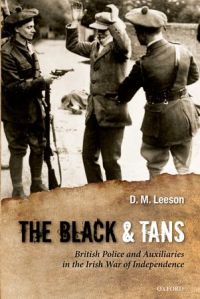
It’s the end of reading week and, surprise, surprise, I’m doing some non-work reading. Black & Tans book cover Specifically, I’m finally digging into a colleague’s recent book The Black & Tans: British Police and Auxiliaries in the Irish War of Independence.

It’s quite a good read, even for someone whose knowledge of modern Irish history comes and goes after the Gladstonian era. In many ways, it reminds me of Christopher Browning’s Ordinary Men: Reserve Police Battalion 101 and the Final Solution in Poland, not that the types of sources or particular situations are much the same, but insofar as both Browning and Leeson write with particular interest in how the situations put unique stress upon the men involved.

Black & Tans takes the conventional wisdom that the Royal Irish Constabulary was a motley group of thuggish WWI vets just looking to spill some blood and cause maximum mayhem (or, conversely, that they were the tools of thuggish English politicians determined to brutally oppress the Irish through terror tactics carried out by the police). His argument, is that it wasn’t a fatal flaw in the people but that the situation of trying to enforce impossible police directives in what was constantly hostile territory where the Black & Tans found themselves virtually under siege (and their challengers vice versa).

You come to see this argument emerging early on. Dr. Leeson’s not in any way an apologist for the forces, but he’s a dab hand with archival sources and elegant argumentation. I’m just over 100 pages into the book now and have a hard time putting it down as I’m encouraged to read just one more section as I learn about the Auxiliaries and their somewhat chequered as well as occasionally inglorious pasts.

I’m proud to call him a colleague and recommend the book which comes out in paperback next month.

Comments Off on Black & Tans: A Reading Holiday

Filed under history, review