Category Archives: history

Bad Reputation

More from the Old Bailey Online: going beyond my stepmother research, I’ve been intrigued by the role of reputation in the records. While many appeals to reputation and motivation were formulaic, the character of the accused and the prosecutors could be critical. This character was determined through appeals to employers, neighbours and relatives.

Jane Wilson was charged with counterfeiting currency (“coining”) in 1746. Her trial illustrates how a woman many agreed was normally hard-working, honest and industrious could be described by others as “stirred and moved by the Instigation of the Devil”. But it wasn’t only Wilson’s reputation that was at stake in the trial. Susannah Jones, who made the accusation against Wilson, saw her own reputation tested and found wanting.

Susannah Jones was the chief witness in the trial of Jane Wilson. According to Jones, Wilson had forced her into counterfeiting. Wilson was described as the chief instigator in forging the coins and spending them in the market while Jones felt trapped and desperately sought for a way out of this criminal enterprise: “I was very uneasy about it; for sometimes she would get drunk, and then she would threaten me. I first sent to the Gentleman, Mr. Buckman, within these three Weeks, and I said, I am very uneasy now my Children are grown out of the Way; and I am frighten’d and threaten’d by a Person what she will do; and I will now leave it off.”1

Buckman, a tailor, corroborated Susannah Jones’ story and explained how Wilson came to be arrested by the authorities.

Q. (to Walter Buckman .) Look upon the Prisoner at the Bar, Do you know her?

Buckman. My Lord, I never saw her in my Life, ’till this Affair was discover’d. The Evidence, Mrs. Jones, sent for me: When I came she said, I am something concern’d I did not send to you before; I have sent for you for something besides the Coat. When she sent to me she was very sober, and under a great Concern; and I was very sober myself. She said, I do assure you, Mr. Buckingham, I have something upon my Spirits that concerns me; I am determin’d to make myself a voluntary Evidence. An Evidence, In what? I said. Says she, I have been concern’d in Coining, and putting off bad Money. I said I would go and speak to a Person that I knew, who was one Vernon.2

If we took Jones and Buckman at face value, as Vernon did, Wilson seemed a dangerous creature.

Other witnesses told a different story, describing Jane Wilson as hard-working, reliable, industrious and, most importantly, concerned about the coining activities she had discovered Susannah Jones to be carrying out, consulting with one long-time acquaintance, Mary Evans, to verify that the fake coin-molds would be useful for evidence. As their stories emerge, it was clear that rather than Jones’ immediately turning evidence against Wilson’s hardened counterfeiting, it had been Susannah Jones that was the counterfeiting mastermind until turning evidence (possibly aware that Wilson was about to spill the beans about her enterprise).

In contrast, Susannah Jones was described as a woman of bad reputation in the district who cursed and kept company in her rented room with “blackguards”. Her landlady, Sarah Brown, further testified that Jones was willing to lie in order to convict Wilson:

Brown. The Evidence, Jones, swore one Time, that she would swear through a Deal Board to be reveng’d of her[Wilson]; she swore this in my Mother-in-Law’s House.

Q. Did you hear Susannah Jones say this yourself ?

Brown. Yes, I did, at White-Horse-Court in Whitecross-street.3

Reluctantly, the judge was forced to an invidious judgment: he acquitted Wilson, who was clearly not the guiding force but could not convict Jones who was protected by having turned evidence. Nevertheless, he made the following statement:

There are two Things very plain, that Susannah Jones, the Witness, is an exceeding wicked Woman; that she hath been concerned in this Thing for a Matter of ten Years, and ’tis, I think, as plain, that before this Woman came acquainted with Jones, she was a hard-working Woman; that she was extremely concerned during the little Time she lived with her; and that she was drawn into this Practice; therefore I could have wished that Susannah Jones might have been prosecuted, and this poor Woman made an Evidence, &c.4

Although all the evidence was against Jane Wilson from the outset in Susannah Jones’ sworn testimony, reputation played a key factor in reversing the story. Wilson’s account became plausible in the judge’s eyes because of the many witnesses who testified as to her good character and honest conduct. Jones’ reliability took a dive as her reputation became manifest. But a bad reputation wasn’t enough to overcome the protection of turning evidence: Susannah Jones, ten years a counterfeiter, walked out of the Old Bailey as a free woman and disappeared from the court’s records.

Notes:
1. Old Bailey Proceedings Online (www.oldbaileyonline.org, version 6.0, 22 June 2011), April 1746, trial of Jane Wilson (t17460409-48).
2. Ibid.
3. Ibid. To “swear through a deal board” (i.e. a plank of softwood like pine) meant one was willing to forcefully back up a lie. See Eric Partridge, The Routledge Dictionary of Historical Slang (London: Routledge & Kegan Paul, 1973), 933.
4. Ibid.

2 Comments

Filed under history

Carnivalesque 75

Welcome to Carnivalesque 75 for ancient and medieval topics in current blogging!

Aspects Ancient: Roger Pearse discusses The Tomb of a Graeco-Roman priest and via 80 Beats comes word that Strabo knew his geology. For those of a linguistic bent, the opening salvo in the story of The Ampersand is up at Shady Characters. I can’t wait for the conclusion.

Ancient archaeology made news of late, especially with excavations in the sewers of Herculaneum. See What the Ancient Romans Ate and Crap, It’s Herculaneum for some interesting commentary on the findings.

Further archaeological work reveals that some Roman ships came with fish tanks! Mitochondrial DNA’s been extracted from a Roman cemetery. Also see this post on Dr. Sarah Parcak’s discovery of 17 previously unknown Delta pyramids and many tombs.

Ponder Locusta, Professional Poisoner at The Ancient Standard. For those interested in sports and sculpture, at ilovehorses.net, an interesting post explains what is a quadriga and how it figures into a long western tradition.

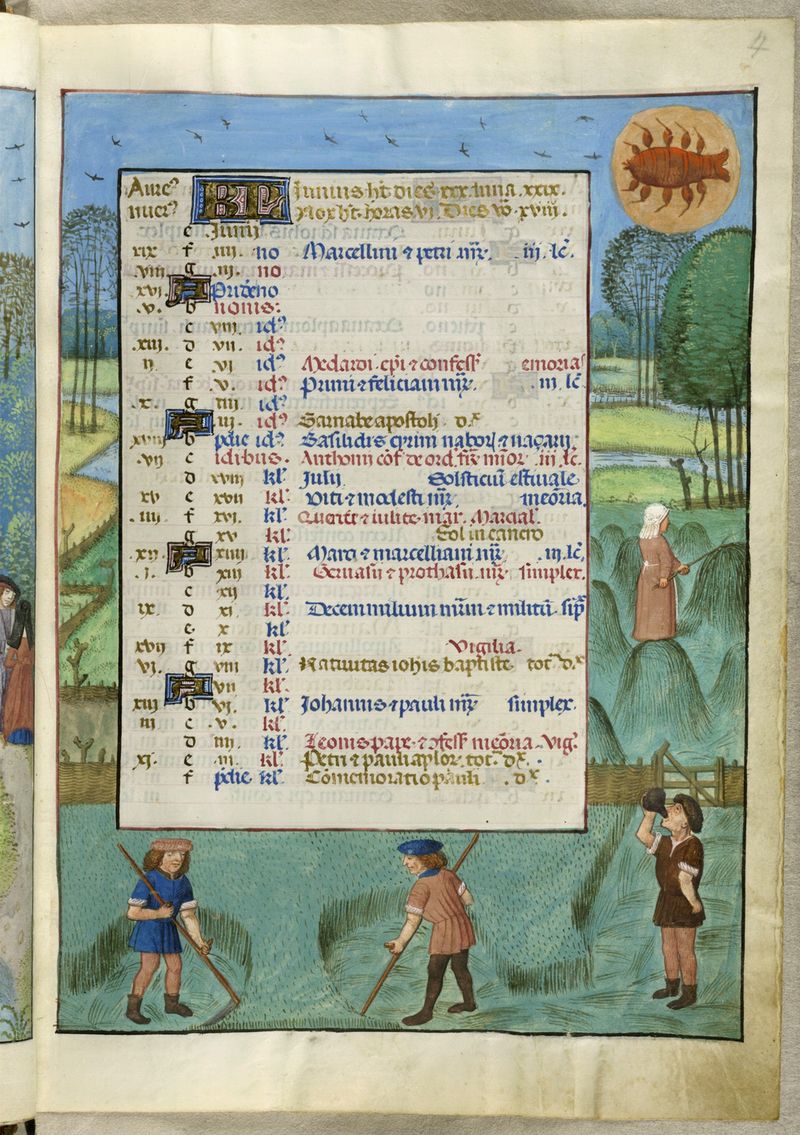
Matters Medieval: Got Medieval starts the month off with an iconography of June (let’s hear it for illuminations of crabs!). The Medieval Garden Enclosed (at the Cloisters) introduces us to Herb Robert and its medieval lore and applications. Also on the medical front, Rinderpest, Measles and medieval emerging infectious diseases documents the historical rise of measles in medieval accounts.

At Muhlberger’s World History, a Frankish history puzzle emerges in Radegund’s Brother. Jonathan Jarrett at A Corner of Tenth Century Europe muses on Samarra as seen through Google Maps. Another Damned Medievalist pointed to Regnum Francorum Online and discussed anachronistic readings of Carolingian charters. It’s all about the livery of seisin! Or is it?

Learn about the gruesome end of Fra Dolcino, Apostle (Executed, 1307) and check out the Medievalists.net report on the discovery of a fourteenth century painting in a historic Welsh chapel. Enjoy a little troubadour chansoneta at Unlocked Wordhoard!

Master Kong Reads the Anglo-Saxon Chronicle: Trashing Robert Ferguson’s Hammer and Cross might engage and Beachcombing explores how medieval Scotland took St. Andrew as a patron. Also, from the Medieval Garden Enclosed, a fascinating essay on Women and the Medieval Garden.

Karl Steel muses on Animals and Chaucer’s ‘Former Age’ at In the Medieval Middle while fifteenth century astronomy gets a new perspective in The Astronomical Revolution didn’t start here.

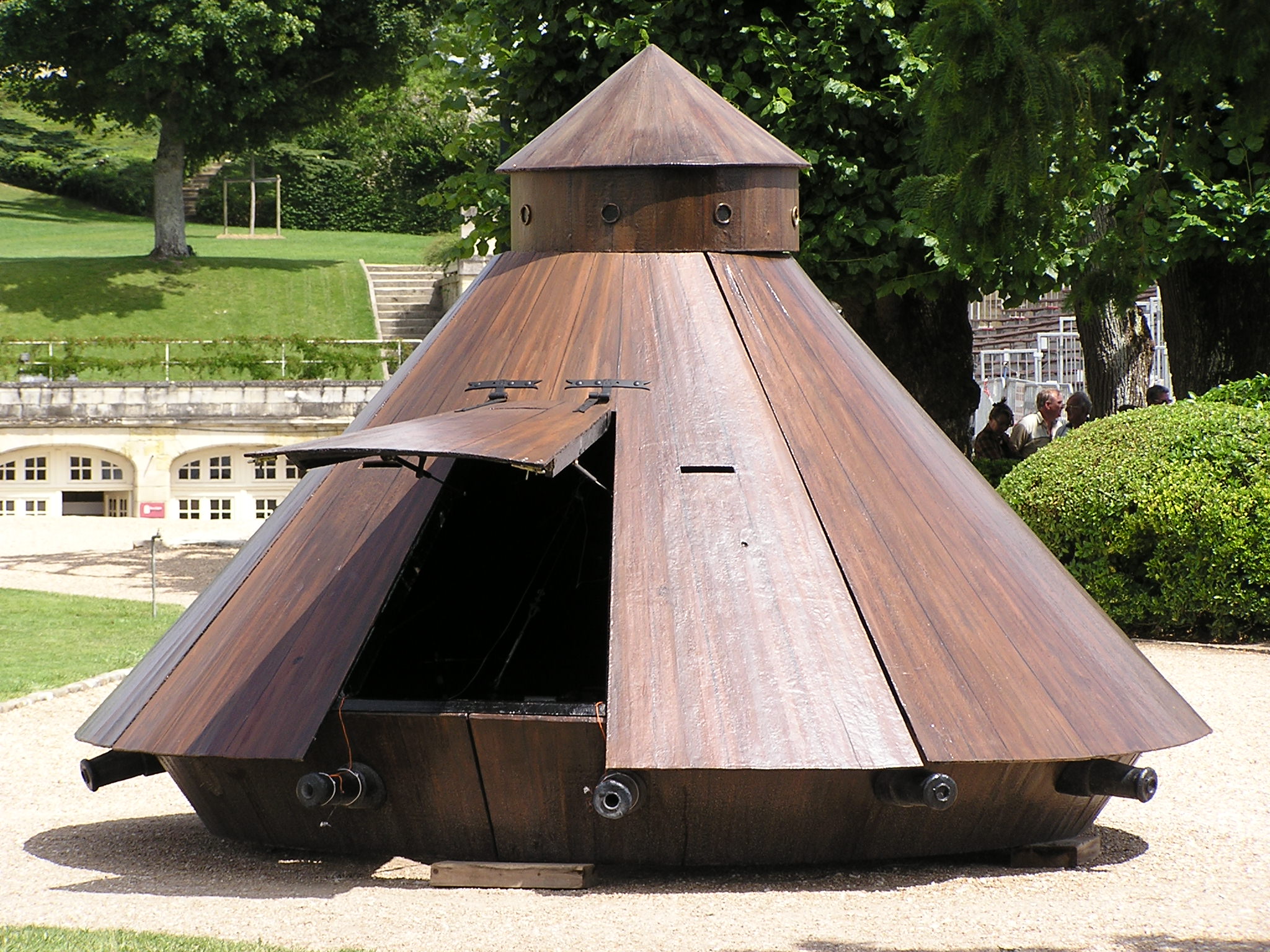
In a final flourish, see Leonardo’s designs brought to life in Jousting with (replica) Medieval Tanks at Strange History and consider some questions on late medieval jousters, again from Steve Muhlberger.

Did I miss a great blog post? Let me know in the comments and make sure to keep on nominating blog posts for the next edition of Carnivalesque (early modern), coming at Madame Guillotine‘s fine establishment!

3 Comments

Filed under history

Criminally Wicked Stepmothers

Naomi Tadmor wrote that “What people expected from their kin gives us insights into social and cultural life no less than what actually came about. This is particularly important because relationships among kin were often marked by negative tension and disappointment.”1 Some of my recent research deals with particularly tense and disappointing family lives as revealed in the records of the Old Bailey Online, a fabulous database of London criminal trial accounts and other reports spanning the period 1674-1913.

I’ve been trawling the records in search of mentions of stepmothers before 1750. This search is complicated by changes in terminology. “Mother-in-law” was regularly used to identify a woman we’d describe as a stepmother today but also could be used to describe the mother of a spouse just as it’s used currently. Confusing? Oh, yeah!

Only three accounts use the phrase “step mother” in the pre-1750 records; 51 use the term mother-in-law and many of these mentions are so fleeting, I can’t determine what relationship the person’s describing. But for those that are identifiable? The stepmothers come off badly almost all the time.

Both accused and convicted criminals bring up stepmothers only to blame them for their own downfall, rightly or wrongly, as in the case of Elizabeth Hewit, convicted in 1734 of robbery. Hewit’s story retold by the Newgate chaplain showed a stepmother as trigger to personal downfall: “Being unkindly treated by a Mother-in-Law, she left her Father, who took little care of her when young”, Hewit embarked on a life of crime.2

Some women tried to fight the stigma of stepmotherhood but being as these are criminal trials, that often ends badly. In 1686, Elizabeth Battison was brought to trial in the death of her stepdaughter, Elizabeth Kell. Battison felt that the stigma of the stepmother might colour how the judge perceived her parenting, so she “deposed that though she was Mother in Law to the Decased [sic] Kell, yet she loved her very well, and always gave her moderate Correction.” A surgeon examined the eleven-year-old’s body, and declared that she died as a result of a blow or kick to the torso, not of natural causes as her stepmother argued. Battison was found guilty.3

In 1726, young Mary Broadbent and some neighbour women were charged by Mary’s father and stepmother with theft. The trial notes show that Mrs. Broadbent described her relationship with Mary as caring and nurturing:

As for the Child, I love her as well as if she had been my own a thousand Times. She has been instructed in the Fear of God; she can say her Catechism in English and French, and can answer all lawful Questions, but she has been drawn aside by wicked Neighbours.

Unfortunately for Mrs. Broadbent and her husband, the prosecutors in the case, the trial soon turned against them. The father and stepmother lost custody of Mary who was taken in by Mr. Broadbent’s horrified sister and brother-in-law who testified against the prosecuting parents, asserting that Mr. Broadbent simply wanted to be rid of Mary in any way possible.4

A few, somewhat positive descriptions of stepmothers survive. In the Ordinary’s Account of September, 1700, when John Wheeler, a condemned thief spoke “to clear the Reputation of his Father and Mother in Law, they being, as he affirmed, not any cause of his Overthrow.”5 William Meers forty years later, described his stepmother’s care as “indifferent”.6 Faint praise, indeed!

These are all within 1042 uses of the word “mother” for the same time period and I’m working my way through these accounts to see if I can find more cases referring to stepmothers. Maybe some of them come off better than the cases I’ve examined already, but I’m not getting my hopes up! It’s pretty clear that, as far as these accounts go, the wicked stepmother of the Cinderella legend (Perrault’s version was published in 1697) was part of a powerful stereotype.7

Are these records representative of all of early modern England’s attitudes and experiences? Hardly. But they’re one more puzzle piece in my research to understand the experience and ideas of stepmotherhood in early modern England. That’s the subject of the book I’m writing.

(This post is adapted from my presentation, “Honour Thy Stepmother: Complicating Family Dynamics in Early Modern England” at the 2011 Berkshire Conference on the History of Women.)

Notes:

  1. Naomi Tadmor, “Early modern English kinship in the long run: reflections on continuity and change,” Continuity and Change 25 (2010) 16.
  2. Old Bailey Proceedings Online (www.oldbaileyonline.org, version 6.0, 20 April 2011), Ordinary of Newgate’s Account, July 1734 (OA17340709).
  3. Old Bailey Proceedings Online (www.oldbaileyonline.org, version 6.0, 20 April 2011), July 1686, trial of Elizabeth Battison (t16860707-12).
  4. Old Bailey Proceedings Online (www.oldbaileyonline.org, version 6.0, 20 April 2011), April 1726, trial of Mary Broadbent Mary Cosier Mary Harding Phillis Harding (t17260420-63).
  5. Old Bailey Proceedings Online (www.oldbaileyonline.org, version 6.0, 26 April 2011), Ordinary of Newgate’s Account, September 1700 (OA17000906).
  6. Old Bailey Proceedings Online (www.oldbaileyonline.org, version 6.0, 26 April 2011), Ordinary of Newgate’s Account, November 1740 (OA17401124).
  7. For context on the origins and use of the Cinderella myth, see Alan Dundes, Cinderella: a casebook (Madison: University of Wisconsin Press, 1982).

2 Comments

Filed under history

Well-Behaved Women and History

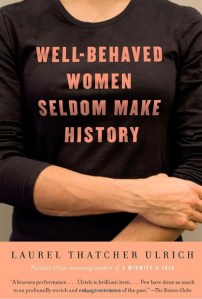
Well-Behaved Women Seldom Make History One of the books that I picked up at the Berkshire Conference on the History of Women was Pulitzer Prize winner and Harvard faculty member Laurel Thatcher Ulrich‘s Well-Behaved Women Seldom Make History. Thanks to Random House for making that freely available to conference-goers who signed up for their mailing list. (See, this kind of stuff is why you want to go to academic conferences. Free or discounted books!)

This book reads more like a linked collection of essays than your conventional academic work. That makes it easy to pick up and, if you had to put it down as I did, making my way back across parts of two countries to come home, always a joy to pick back up. The title of the book comes from an academic article Ulrich published early in her career in which she noted of virtuous early American women “Hoping for an eternal crown, they never asked to be remembered on earth. And they haven’t been. Well-behaved women seldom make history.” That line launched a tidal wave of popular culture awareness, appearing on t-shirts, mugs, posters and other paraphernalia, as the author ruefully and gratefully recounts. This book, she writes, is her “gift to all of those who continue to make history–through action, through record-keeping and through remembering.”

What a gift it is: she opens by retelling the stories of three women writers: Christine de Pizan, Elizabeth Cady Stanton and Virginia Woolf. While highlighting their differences (and there were many!), Professor Ulrich also highlights their similarities that link a fifteenth century continental courtier, a nineteenth century American suffragist and a twentieth century English avant-garde author: the burning need to recount women’s history. While their stories might well be familiar to you as they were to me, I had to love how beautifully the book laid out their lives and linked their experiences. Ulrich is wonderfully accomplished at drawing the reader into the stories of these women and then spinning those themes back out in the following chapters.

As the book progresses, we return time and again to these three women and many more as Ulrich tackles themes of women as warriors, artists, slaves, labourers and activists. You’ll learn how women like Elizabeth Cady Stanton both aided and overlooked the cause of abolition in her own single-minded focus on women’s rights, as well as how many women were celebrated in one era only to be forgotten in short term. Their rescuers, historians of women’s history, have restored these great women (such as Harriet Tubman and Christine de Pizan) to our historical awareness: they, too, earn praise from Ulrich.

As the author of A Midwife’s Tale, Ulrich is wonderfully prepared to tell stories of women’s overlooked lives. As a seasoned classroom teacher, she’s also honed a series of analytic vignettes that come to play in this book: you see why women’s history is important not from a lecture, but from experiencing it through the stories unfolding. Even women historians come in for some history here: a lovely series of vignettes explains how scholars like Joan Kelly and Renate Bridenthal came to embrace (and significantly shape) the nascent field of women’s history. Ulrich also weaves into her account the evolution of the Berkshire Conference of Women Historians from the only informal option for professional women to a huge and hugely influential academic society.

All through, she hammers home why we need to care about women’s history. I’ll sum up with some words from her last chapter, “Making History”:

If history is to enlarge our understanding of human experience, it must include stories that dismay as well as inspire. It must also include the lives of those whose presumed good behavior prevents us from taking them seriously. If well-behaved women seldom make history, it is not only because gender norms have constrained the range of female activity but history hasn’t been very good at capturing the lives of those whose contributions have been local and domestic. . . .
Well-behaved women make history when they do the unexpected, when they create and preserve records, and when later generations care.

If you are curious about those generations of women who stretch back to Anon and forward to today, or you simply appreciate a well-written work of sweeping scholarship, you are sure to appreciate this book. Buy the book, buy the t-shirt, buy the bumper sticker, too, and think about making history while you’re at it!

4 Comments

Filed under history, review

Catching up at the Berks

Friday was such a busy day that I didn’t have a chance to post any blog reports from the conference, but I did tweet a couple of sessions which I enjoyed greatly. If you haven’t already done so, check out the #Berks2011 twitter feed which compiles all the updates shared by historians who’re here and sharing!

First off, click through to the Berkshire Conference Digitial History Showcase which offers an in to all sorts of amazing digital tools from blogging platforms to virtual classroom tools. I was taken by their explanation of tools for exhibits and tours, particularly Omeka. I’m itching to give this a whirl with one of my classes in the fall: maybe my graduate students in historical methods?

I posted a series of summaries from my Friday sessions to Twitter already. One key element threading through all of this is a worry that maybe we read too much agency into how women appear in the legal and economic record. Simply because a woman is on record as having been part of a loan or donation, can we know how much she was involved in the planning and approval of the action? Shannon McSheffrey of Concordia, in her comments to the last panel I attended on Friday dealing with Generative Labor, also wisely cautioned that we need to remember that our modern interest in economic resources as desirable end isn’t always so much of a focus in medieval lives where chastity and religious aspirations figured greatly. This morning’s session where I presented my research on early modern English stepmothers provoked all sorts of interesting insights from the audience directed at the larger issues the panel raised (and our discussant, Lynn Botelho, carefully teased out) about how we are concerned with questions of language (stepmother is a loaded word, for instance, in the early modern English records) and sources (I want to cast my own net wider and bring in local records from a couple of parishes and/or villages that might support a prosopography of blended families beyond the very dysfunctional relationships the Old Bailey Online records document).

Tenured Radical has already filled readers in on some of Friday’s activities, up to the blogger meet-up at 5:30. We were sad that Historiann couldn’t join us, but we still had enough people there in force to take over the big table in the Grad Lounge. Knitting Clio, cliotropic, Clio Bluestocking, Scattered and Random, Another Damned Medievalist, Tenured Radical, Tanya Roth and one other non-blogging historian sampled the fine beverages from the bar while discussing strategies to make digital history more accessible to our colleagues.

After grabbing a quick dinner at the Dining Commons, I convinced some of our group to follow me to a presentation by Deborah Harkness whose A Discovery of Witches was a novel that I read this spring and adored. Romantic paranormal suspense woven into a world of archival research and historical alchemy: what more could you want? Especially when it’s written by a historian who knows her field and has a way with words. She read some passages from the book and discussed a bit of how she brought it into being. Best of all? She told us that she’s heading off to finish up the second book in the trilogy. I can’t wait for it!

ADM compiled some of her thoughts about what we could do better to represent premodern history in her open letter, Dear Berks Organizers. Since the next Big Berks will be in Toronto in 2014, I have good hopes this will come to fruition since Toronto is where Judith Bennett and many other scholars (including yours truly) learned something of the craft of history. We can come full circle there in 2014 to highlight the best in women’s history from across the globe and across the eras!

I have to praise the fine work of the site committee and volunteers for working so hard on supporting the conference. Heroic endeavours brought people in at the wee hours of Friday morning from the airport and some of those same volunteers were up and at them to make sure the 8:30 sessions started smoothly. I volunteered a few hours, myself, to assist people with technology but that was just a drop in the bucket with so many people lending a hand, whether officially a volunteer or not. There’s a wonderfully supportive attitude amongst the conference-goers at the Berks!

But now it’s lunchtime and I have much more of the conference to enjoy, including the infamous Saturday night dinner and dance. See you anon!

3 Comments

Filed under academe, history

Decoding Aristotle and Phyllis

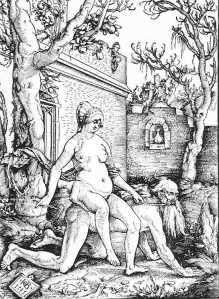
Phyllis and Aristotle A favourite subject of Renaissance artists, the cautionary tale of Aristotle and Phyllis is a great example of how much knowledge goes into historical analysis.

Sixteenth century versions recounted how Phyllis, a wife or courtesan of Alexander the Great, was so beautiful that she charmed even his legendary tutor, Aristotle. Seeking to avenge herself for an earlier slight by the counsellor, Phyllis had Aristotle prove his devotion by agreeing to wear a bit and bridle, then be ridden around by Phyllis in a palace garden where he presumed (wrongly!) that they would not be seen. Silly Aristotle! Phyllis arranged for Alexander to witness her triumph and poor Aristotle was left to explain to the young king that if a woman could achieve this with a wise old man, how much more vulnerable were young men!

Sometimes when I teach early modern history, I begin the course sharing a selection of images from the time, including this one. At first, students mostly don’t know what to make of it. They don’t know the story. Some of them don’t know Aristotle! So I tell them the story and a bit about the significance of Aristotle, then I ask them to examine the image again, maybe picturing themselves as a sixteenth century woman or man, encountering this image. How would he or she react? What concepts and beliefs might this image challenge or reinforce? If they know the Wife of Bath’s Tale, how do these compare? What do they think might be a “good Christian” attitude about this story given what they know of the period? Would anyone have spoken for Phyllis (just as, not quite a century later, Montaigne pondered lighting a candle for St. Michael’s dragon)?

Then there are all the questions I don’t even know enough to ask of them or myself.

It’s a useful reminder of how much we have to know to get into the mindset of a historical time – we have to know about Aristotle, we have to know about this story, we have to know about sexual norms and there’s so much more. We can instinctively smirk when we see the world turned upside down, with Phyllis triumphant, but we should also think how much this picture reinforced quite the opposite.

4 Comments

Filed under history, teaching

Carnivalesque Coming

Illumination from Psalter Look for a fabulous compendium of the best and latest bloggery on ancient and medieval topics coming the weekend of June 18th, right here. Yup, I’m hosting Carnivalesque 75 at my freshly re-established blog and welcome any suggestions of recent posts on premodern content. Leave a comment with a link or use the Carnivalesque Nomination Form.

In the meantime, check out the most recent editions for matters ancient/medieval at Jost a Mon (April) and early modern at Res Obscura (May). See you two weeks hence!

1 Comment

Filed under history

Filthy Footnote Redux

An earlier foray into the mash-up of popular culture and history came with my chapter in Twilight and History. I’m sharing some notes that didn’t make it into the final version of the chapter on Carlisle, patriarch of the ethical Cullen vampire clan. Be warned: this gets very dirty, very quickly: sewer dirt, but only of the virtual variety!

No Secrets in Open Sewers?

In Twilight, Edward, the hero, provided a brief narrative of his adoptive father Carlisle Cullen’s background, growing up in seventeenth-century London. The story is brief and hinges upon Carlisle’s taking up, with great reluctance, the witch-hunting schemes of his puritanical father. Carlisle is said to have stirred up more than he bargained for, an ancient group of vampires, hiding in the sewers of London.

Now, the modern sewer system of London is, like many other public works, an artifact of the Victorian era, some two hundred years after Carlisle’s day. Does this mean that Carlisle Cullen time-travelled in his witch hunts? No! There were sewers in Stuart London but they were a hodgepodge of above-ground and underground places that could really turn your stomach or put your life at risk, seeking to explore them.

Mind Your Step!

To get a perspective on the subject, I began with Emily Cockayne’s wonderful recent book Hubbub: filth, noise & stench in England 1600-1770 which focuses on the unpleasant, practical and very human history of early modern life. Refuse and excrement coursed through most cities in ditches, streams and rivers — literally open sewers. In more sophisticated parts of the cities, kennels (channels) flowed alongside the streets or lanes and occasionally roared with run-off water, flowing fast enough to drown the unwary!, as they carried away London’s filth with least risk to hem and health. While the Twilight vampires who reportedly lurked in the city of London, like the one that Carlisle spooked out, weren’t particularly prepossessing types, it’s unbelievable could have concealed their supernatural and sparkly nature in any of the city’s filth-choked open waterways.

Cesspits and Conduits

Open sewers weren’t the only way in which waste and water were carried through the city. In the basements and back gardens of residences, cesspits, cesspools and privies that sometimes connected to the open sewers were a primitive precursor to the more sophisticated sewers (shoars) built in English cities a century or more later. These weren’t failsafe systems as Samuel Pepys found to his dismay in 1660 when his neighbour’s cess discharged into his own cellar! When the nightcellar men came to take away the waste (their work wasn’t a public service as human waste was a valuable source of saltpeter for gunpowder manufacturing and also marketed in the countryside as fertilizer), the unpleasantness for the diarist grew as the workers had to remove the sewage through Pepys’ own house! (October 20, 1660 Diary of Samuel Pepys.)

London’s growing population strained the outdated systems of waste-management. Londoners complained about the situation, especially as waste contaminated the water used in households. “Rivers received a rich stew from the cities — from domestic and trade sources, particles of earth, soot, sand, turds and rainwater. Silty liquid arrived via streets, kennels and open ditches. A small but increasing amount arrived via subterranean sewers.” (Cockayne, 199) The first steps toward mandating a separation of waste and household water were articulated in the seventeenth and eighteenth century.

Roman Remains

Although a network of publicly-mandated and maintained sewers wasn’t in place by Carlisle Cullen’s days as a witch hunter, it’s plausible that he turned his attention to these cellars, cesspits, sewers and other shadowy areas where most other Londoners would have, like Pepys, assiduously avoided. But I suggest that there’s another part of London’s history where Carlisle’s nemesis, the ancient London vampire, lurked. A disused, antique sewer system, a legacy of Roman London, underlay parts of the old foundation of Roman Londinium and survived, partially intact, into the modern era. In the nineteenth century, John Hollingshead made a tour of Underground London with an informative guide he dubbed “Agrippa” in honour of the ancient remains of Roman sewers that were incorporated into the varied parts of the subterranean world he now explored. “Roman London means a small town, bounded on the East by Walbrook, and on the West by the Fleet. You cannot touch upon sewers without coming upon traces of the Romans; you cannot touch upon the Romans without meeting with traces of sewers.” (Hollingshead, 62-63)

Underground Rivers

Not just the remains of Roman-engineered sewers but other underground waterways lurked below the city’s streets and foundations. The Walbrook, the ancient river mentioned as one of the boundaries of Roman London in Hollingshead’s account, had been so buried by bridges and vaulting (as well as parts of the old London wall from which it took its name) that by 1598, John Stow could report that it had been entirely covered over. Entire buildings, such as St. Margaret’s church in Coleman Street ward, literally were built over the Walbrook’s course. (Stow, 222) The Walbrook and other small waterways were victims of London’s growth. By the 1660s, when Carlisle took over his father’s witch hunts, there would have been a wealth of locations in the literal underside of the city where those of stout heart and strong stomach could explore.

History in the Sewers

Today, we’re finding that old cesspits and the like are a valuable source for historians and archaeologists as we’ve recently been reminded with excavations underway in Stratford to explore William Shakespeare’s cesspit. But given the relative isolation of this cesspit, far removed from the old Roman sewers that London or York enjoyed, I expect the archaeologists will be safe from encounters with any of Stephenie Meyer’s vampires!

Bibliography:

  • Cockayne, Emily. Hubbub: filth, noise & stench in England 1600-1770. (New Haven, CT: Yale University Press, 2007).

  • Hollingshead, John. Underground London. (London: Groombridge and Sons, 1862).

  • Pepys, Samuel. The Diary of Samuel Pepys. http://www.pepysdiary.com/. (1660-1669)

  • Stow, John. A survey of London. (London: John Wolfe, 1598). STC 23341.

(Note: an earlier version of this post was published on my blog in April, 2010 but since that couldn’t be saved, I’m updating it and reposting it here.)

2 Comments

Filed under history, pop culture

Anne Boleyn, Squib

In my chapters for Harry Potter and History, I made much of Anne Boleyn, not just for her interesting and significant life, but also because she figures into the Harry Potter mythos, albeit in a small way. In an online game on her website, author J. K. Rowling revealed that in her story world Anne Boleyn was a Squib (someone born to wizarding parents who never developed magical abilities).

Anne Boleyn by Holbein While Anne is hardly the focus of the series, I was amused that Rowling seemingly couldn’t let such a delicious character entirely pass by her story world. Anne Boleyn’s life is endlessly fascinating, having been fodder for films (The Other Boleyn Girl, Anne of the Thousand Days – both adapted from other media), television series (The Tudors arguably launched itself off of the fascinating story of Anne’s rise and fall) and, of course, novels. Anne Boleyn is a cultural industry, in and of herself.

There are literally dozens, perhaps even hundreds of novels featuring Anne Boleyn. As others have rightly noted, her life story has a tabloid quality about it that immediately captures readers’ interest with frissons of excitement over questions of adultery, treason and execution, all at a royal court. But for Rowling, the greatest appeal had to be Anne’s association with witchcraft, most fully articulated by Retha Warnicke in The Rise and Fall of Anne Boleyn (although Eric Ives disputes her interpretation strongly in his own writings on Anne such as The Life and Death of Anne Boleyn). Charges that she bewitched the king are interesting, but hardly the meat of what was held against her in her trial. (More interesting is Warnicke’s link between her miscarriage and witchcraft accusations.)

Whether or not the charges of witchcraft levied against Anne were serious and significant in her downfall wasn’t a concern for Rowling when she whimsically picked on the detail of the charges to incorporate Anne Boleyn into wizarding world history. It’s simply a fun concept for author and readers. Are we to imagine that Anne’s mother, perhaps, had attended Hogwarts in her youth? Was Anne sadly disappointed in her ambition to do the same, only reluctantly turning toward capturing a king’s interest instead of achieving renown in the magical world? Did she employ potions and charms to win the king’s heart? Unless Rowling revisits the wizarding world in the sixteenth century, such speculation will only be fodder for blog posts and fanfiction.

5 Comments

Filed under history, pop culture

Being a Pop Culture Historian

I got my hands on copies of Harry Potter and History (Amazon.com) just the other day. As you can see, I’m very pleased, not only because I have two chapters in the collection, but also because I have a whackload of new fun reading to zip through.

Professional Pride: In writing for a pop culture project, a scholar needs to do right by their field. You don’t spin stories out of nothing or rely on tertiary sources if you want to grab readers’ attention and paint a compelling picture of how the fictional world they know relates to history. So you dig for hooks (I used Virginia Woolf’s A Room of One’s Own to explain the roles and limits of British women in real world history for “Witches vs. Women: What Muggles Could Learn from Wizarding History”). You’ll also find quotes from primary sources as well as insights credited to dozens of historians whose books, chapters, articles and scholarly encyclopedia entries filling the end notes for my chapter. Many historians are also mentioned by name in the body of the text.

Fandom Lore: A pop culture historian also has to know the pop culture source. This doesn’t mean just popping in a DVD and watching the movie version: it means reading the texts (if they exist) and critically exploring the story world. I’m a self-confessed fan of many books and shows. I have been “into” fandom for a long time. When you sign on to write about a pop culture topic, you have to develop or refresh your knowledge of that source material. So, yes, I’ve read all of the Twilight books now (more than once) as well as all of Rowling’s Harry Potter books (including the ancillary Quidditch Through The Ages, Fantastic Beasts and the Tales of Beedle the Bard). I also had repeatedly watched every episode of Battlestar Galactica that had yet aired before “The Battle for History in Battlestar Galactica” went off to the editors of Space and Time: Essays on Visions of History in Science Fiction and Fantasy Television. (Yes, I know I’ve been “Jossed” but the final edits were done before the last half of season four aired.)

Respect for the Reader: Writing for a popular audience is often described as “dumbing down” a subject. I believe that it’s a true test of scholarly mettle to communicate clearly to a non-specialist. Someone who’s inspired to pick up your book, whether at the bookstore or online, and browse through it is giving you a chance to show them why they should care and what they can get from a little time spent reading on the subject. They may not have your specialist knowledge of history, but they may remember arcane details of the pop culture source in great detail. Why not use that knowledge for your own advantage and let the pop culture material lead readers to real historical learning that they’re likely to retain since it relates to another well-developed interest? You may also find that you learn something from the well-established fans, as well.

1 Comment

Filed under history, pop culture