Early Modern War Teaching

Today I wrapped up my half of a team-taught third-year course on Early Modern War, 1350-1850. Next week’s our reading week after which my co-instructor, Dave Leeson, takes up where I left off, circa. 1650. We opened the course with a book-end examination of Greece at the start and the end of our periods – I talked about Greece in the Venetian-Turkish Wars and then we jumped forward to the cause of Greek Independence in the early nineteenth century. I tried to frame each class meeting on different historiographic debates or thematic elements and then illustrate those with interesting examples and compelling readings. We wrapped up each class with discussions on the day’s assigned readings: pulling out arguments and assessing our responses to the same. To give you a taste of what the course has been like, I’m sharing parts of our syllabus below:

Course Objectives: Students Soldiers in Peasants' War, 1525will identify the key technological, cultural, tactical, and strategic developments that have shaped pre-modern warfare; demonstrate awareness of the role of political, economic, and social changes that have shaped war in the world through their research, analysis and assessment of key aspects of the history of early modern war and warfare.

My class topics for the first half of term:

January 8; The Military Revolution Debate

Readings: Michael Roberts, “The Military Revolution, 1560-1660” (Rogers); Geoffrey Parker, “In Defense of the Military Revolution” (Rogers)

January 12; The Rules of War & Chivalric Culture
Readings: Anne Curry, “Disciplinary Ordinances for English and Franco-Scottish Armies in 1385: An international code?” (Reader)

January 15; War as Set-Piece: Crécy, Poitiers & Agincourt
Readings: Clifford J. Rogers, “The Military Revolutions of the Hundred Years War” (Rogers)

January 19; Siege Warfare & the Early Modern Arms Race
Readings: Thomas F. Arnold, “Fortifications and the Military Revolution: The Gonzaga Experience, 1530-1630” (Rogers)

January 22; The Military Revolution at Sea
Readings: Louis Sicking, “Naval warfare in Europe, c. 1330- c. 1680” (Reader)

January 26; War from Below: Revolts & Riots

Readings: Anthony Fletcher & Diarmaid MacCulloch, “Kett’s Rebellion” (Reader)

January 29; Citizen and Soldier: Early Modern Military Cultures
Readings: Angela McShane, “Recruiting Citizens for Soldiers in Seventeenth-Century English Ballads” (Reader)

February 2; Supply and Demand: The Business of War

Readings: I.A.A. Thompson “’Money, Money, and Yet More Money!’ Finance, the Fiscal-State, and the Military Revolution: Spain, 1500-1650” (Rogers)

February 5; New Models of Armies: Military Command and Discipline

Readings: David A. Parrott, “Strategy and Tactics in the Thirty Years’ War: The ‘Military Revolution’” (Rogers)

February 9; Commercial and Colonial Wars, 1492-1650
Readings: John F. Guilmartin, Jr. “The Military Revolution: Origins and First Tests Abroad” (Rogers)

February 12; An Age of Atrocity?
Readings: Will Coster, “Massacre and Codes of Conduct in the English Civil War” (Reader)

Texts: Clifford J. Rogers, ed., The Military Revolution Debate: Readings on the Military Transformation of Early Modern Europe (Boulder, CO: Westview Press, 1995) plus additional materials available via D2L and/or on reserve (“Reader”)

Assignments:
Essay Proposal One: 10% (Due January 26, a brief proposal of the topic for Essay One that includes a bibliography.)
Essay One: 25% (Due February 23, an 8-10 page research essay dealing with a topic in the history of war from 1350 through 1650.)
Essay Proposal Two: 10% (Due March 12, a brief proposal of the topic for Essay Two that includes a bibliography.)
Essay Two: 25% (Due April 2, an 8-10 page research essay dealing with a topic in the history of war from 1650 through 1850.)
Final Examination: 30% (All essay cumulative exam scheduled at the end of term.)

3 Comments

Filed under history, teaching

Mary Carleton, the Heroine Bigamist

She was born in Canterbury, or maybe Cologne, in 1634 or 1639 or perhaps even as late as 1642. Whoever she was and wherever she came from, Mary was a fascinating individual Counterfeit Lady who captured the interests of many, including the famed diarist Pepys. She convinced many Londoners that she was a wealthy and well-educated German princess but other contemporaries claimed Mary was actually the runaway wife of a Canterbury shoemaker who fled to Barbados seeking to escape her husband before taking up with three other men, the last of whom, John Carleton, prosecuted her for bigamy at the Old Bailey in 1663. When Mary was acquitted, she took lovers, changed identities and supported herself through tricks and thievery. Convicted of theft in 1670, she was transported to Jamaica but engineered her return to England where she was caught again, and recognized. Confessing all, Mary was taken to the gallows at Tyburn and executed in January of 1673.

Too often we assume that our modern age of celebrity culture is unique in fixating on the bad boys and girls of the day. But Mary Moders, as she was born in Canterbury, fascinated her contemporaries to the extent that she spawned two remarkable flurries of publications decrying her perfidy or defending her honour. Some scholars have claimed that her defensive memoirs, An Historical Narrative of the German Princess and particularly The Case of Madam Mary Carleton, were so learned and well-written that they must have been authored by someone else, i.e. a man. Other academics and even Mary’s most skeptical contemporaries believed these were her own words. Those who doubted Mary’s truthfulness but not her authorship pointed to Mary’s facility with words, her practice at forging identity documents and her skill at appearing part of the highest ranks of society: this was no empty foil but a full-out confidence artist.

In her long and varied career, Mary was also a bigamist several times over: she left her first husband after the death of two children, marrying a doctor who aided her in her escape before abandoning him and taking up with a bricklayer. After she travelled to London in the guise of a rich continental woman, she drew the attention of the Carleton family and was courted by young John Carleton, an ambitious lawyer’s clerk. The two of them must have been a disappointment to each other in terms of riches and opportunities. The Carletons, tipped off to Mary’s true past, attempted to prosecute her for bigamy. A 1604 legislative change, “An Act to restrain all persons from marrying until their former wives and former husbands be dead” (I Jac I, c. 11) had taken what was formerly a spiritual offense punishable by penance and transformed it into a felony crime. Mary could have been executed for her disregard of the solemnity of marriage as other contemporaries were.

However, the Carletons failed to document Mary’s bigamous past. They produced few witnesses who could testify to her previous life in Canterbury and the case was overthrown. Instead of a humbled convict, Mary became a darling of fashionable London. She was visited by gawkers while still in custody and may well have used the experience to find new ways to exploit her new-found fame to extract gifts and confidences from those who rose to her defence. Given her later convictions for theft of silver plate and the heady riches she accumulated through fraud, Mary appears to have been always on the make.

And yet, how much can we really know of what she did and what she desired? As her best biographer, Frances Kirkman, author of The Counterfeit Lady pictured above, wrote of her in 1673: “How can Truth be discovered of her who was wholly composed of Falsehood?” For the intriguing story of a woman who shed the conventional life and embraced an early form of celebrity culture in a life of scandal and adventure, look no farther than the bigamous thief, Mary Carleton.

Suggested Readings:
Susan Brown, Patricia Clements, and Isobel Grundy, eds. “Mary Carleton entry: Overview screen” within Orlando: Women’s Writing in the British Isles from the Beginnings to the Present. Cambridge: Cambridge University Press Online, 2006. http://orlando.cambridge.org/public/svPeople?person_id=carlma.
Kate Lilley, “Mary Carleton’s False Additions: The Case of the ‘German Princess'” Humanities Review 2010 https://www.academia.edu/265004/Mary_Carletons_False_Additions_the_Case_of_the_German_Princess.
Janet Todd, “Carleton , Mary (1634×42–1673)”, Oxford Dictionary of National Biography, Oxford: Oxford University Press, 2004 http://www.oxforddnb.com/view/article/4676.
Geraldine Wagner, “The Staged Self in Mary Carleton’s Autobiographical Narratives” CLCWeb 7:3 (September, 2005) http://docs.lib.purdue.edu/clcweb/vol7/iss3/7.

1 Comment

Filed under crime, history

What’s Next?

2014 turned out to be a banner professional year, despite health problems that sapped my strength for most of the first six months of the year. I shepherded four different projects into print that resulted in one scholarly article, three book chapters and a co-edited book. That also cleared a lot of my academic writing to-do list (except for Game of Thrones and History), leaving me in the strange situation of trying to determine exactly what is next.

I’ve been telling myself since the end of October that I could either go with the stalled article draft that’s sitting on my hard drive or move sideways to the related article idea that hasn’t been giving me kittens as the first piece has. Seriously, every time I reopen the first file, I find another point that makes me stop and think “self, isn’t that taking the analysis off-topic?” The stalled draft is stalled for a good reason: it’s not coherent and focused.

In contrast, the related article is just an idea, but it takes one of the elements from the stalled article and runs with only that element. I think that’s a better way to approach the project: start by outlining the clear elements in the sources and then move onto the more complex questions from their interaction.

So I know, when I stop to think about it, which way I need to go with my writing. The tricky part was that I needed the last week to see clearly. A week ago I wrapped up my marking for the fall term. That’s given me a week free of teaching worries (except for my new preps for January) and other pressures of the term or family life. That breather week has helped me to realize what I can and can’t do.

The next trick is not to get too far ahead of myself on the project. I’m going to open a new note in Evernote to collect any insights but, otherwise, I won’t tackle this until January 5 when the new term begins. Let’s see what another week off of the hamster wheel can do for my prospects ahead.

4 Comments

Filed under writing/editing

Not Much, How ‘Bout You?

It’s been a crazily busy end of the year here. I’m buried in marking at the same time that I have to wrangle a mountain of course preps. Two new on-campus courses and the first run of the ancient Near East survey ready to run as an online course. Oh, and research and writing. In and around there I have to get everything ready to host the annual holiday celebrations that will only start to feel real once Eldest returns from university next week.

I feel as if I’ve become a very boring person in terms of my own life precisely when my research and teaching have become their most interesting and exciting. After all, this year I’ve published or presented on hobbits and historical wizards and science fiction and Westerosi folk and badass early modern women like Margaret Pole!

But I’m boring in that I don’t do that much besides work and personal maintenance. I don’t find the time for cross-stitch or any other art – activities that used to keep me balanced during my undergraduate and grad school years. I walk the younger dog every day and sometimes let the older dog tag along if she’s up for it. But that’s hardly an exciting exercise regime. I’ve read a lot of books, certainly, but far more for work than for pleasure. I cook a lot more than I had, but that’s more the necessities of a new and healthier diet, but I don’t really feel inspired to turning the kitchen into my personal hobby central.

I’ll put my mind to it but for now, I have that whackload of marking still to manage. I’d love to hear how you’re doing, though!

4 Comments

Filed under personal

Occult Words

Next Tuesday wraps up my team-taught “History of the Occult” course. As I review my slides, running from antiquity through the mid-seventeenth century, I was interested to see what I blathered on the most about. Here’s a word cloud to Wordle: Occult, Ancient to Early Modern provide one perspective on how I taught them in my half of the term. It’s interesting to see that magic dominated occult, at least in what I projected on the screen. I’ll have to ask the students if that was their impression, too, when we review for the final exam.

Comments Off on Occult Words

Filed under history, teaching

“The Hobbit and History” Giveaway

In The Hobbit and History by Janice Liedl conjunction with Goodreads I’m giving away two copies of The Hobbit and History. The contest is open to residents of the US and Canada (sorry but holiday post makes this a crazy time to ship packages farther afield) and entries close at midnight, EST, on Tuesday, December 9.

See the giveaway details and enter to win!

Comments Off on “The Hobbit and History” Giveaway

Filed under pop culture

The Hobbit and History: Viking Vengeance and Dwarvish Destiny

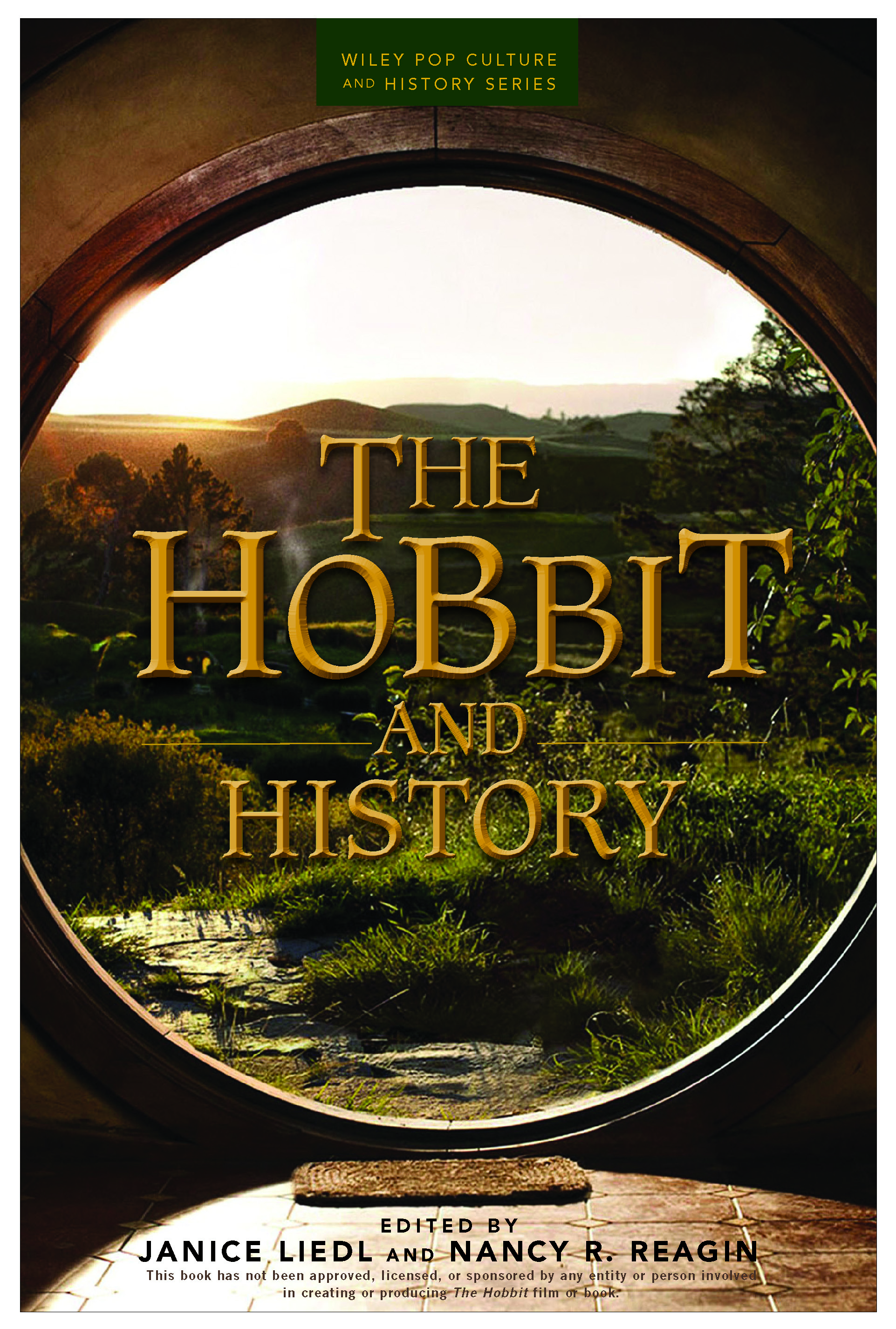
The Hobbit and History is out. Do you have your copy yet?

In the second chapter of the collection – “From Oakenshield to Bloodaxe: The Viking Roots of Tolkien’s Dwarves”, you learn about the thirst for vengeance in Tolkien’s dwarves and in historical Viking culture. Thorin Oakenshield was hardly unique in holding a grudge against those who had brought his family down. Medieval leaders waged bloody and devastating wars to right wrongs against their families. Consider the case of Ívarr the Boneless, a ninth century Dane who led a massive army to seek vengeance for his father’s death.

Ívarr the Boneless was a Viking warrior. His epithet may seem odd and has inspired furious debate. Did he have a degenerative bone condition, perhaps osteogenesis imperfecta? Was he extraordinarily limber and the byname a sort of joke about his flexible maneuvering? Or maybe the story began in some great act of daring, just as Thorin Oakenshield takes his epithet from his quick thinking on the field of battle.

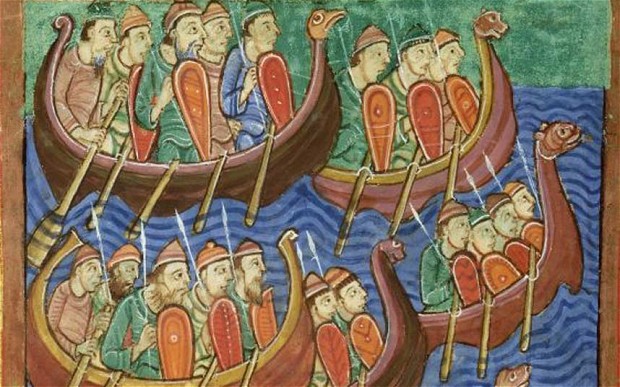
Historically, Danes invading England by sea Vikings weren’t only concerned with warfare and vengeance. They were also great traders, explorers and ambitious settlers. Some ventured as far afield as Newfoundland and Istanbul, and Viking hoards have been found to contain such exotic treasures as Arabic coins and a statue of Buddha. As a recent exhibition at the British Museum reminded us, the Vikings were more than bloodthirsty marauders, they were poets, artisans and adventurers. But the Vikings were also devoted to their families and friends. Insults against a friend could spark a bitter rivalry. Attacks against a relative often spurred the Vikings onto war.

As Colin Gibbons notes in The Hobbit and History, Ívarr lost his father, Ragnar Lodbrok to a cruel and vindictive opponent, King Ælla of Northumberland. The Scandinavian king was reportedly executed by being cast into a snakepit. His sons were incensed at their father’s ill-treatment and mounted an invasion of the Anglo-Saxon kingdoms at the head of what is sometimes know as the “Great Heathen Army”. From 865-869, Ívarr rained ruin upon his English enemies. He and his brothers saw Ælla pay the final, horrific price for his execution of Ragnar. After conquering much of the Anglo-Saxon lands, Ívarr turned to Ireland, conquering there. By the time of his death, likely around 873, he and his brothers had triumphed over their enemies.

So, too, Thorin Oakenshield seeks vengeance against those who have wronged his family – Smaug who seized their royal stronghold and others as well. His thirst for vengeance is as strong as that of any of these historical Vikings. Learn more about the parallels between the Vikings and the dwarves when you read The Hobbit and History!

Comments Off on The Hobbit and History: Viking Vengeance and Dwarvish Destiny

Filed under history, pop culture

The Hobbit and History: Five Armies & Five Kings

The Hobbit and History comes Cover for The Hobbit and historyout on Tuesday. Order your copy or pick it up at your favourite retailer soon. In the meantime, read today’s historical snippet. Chapter One by Marcus Schulzke, “The Faces of the Five Armies”, examines historical parallels from the Middle Ages and Renaissance that help you better understand the dynamics of Tolkien’s battling forces in that culminating conflict. Given that the third movie in Peter Jackson’s adaptation is all about this, with reports that the battle itself will take forty-five minutes of screen time, it can only help to get Dr. Schulzke’s smart perspective on the topic.

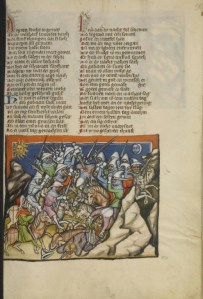
Today’s Getty Museum MS 88.MP.70.119blog post goes a bit farther back in history to look at another parallel for Tolkien’s riveting “Battle of the Five Armies” taken out of biblical history. This image is from a fifteenth century German universal chronicle and it depicts the defeat of five kings of southern Canaan as told in the Book of Joshua, 10:2-27. In the Bible, Joshua was following Moses’ lead to take the Holy Land for the Israelites, even if that meant deposing and destroying its current Canaanite inhabitants. After successes in the north, Joshua met renewed resistance from a coalition of five kings: the kings of Jerusalem, Hebron, Jarmuth, Lachish and Eglon. Their coalition reflected many common interests: culture, religion and fear of the death rained down upon the Canaanites by the increasingly powerful Israelites. These five kings plotted against Gibeon, a city that had made a covenant with Israel. The Gibeonites appealed to Joshua who, supported by the Lord, marched south against the five kings.

This was a long and deadly battle, made longer by miraculous intervention. A devastating and targeted hailstorm wreaked havoc with the coalition against the Israelites, killing many in the five kings’ armies. According to the Book of Joshua, God manifested his powers, again, on the side of Joshua and the Gibeonites: illuminating the battlefield long past the normal stretch of hours.

Sun, stand thou still upon Gibeon; and thou, Moon, in the valley of Ajalon. And the sun stood still, and the moon stayed, until the people had avenged themselves upon their enemies. Is not this written in the book of Jasher? So the sun stood still in the midst of heaven, and hasted not to go down about a whole day. (Josh 10:12-13)

The five kings sought refuge in a cave where they were walled in by their foes, only to be released and executed after Joshua’s forces had eradicated all of their armies, seizing the five cities for Israel.

Some coalitions are strong, like that of Joshua and the Gibeonites, united by the power of the covenant. Others, like the coalition of the five kings, are weak. Some coalitions are supported by great magic – the miracles that the Lord provided Joshua and his army or the wonders that a great wizard and even a little hobbit with a magic Ring might possess. Some coalitions find their dark support – Ba’al or Sauron – insufficient to the task. And sometimes five or more armies might all meet upon the field for a very long day and more to hash out the future of their world.

Comments Off on The Hobbit and History: Five Armies & Five Kings

Filed under history, pop culture

Women’s History Week, 2014

Do you want to know what I’ve been doing the past few weeks besides checking proofs for my next article in Rethinking History and next month’s The Hobbit and History as well as teaching a lot and grading even more? Getting ready for Laurentian University’s latest iteration of Women’s History Week!

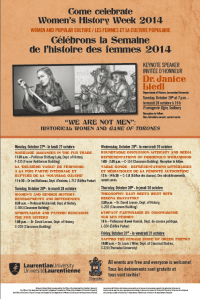
Here’s the poster advertising all the talks that you can attend during Women’s History Week at Laurentian University, October 27-31, 2014:
Poster for Women's History Week Going strong for over twenty years, Women’s History Week explores the diverse and intriguing topics of women’s history as shown in the scholarship of Laurentian faculty and students. This year our theme is Women and Popular Culture. From antiquity to the present-day, drawing on history, literature, political science and classics, Women’s History Week has a lot to offer.

I’m giving the keynote address, Tuesday evening in downtown Sudbury on Women and Game of Thrones. Have you always wondered if Martin’s women in their manoeuvring for power were at all historically plausible? Join us at the Fromagerie at 7pm and see! We also have a roundtable on Wednesday, the 29th, on literary and media representations of indigenous womanhood along with classroom talks throughout the week.

PDF Poster for Women’s History Week, 2014

3 Comments

Filed under history, pop culture

From Historiann: The New York Times Book Review Interview

Have you read the history news of late? If so, you’ve probably seen the comment and kerfuffle over the recent New York Times book review interview with James Macpherson. With his new book out on Jeff Davis, Macpherson was asked about what books he was reading, would recommend, etc. Normal book-selling shtick, except for where some historians noted the near-complete absence of women from the esteemed academic’s list of suggestions. As you might expect, Historiann weighed right in with a pithy comment or two. She followed those observations up with her own take on answering those same questions. Delicious!

Because, damnit, gender representation matters and if your long list of books you read and admire have nearly no women and nearly no diversity on it, that says something about your habits of mind that I’m not exactly thrilled about. Don’t get me wrong: I’m not saying there has to be a quota, but with so much amazing history being written by women and men worldwide, you need to keep yourself open to that range, not close yourself off in a comfortable corner.

Historiann challenged her readers to take the interview questions, just as she did, and answer them on their blogs. I’m doing that although a few of these questions are more challenging for me than they would be for an Americanist but, hey, what did I say about diversity and range? I teach 5500 years of history at every level from the freshman survey to the graduate seminar. If I’m not open to reading a wide variety, shame on me. Here’s my list, where’s yours or what do you think I need to read after seeing my responses? I’m all ears!

What books are currently on your night stand?

The top two (what? Who doesn’t have stacks of books on or serving as a night stand?) are The Secret Diary of Lizzie Bennet and Eleanor Hubbard’s City Women: Money, Sex and the Social Order in Early Modern London.

What was the last truly great book you read?

This is tough simply because I’ve read so many amazing and inspiring books in the past year. For history, I’d have to say that my most recent “oh wow!” moment came when I picked up Alison Games’ The Web of Empire: English Cosmopolitans in an Age of Expansion, 1560-1660. I’m so pleased that I assigned this for my second year British history students!
Continue reading

9 Comments

Filed under history