
Next Tuesday wraps up my team-taught “History of the Occult” course. As I review my slides, running from antiquity through the mid-seventeenth century, I was interested to see what I blathered on the most about. Here’s a word cloud to 
Category Archives: history
Occult Words
The Hobbit and History: Viking Vengeance and Dwarvish Destiny
The Hobbit and History is out. Do you have your copy yet?
In the second chapter of the collection – “From Oakenshield to Bloodaxe: The Viking Roots of Tolkien’s Dwarves”, you learn about the thirst for vengeance in Tolkien’s dwarves and in historical Viking culture. Thorin Oakenshield was hardly unique in holding a grudge against those who had brought his family down. Medieval leaders waged bloody and devastating wars to right wrongs against their families. Consider the case of Ívarr the Boneless, a ninth century Dane who led a massive army to seek vengeance for his father’s death.
Ívarr the Boneless was a Viking warrior. His epithet may seem odd and has inspired furious debate. Did he have a degenerative bone condition, perhaps osteogenesis imperfecta? Was he extraordinarily limber and the byname a sort of joke about his flexible maneuvering? Or maybe the story began in some great act of daring, just as Thorin Oakenshield takes his epithet from his quick thinking on the field of battle.
Historically, 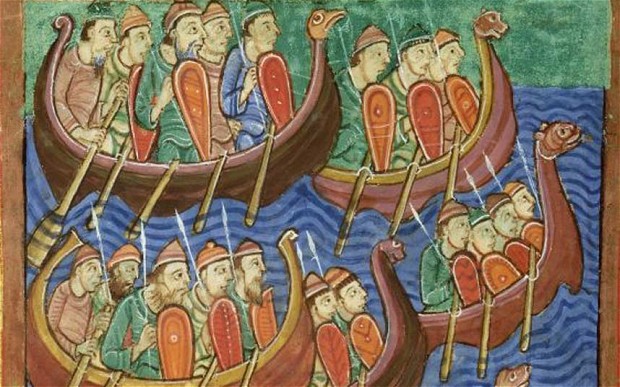 Vikings weren’t only concerned with warfare and vengeance. They were also great traders, explorers and ambitious settlers. Some ventured as far afield as Newfoundland and Istanbul, and Viking hoards have been found to contain such exotic treasures as Arabic coins and a statue of Buddha. As a recent exhibition at the British Museum reminded us, the Vikings were more than bloodthirsty marauders, they were poets, artisans and adventurers. But the Vikings were also devoted to their families and friends. Insults against a friend could spark a bitter rivalry. Attacks against a relative often spurred the Vikings onto war.
As Colin Gibbons notes in The Hobbit and History, Ívarr lost his father, Ragnar Lodbrok to a cruel and vindictive opponent, King Ælla of Northumberland. The Scandinavian king was reportedly executed by being cast into a snakepit. His sons were incensed at their father’s ill-treatment and mounted an invasion of the Anglo-Saxon kingdoms at the head of what is sometimes know as the “Great Heathen Army”. From 865-869, Ívarr rained ruin upon his English enemies. He and his brothers saw Ælla pay the final, horrific price for his execution of Ragnar. After conquering much of the Anglo-Saxon lands, Ívarr turned to Ireland, conquering there. By the time of his death, likely around 873, he and his brothers had triumphed over their enemies.
So, too, Thorin Oakenshield seeks vengeance against those who have wronged his family – Smaug who seized their royal stronghold and others as well. His thirst for vengeance is as strong as that of any of these historical Vikings. Learn more about the parallels between the Vikings and the dwarves when you read The Hobbit and History!
Comments Off on The Hobbit and History: Viking Vengeance and Dwarvish Destiny
Filed under history, pop culture
The Hobbit and History: Five Armies & Five Kings
The Hobbit and History comes 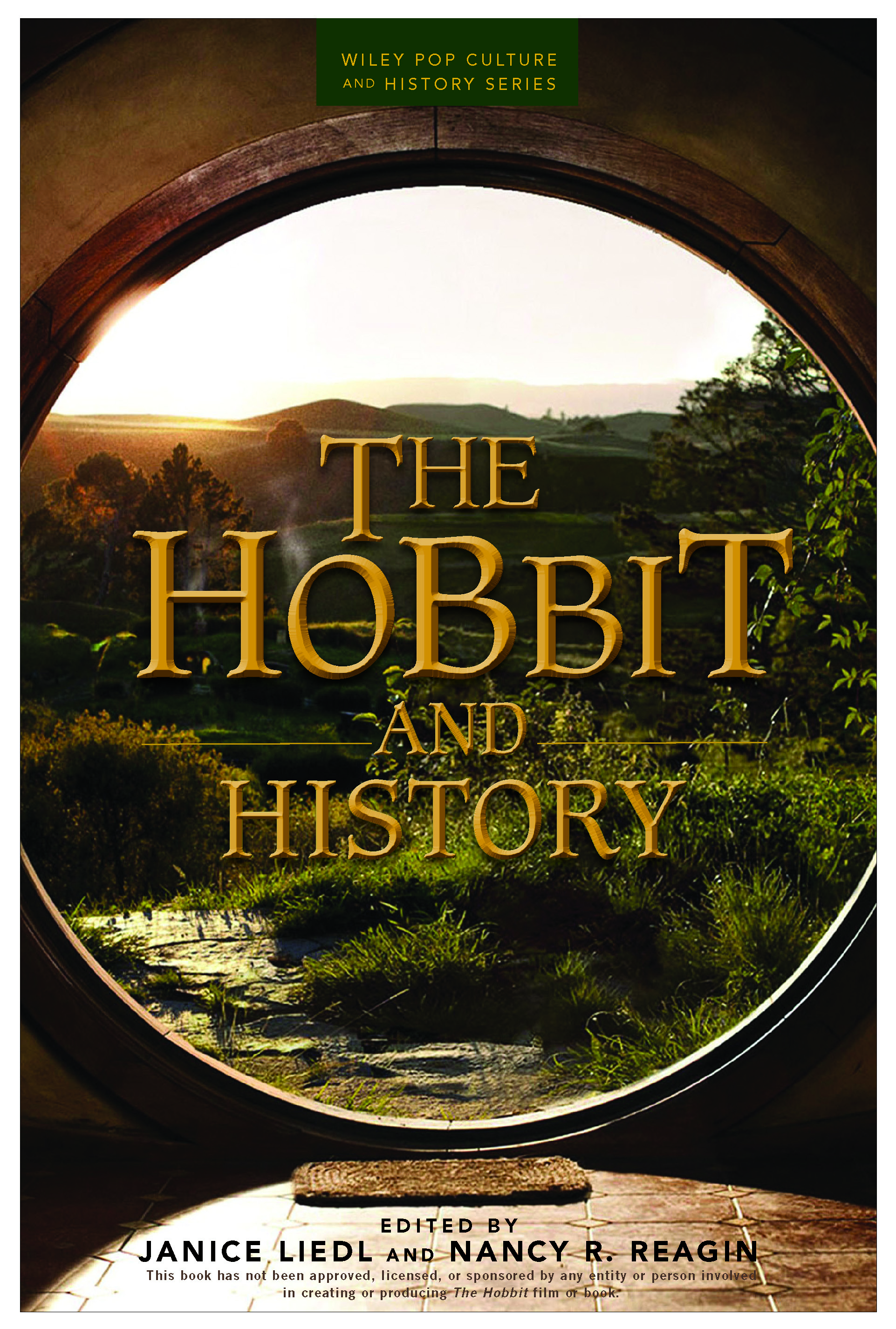 out on Tuesday. Order your copy or pick it up at your favourite retailer soon. In the meantime, read today’s historical snippet. Chapter One by Marcus Schulzke, “The Faces of the Five Armies”, examines historical parallels from the Middle Ages and Renaissance that help you better understand the dynamics of Tolkien’s battling forces in that culminating conflict. Given that the third movie in Peter Jackson’s adaptation is all about this, with reports that the battle itself will take forty-five minutes of screen time, it can only help to get Dr. Schulzke’s smart perspective on the topic.
Today’s 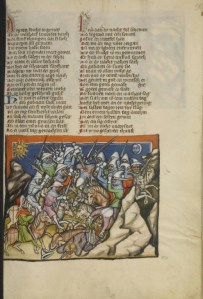 blog post goes a bit farther back in history to look at another parallel for Tolkien’s riveting “Battle of the Five Armies” taken out of biblical history. This image is from a fifteenth century German universal chronicle and it depicts the defeat of five kings of southern Canaan as told in the Book of Joshua, 10:2-27. In the Bible, Joshua was following Moses’ lead to take the Holy Land for the Israelites, even if that meant deposing and destroying its current Canaanite inhabitants. After successes in the north, Joshua met renewed resistance from a coalition of five kings: the kings of Jerusalem, Hebron, Jarmuth, Lachish and Eglon. Their coalition reflected many common interests: culture, religion and fear of the death rained down upon the Canaanites by the increasingly powerful Israelites. These five kings plotted against Gibeon, a city that had made a covenant with Israel. The Gibeonites appealed to Joshua who, supported by the Lord, marched south against the five kings.
This was a long and deadly battle, made longer by miraculous intervention. A devastating and targeted hailstorm wreaked havoc with the coalition against the Israelites, killing many in the five kings’ armies. According to the Book of Joshua, God manifested his powers, again, on the side of Joshua and the Gibeonites: illuminating the battlefield long past the normal stretch of hours.
Sun, stand thou still upon Gibeon; and thou, Moon, in the valley of Ajalon. And the sun stood still, and the moon stayed, until the people had avenged themselves upon their enemies. Is not this written in the book of Jasher? So the sun stood still in the midst of heaven, and hasted not to go down about a whole day. (Josh 10:12-13)
The five kings sought refuge in a cave where they were walled in by their foes, only to be released and executed after Joshua’s forces had eradicated all of their armies, seizing the five cities for Israel.
Some coalitions are strong, like that of Joshua and the Gibeonites, united by the power of the covenant. Others, like the coalition of the five kings, are weak. Some coalitions are supported by great magic – the miracles that the Lord provided Joshua and his army or the wonders that a great wizard and even a little hobbit with a magic Ring might possess. Some coalitions find their dark support – Ba’al or Sauron – insufficient to the task. And sometimes five or more armies might all meet upon the field for a very long day and more to hash out the future of their world.
Comments Off on The Hobbit and History: Five Armies & Five Kings
Filed under history, pop culture
Women’s History Week, 2014
Do you want to know what I’ve been doing the past few weeks besides checking proofs for my next article in Rethinking History and next month’s The Hobbit and History as well as teaching a lot and grading even more? Getting ready for Laurentian University’s latest iteration of Women’s History Week!
Here’s the poster advertising all the talks that you can attend during Women’s History Week at Laurentian University, October 27-31, 2014:
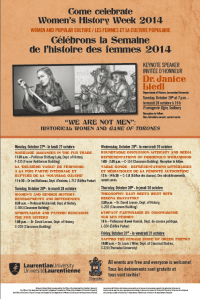 Going strong for over twenty years, Women’s History Week explores the diverse and intriguing topics of women’s history as shown in the scholarship of Laurentian faculty and students. This year our theme is Women and Popular Culture. From antiquity to the present-day, drawing on history, literature, political science and classics, Women’s History Week has a lot to offer.
I’m giving the keynote address, Tuesday evening in downtown Sudbury on Women and Game of Thrones. Have you always wondered if Martin’s women in their manoeuvring for power were at all historically plausible? Join us at the Fromagerie at 7pm and see! We also have a roundtable on Wednesday, the 29th, on literary and media representations of indigenous womanhood along with classroom talks throughout the week.
Filed under history, pop culture
From Historiann: The New York Times Book Review Interview
Have you read the history news of late? If so, you’ve probably seen the comment and kerfuffle over the recent New York Times book review interview with James Macpherson. With his new book out on Jeff Davis, Macpherson was asked about what books he was reading, would recommend, etc. Normal book-selling shtick, except for where some historians noted the near-complete absence of women from the esteemed academic’s list of suggestions. As you might expect, Historiann weighed right in with a pithy comment or two. She followed those observations up with her own take on answering those same questions. Delicious!
Because, damnit, gender representation matters and if your long list of books you read and admire have nearly no women and nearly no diversity on it, that says something about your habits of mind that I’m not exactly thrilled about. Don’t get me wrong: I’m not saying there has to be a quota, but with so much amazing history being written by women and men worldwide, you need to keep yourself open to that range, not close yourself off in a comfortable corner.
Historiann challenged her readers to take the interview questions, just as she did, and answer them on their blogs. I’m doing that although a few of these questions are more challenging for me than they would be for an Americanist but, hey, what did I say about diversity and range? I teach 5500 years of history at every level from the freshman survey to the graduate seminar. If I’m not open to reading a wide variety, shame on me. Here’s my list, where’s yours or what do you think I need to read after seeing my responses? I’m all ears!
What books are currently on your night stand?
The top two (what? Who doesn’t have stacks of books on or serving as a night stand?) are The Secret Diary of Lizzie Bennet and Eleanor Hubbard’s City Women: Money, Sex and the Social Order in Early Modern London.
What was the last truly great book you read?
This is tough simply because I’ve read so many amazing and inspiring books in the past year. For history, I’d have to say that my most recent “oh wow!” moment came when I picked up Alison Games’ The Web of Empire: English Cosmopolitans in an Age of Expansion, 1560-1660. I’m so pleased that I assigned this for my second year British history students!
Continue reading
Filed under history
What I Learn Teaching Women’s History
This term I’m revisiting a course on pre-industrial western women’s history. The last time I taught it, I was pregnant with my eldest child who’s now university age. Yes, I am that old.
Obviously, the course has been completely revised for the new millennium. No dragging out reams of yellowed lecture texts. A lot has changed in history in the intervening years and I wanted to take advantage of those advances in scholarship while also implementing a more appropriate model of assignments than “some essays, maybe a midterm, and a final exam.”
It’s working wonders, no doubt aided by choosing one of my favourite recent books in women’s history as a course textbook: Judith Bennett’s History Matters: Patriarchy and the Challenge of Feminism. Every few weeks, students write a short response paper analyzing one part Bennett’s argument in light of another reading of their choice and we have a discussion based upon the material. Sometimes the discussions are pretty fabulous as when we tackled how history textbooks they know have (or have not) incorporated women’s history. This sparked a lot of passionate discussion about what should be and why it isn’t always in the master narratives of our discipline. I’m happily anticipating their response to her chapter on economic history “Less Money Than a Man Would Take”. Nothing ferrets out faulty assumptions and presumptions like taking your argument down to the building blocks and essential concepts – women’s history critiques of the status quo consistently makes that happen.
I’m also pleased with the way students have embraced a presentation-heavy course model. Each student makes three presentations over the term on individuals, concepts or events that were important to pre-modern women’s history. Most days we have three to five presentations at the start of class, which are worth every minute of class time that they fill as the audience listens attentively (presentation subjects are fodder for the final exam) and ask questions thoughtfully as well as answering questions posed by the presenter. I’m learning that even in a third-year course, we can set a pretty high standard for formal participation, “ownership of the course” by students, if you will, where they craft mini-lessons on the subjects they’ve chosen. It’s helped me direct the rest of the class much more usefully as I take up the reins after their presentations and can use that time to fill in the gaps or build upon their insights.
It continues to be a pleasure to teach this class, to introduce them to a wealth of fascinating history and learn from the classroom experience how invigorating a clean sweep can be from the professor’s perspective. My only regret is that it will likely be many years before I teach this particular course on campus again (for complicated issues of workload and curriculum) but I’m certain that the lessons I’ve learn here won’t go to waste.
Milestones & Memory at the Old Bailey
Happy New Year or, perhaps, happy Twelfth Night. It is the eve of Epiphany and also the return of our academic term. We mark time in various ways – by the year, by our age and, sometimes, by memorable events or milestones. I noticed this the other week when I was exploring my favourite historical database, Old Bailey Online and ran a search for “Christmas”. It returned 4417 hits, most of which were in reference to a particular Christmas Day as in the testimony given against Mark Fenton for housebreaking in February 1695: “he Prisoner came to see the House (it being to Lett) a little before Christmas last”.1
Other Christian holidays also figure in the trial reports and Ordinary’s Accounts that make up the database records, but much less often: Easter less than a thousand, Michaelmas over five hundred times, Midsummer half that and Whitsun half that again. Epiphany occurs five times, three of the accounts referring to one Epiphany Parker (tried in 1776 and 1777 for crimes, but only found guilty in the second instance, for which she then appears in the punishment summary to work five years on the river.2 The other two mentions of the holiday focus on readings, albeit in very different circumstances (one, the Ordinary’s description of his readings for the third Sunday of Epiphany and the other, a man suffering mental illness, who assaulted his daughter after reading the gospel for the fourth Sunday after Epiphany.
Another interesting temporal term, “birthday” comes up over 250 times beginning in the 1740s, with frequent links to the monarch’s birthday which would have been a noteworthy moment of public celebration (as well as, possibly, an opportunity for street crime or public conflict).
I began to explore other temporal phrases, such as “Tuesday last” which turns up 241 instances. These types of phrases are more elastic – suggesting trials that closely followed offenses, allowing individuals such as Sarah Loyzada to locate her experience precisely as in her account from the December 1732 trial of Ebenezer Dun:
“I live in Castle-Yard in Houndsditch . On Tuesday last was a Fortnight, I made my House fast, and went to Bed. The Watch call’d me up about 1 in the Morning, I found my Kitchen Casement taken off, and miss’d 4 Pewter Dishes, a Stew-pan, a Sauce-pan, and a Coffee-pot.”3
If I can take the time to read through another couple of hundred trials, I may come up with another group of test phrases and terms to see how the past is measured in these accounts: what are the habits of mind and turns of phrase that leap to the tongue when explaining when something happened in eighteenth or nineteenth century London courts? How did individuals and the broader society parse time outside the formal strictures of the calendar? How did people remember and recall, then, and what does it tell us about English life?
1. Old Bailey Proceedings Online (www.oldbaileyonline.org, version 7.0, 06 January 2014), February 1695, trial of Mark Fenton, alias Felton (t16950220-27).
2. Old Bailey Proceedings Online (www.oldbaileyonline.org, version 7.0, 06 January 2014), February 1777 (s17770219-1).
3. Old Bailey Proceedings Online (www.oldbaileyonline.org, version 7.0, 06 January 2014), December 1732, trial of Ebenezer Dun (t17321206-23).
Comments Off on Milestones & Memory at the Old Bailey
Filed under history
Reading London
I’m simultaneously shocked and tickled pink to be teaching a course relating to my research specialty at the graduate level. After more than a decade teaching historical methods and years before that teaching nineteenth century European social history (don’t ask), teaching “Topics in British History” will be a positive pleasure.
The course theme is London, 1550-1950. Do you want to read along with my M.A. students? Here’s our reading list:
- Derek Keene, “Metropolitan comparisons: London as a city-state” Historical Research (November 2004) 77 (198), 459-480. DOI: 10.1111/j.1468-2281.2004.00218.x
- Vanessa Harding, “City, capital and metropolis: the changing shape of seventeenth-century London” in Imagining Early Modern London: Perceptions and Portrayals of the City from Stow to Strype, 1598-1720. Ed. J F. Merritt (Cambridge: Cambridge University Press, 2001), 117-143.
- Paul Slack, “Perceptions of the Metropolis in Seventeenth-Century England” in Civil Histories: Essays Presented to Sir Keith Thomas. Ed. Peter Burke, Brian Harrison, and Paul Slack (Oxford: Oxford University Press, 2000), 161–80.
- Amanda Vickery, “An Englishman’s Home Is His Castle? Thresholds, Boundaries and Privacies in the Eighteenth-Century London House” Past & Present 199 (May, 2008), 147-173. DOI:10.1093/pastj/gtn006
- David Day, “Kinship and Community in Victorian London: the ‘Beckwith Frogs'” History Workshop Journal 71 (Spring 2011), 194-218.
- Benjamin Heller, “Leisure and the Use of Domestic Space in London” The Historical Journal 53:3 (September 2010) 623-645 DOI: 10.1017/S0018246X10000221
- Robert Bucholz and Joseph Ward, London: A Social and Cultural History, 1550-1750 (Cambridge: Cambridge University Press, 2012) 9780521896528
- Tim Hitchcock, Down and Out in Eighteenth Century London (London: Continuum, 2007) 9781852855529
- Caroline Shenton, The Day Parliament Burned Down (Oxford: Oxford University Press, 2012) 9780199677504
- Rosalind Crone, Violent Victorians: Popular Entertainment in Nineteenth-Century London (Manchester: Manchester University Press, 2012) 9780719086854
- Jonathan Schneer, London 1900: The Imperial Metropolis (New Haven: Yale University Press, 2001) 9780300089035
- Maureen Waller, London 1945: Life in the Debris of War (New York: St. Martin’s, 2006) 9780312338046
I’m also steering them towards many outstanding websites, including the following:
- The Map of Early Modern London
- London Lives, 1690-1800
- London’s Screen Archives
- London at British History Online
- London History at The City of London official website
- Charles Booth Online Archive – Life and Labour in London, 1886-1903
Am I missing anything great? Suggestions are eagerly welcomed in the comments. Classes begin January 6th with the first three articles on the list and we’ll wrap up the meetings in early April.
Woman’s Rule: The Challenges Facing Daenerys
In Martin’s Game of Thrones series, the character of Daenerys Targaryen casts a long shadow. From the moment that rumours of her wedding to Khal Drogo come to King Robert’s ears back in Westeros, he is determined that she should die. Was it because he saw the young woman, herself, as a serious threat to his throne? No. Robert Baratheon’s fears were tied up in Daenerys’ possibility to bear a son who would challenge the Baratheon kingship as he makes clear in this first season conversation with Ned Stark.
This is a familiar conception of women and political power for medieval historians. The great conflict of the Hundred Years’ War between England and France derived from a difference of opinion on female inheritance. When Charles IV died in 1328 without any direct male heirs, there was a legitimate question about who should succeed. King Charles’ closest male relative was his nephew, Edward III of England, son of Isabella of France. Edward’s claim was rejected in favour of another cousin whose royal French descent had never been sullied by passing through female lines – Philip VI, the first Valois king.
The principle invoked by French jurists and courtiers in support of Philip’s claim was a tradition in French history known as Salic Law. An early medieval Frankish law code, the Lex Salica included a provision which held that “of Salic lands, no part of the inheritance shall come to a woman but the entirety of the heritable land shall come to the man.” What exactly was Salic land and what was meant by “the inheritance” wasn’t exactly clear. Hotly contested and even amended over the centuries to allow female inheritance, the principles of Salic Law were revived in the fourteenth century to exclude Isabella’s lineage from claiming the French crown. When England’s Edward III failed to accept this judgment, war ensued but it was never on behalf of putting his mother on the throne. (Knowing what we know of Isabella who was implicated in the death of her husband, Edward II and luridly termed “The She-Wolf of France” in some histories, her son might well be forgiven for wanting to bypass Mother Dearest.)
Principles of inheritance in Westeros seem very much in line with this particular medieval mentality that land and rule were manly concerns. We are told of a bloody and devastating civil war between two branches of the Targaryen family known as the Dance of the Dragons. The death of King Viserys left two possible contenders: his elder daughter, Rhaenyra, and her younger half-brother, Aegon. Their dispute tore apart the kingdom and the resolution of the civil war relegated women to the last-chance position of inheritance, a view almost as drastic as the Salic Law. (Read an excerpt from Martin’s “The Princess and the Queen, or the Blacks and the Greens”, forthcoming in Dangerous Women published by Tor (December, 2013).)
This devastating civil war bears close resemblance to another infamous episode in English medieval history – the Civil War of Stephen and Matilda. Lasting from 1138-1154, this cousinly conflict devastated England so utterly that one contemporary chronicler swore that it was as if “Christ and his angels slept”. Although not so closely related as their Westeros parallels, Matilda (the old king’s daughter and recognized heir) and Stephen (her cousin whose royal right came through a female line) represented similar choices. More medieval English nobles preferred Stephen to Matilda (who was sometimes termed arrogant) but many were loyal to Matilda, if only to honour their oaths to King Henry I. Matilda was relentless and effective: her husband’s campaigns brought Normandy under her control and, for a while, she held power in England, too. But the divide was too deep to paper over. The anarchy ended only when Stephen agreed to recognize Matilda’s son as heir – the future Henry II.
Matilda and Isabella were sidelined from the succession, but that is not a role that Dany is ready to accept. Perhaps it is because she believes herself to be the last Targaryen after her brother’s gruesome death? If so, she might well be expected to meekly step down in favour of one of the other claimants being groomed, such as Young Griff, or an eventual son as Robert feared. I believe that Daenerys is not just putting herself forward as the last of her line but that she has come to believe in herself as a legitimate, even the predestined ruler, with no apologies needed for her gender.
Consider this snippet from Dany’s conversation with a hostile mercenary captain, Prendahl, who disputes her ability to wage a campaign:
“Woman?” She chuckled. “Is that meant to insult me? I would return the slap, if I took you for a man.” Dany met his stare. “I am Daenerys Stormborn of House Targaryen, the Unburnt, Mother of Dragons, khaleesi to Drogo’s riders, and queen of the Seven Kingdoms of Westeros.” – A Storm of Swords
Here, Daenerys stands against the historical notion that a woman was only a vessel of royal inheritance. Daenerys Targaryen sees her self-worth more than in her presumed position as the last of the Targaryens. She adds to those distinctions others that are hers and hers alone: the Unburnt, because she survived her husband’s funeral pyre which hatched the dragons which she sees as her children (and also as vindication of her Targaryen right to rule). From these virtues, it is a short step to assert her role as queen of the Seven Kingdoms, not in trust for an unborn son, but in her own right.
However, just as with the Ghiscari captain’s disdain, Daenerys has much to overcome to make that last boast into a reality – the widespread prejudice in Westeros and beyond against a woman’s right to rule. For this last challenge, history offers other interesting parallels, from the military exploits of Joan of Arc to the self-assured reign of Elizabeth Tudor. Which model of women and inheritance will win out in George R. R. Martin’s world? History cannot say, but it shows that Daenerys’ problems will not end on the battlefield but can extend on indefinitely with the entrenched prejudices against women’s rule.
Comments Off on Woman’s Rule: The Challenges Facing Daenerys
Filed under history, pop culture
Ambition and Reputation: The Personal Politics of Gender
In 510 BCE, a Roman woman by the name of Lucretia was threatened and raped by the king’s son. Daughter of the chief magistrate of the Roman kingdom and wife of a governor, Lucretia demanded justice of her father and then committed suicide while the men of the court debated their plan of attack.  It took another man, Brutus, to rally his fellow Romans around Lucretia’s death, bring down the tyrant Tarquins and establish the republic.
Lucretia killed herself because her reputation had been, in the thinking of the time, irretrievably damaged. Sextus Tarquinus’ attack had certainly damaged his reputation (and that of royalty in general as far as Romans would be concerned), but, on a personal level, it had created an unendurable shame for Lucretia. She preserved her honour by taking her own life.
That choice would have seemed foolish to Cersei Lannister. When her reputation was threatened as news of her incestuous affair with Jaime came to Ned Stark’s attention, she incredulously spurned his suggestion that she flee with her children. As Cersei notes, in the game of thrones, you win or you die, and she intends to win. 
To Cersei, reputation was important but only in terms of preserving the outward trappings of good reputation, not the inward satisfaction of rectitude. Lucretia’s choice would have been unfathomable to Robert Baratheon’s queen who channelled her anger at Robert’s obsession with Lyanna, his long-dead betrothed, into the promotion and preservation of her Lannister legacy on the throne. Cersei was not focused on her personal relationship with that royal power – that was the purview of her father, Tywin Lannister. This lands the queen in trouble when, after Robert’s death, Tywin is all too eager to marry her off again, no matter how unhappily, if it will secure the Lannister family.
Cersei’s unhappy experience with her own desires discounted against the concerns of family ambition resembles that of many medieval and early modern noblewomen such as Lucrezia Borgia.  This Lucrezia, known to popular memory as a poisoner and accused of incestuous relations with her brother Cesare, was three times married in pursuit of family ambitions. Today, scholars are reopening the debate about Lucrezia’s independence of action in her family and with regards to her marriages, such as in Diane Yvonne Ghirardo’s recent “Lucrezia Borgia as Entrepreneur” Renaissance Quarterly 61:1 (Spring 2008): 53-91 who quotes a contemporary observer as characterizing the duchess as “a very intelligent woman, astute”.
That description seems tailor-made for another ambitious courtly woman in Westeros: Margaery Tyrell.  The Tyrells control a different type of wealth than the gold of Casterly Rock: in this case it is the gold of Tyrell grain that makes them rich. As Matthew Yglesias claims, thanks to both the immediate appeal of foodstuffs, a renewable and vital resource, especially in hard times, as well as the savvy use of their resources made by Margaery and others, House Tyrell is wealthier than House Lannister.
Coached by her ruthless grandmother, the Queen of Thorns, Margaery marries Robert Baratheon’s equally ambitious younger brother, Renly, hoping to secure the seven kingdoms as his consort. When Renly is assassinated, Margaery is heartbroken not at the loss of her husband but at the loss of her opportunities as this conversation with Petyr Baelish proves. She doesn’t just want to be “a queen”, she wants to be “the queen” and Renly was her best bet until his death. Now Margaery must rethink her plans.
Both Margaery and Cersei have to watch their reputation, however, as their political power is subordinated to that of the men in their lives and their relationships are dependent upon remaining lily-white in the public eye. Margaery’s managing of her brother, Loras, her first husband, Renly and her second suitor, Joffrey, are all that give her hopes of gaining that ultimate prize in royal status. Cersei must subdue the truth of her incestuous affair to stay in her position as queen mother or face certain and utter condemnation should the truth ever leak irretrievably. In any case, neither woman has the wherewithal to pursue the throne directly as Danaerys Targaryen prepares to do.
What are the historical cautions for a Targaryen queenship? Stay tuned for the next installment here at this blog!
Filed under history, pop culture
 jliedl.ca