Category Archives: history

In the Restricted Section

Over the summer and unbeknownst to me, my university library moved all the U, V and Z (Library of Congress classifications) books out of the general circulations stacks and into storage. Err, the first floor depository, they say. I call it “The Restricted Section”.

Harry wandered over to the Restricted Section. He had been wondering for a while if Flamel wasn’t somewhere in there. Unfortunately, you needed a specially signed note from one of the teachers to look in any of the restricted books, and he knew he’d never get one. These were the books containing powerful Dark Magic never taught at Hogwarts, and only read by older students studying advanced Defence Against the Dark Arts. (J. K. Rowling, Harry Potter and the Philosopher’s Stone)

Just imagine, wandering innocently into your library, in search of five books you need to check out for your class. You know they’re there. You check them out every year (it’s a small class of grad students – they can share the books over the last half of the term). But the books aren’t there. The whole circulating collection seemingly ends with the T classification for technology topics. But wander farther afield and there’s nothing. Not even a sign. I stumbled about the third floor for ten minutes, looking for where the books had gone to – I knew we had hundreds, if not thousands of titles in that range that had seemingly disappeared.

Only when I headed down to the circulation desk did I get an explanation – those books had been moved to the first floor, off limits to users – I’d have to ask a librarian to retrieve them for me. I presume (but I wasn’t told explicitly), that this was done to free up room upstairs in the circulating collection or ‘stacks’ – as new books are added, and a few are every year, they fill up the current ranges and threaten to overflow. Plus, goodness knows!, we can’t cut back on the study desks and comfy chairs that have filled in around the circulating books over the years.

Still, just wrap your heads around the situation with the books for a bit. Entire classifications of library books are gone. Sure, if you look at each individual catalogue listing, as I did later, you see a note after the call number that explains the book is located at the 1st Floor Depository. But imagine you’re an undergraduate – what does that mean? There’s no word of where that is or what you’ll need to do to see the book. How likely are you to go and ask for that? There’s not even a sign at the end of the range of books still available indicating that you need to go elsewhere and speak to someone. Even better: maybe you committed the call number to memory when you trotted off on your quick search after getting the information from the first page of the catalogue entries? If so, I bet you’ve forgotten it after a few minutes of fruitless searching.

Will you ask? will you wait? Or will you just give up? Remember, you’ve got to intuit that you have to ask someone specially for these books and then you have to wait for them to get them. We aren’t blessed with an overabundance of librarians – on weekends and into the evening, who’s going to be around to fulfil requests? Who’s going to ask if it seems even slightly daunting.

Now consider the role of shelf-browsing? How many of you have found wonderfully useful books just by running your fingers along the shelves, to see what’s there beside the book you came to get? How can you do that now that entire swathes of the library are off in storage. I’ll give you a hint – our catalogue doesn’t have that function anymore to browse a range of call numbers so you won’t.

90% of my students will give up if they think they might want one of these books. They’ll change their topic, make do with what’s online or simply pass the material by. And so the usage stats will drop even more and the library will feel justified in carting these and other books off to our local equivalent of the Restricted Section.

So much for consulting the bibliographies to direct you to other works in particular. Pay no attention to the vast scholarship in print on authorship, reading and publishing that also sits in this range – they’re all getting condemned to near uselessness by such a decision. So much for the many classic and current works of military history and scholarship – if they’re in the U category as opposed to particular national histories, they’re out of reach for ordinary library patrons at my institution.

I’m also afraid of what’s next – in any given year, for my teaching and research, I check out books from many different Library of Congress areas, particularly B, D, H, J, P and Z. What if they decide to shave off those lightly used A & B classifications into the depository next? How am I going to get my students to engage with the works of religious thinkers and the abundant scholarship we own in print of the same if the books are tucked away elsewhere.

Yes, this is a first world problem but it really irked me. I work hard enough to get our students to appreciate the range of books we have available at our library. When something like this happens, I’m filled with despair. What’s the point if our books are going to be consigned to the Restricted Section, willy-nilly?

7 Comments

Filed under academe, history, teaching

Be My Colleagues!

We’re hiring two tenure-track positions in the History/Histoire program at Laurentian.

(1) Un poste francophone menant à la permanence en histoire autochtone nord-américaine au rang de professeur(e) adjoint(e). Entrée en fonction: le 1er juillet 2013. Les tâches liées au poste comprennent l’enseignement en français aux niveaux du premier et du deuxième cycle, des travaux de recherche et des responsabilités administratives. Les qualifications requises consistent en un doctorat en histoire (ou alors presque terminé) et une excellence démontrée en recherche et en enseignement dans le ou les domaines de spécialisation. Les candidates et candidats sont priés de soumettre un exposé de leurs recherches actuelles et planifiées, un dossier d’enseignement, un curriculum vitae et trois lettres de recommandation.

(2) An English-language tenure-track appointment in North American Indigenous history at the rank of Assistant Professor, beginning July 1, 2013. Qualified candidates with expertise in the areas of northern, rural, or health history are especially encouraged to apply. The successful candidate will be expected to teach in English at the undergraduate level, and to participate in the M.A. program. Applicants must have a completed Ph.D. or be near to completion, with demonstrated research productivity and teaching experience. Candidates should submit a statement of current and prospective research, a teaching dossier, a curriculum vitae, and three letters of reference.

Continue reading

Comments Off on Be My Colleagues!

Filed under academe, history

CFP: A Game of Thrones and History

We are seeking proposals for essays to be included in an edited collection with the working title of A Game of Thrones and History, to be published by Wiley in 2013 as a volume in its ‘Pop Culture and History’ series. We’re looking for essays that elaborate the historical context of G.R.R. Martin’s A Song of Ice and Fire series, examining individual characters or aspects of Westeros and other cultures against a historical backdrop, or analyzing how popular historical understandings inform the material.

The collection is aimed at a broader audience than is the case for many scholarly collections, and seeks to make visible for readers the underlying use of historical events and culture in A Game of Thrones. We welcome submissions from historians or those in cognate disciplines, including gender studies, medieval studies or cultural studies.

Possible topics include, but are not limited to: Continue reading

1 Comment

Filed under history, pop culture, writing/editing

The Galley Has Landed

Holding the galley for "Star Wars and History" It came today in the mail, my copy of the galley proof for Star Wars and History. And even though it’s still missing the colour inserts (oh, those’ll be gorgeous) and a few corrections we caught at the proof stage and the index and the back cover copy? It’s amazingly gorgeous!

I can’t wait for November!

6 Comments

Filed under history, pop culture, writing/editing

The Galleys are Coming

Just heard that the galleys for Star Wars and History are ready. Galleys are the perfect-bound pre-release versions of books (sometimes know as ARCs or Advanced Reader Copies). They’re pretty much the last step (besides finalizing the index and the jacket) as a book goes to press. Copies of the galleys go to publishers’ sales reps, reviewers and, in our case, other historians we’re hoping will write glowing blurbs to add to the jacket copy.

And I’ll be seeing a copy myself really soon which is a good thing to get me over the late summer hump with which I’m struggling. That’s nothing serious, just a combination of time-sucking tasks cluttering up my to-do list. Term starts in a month, eep!, and I’m so not ready but galleys? That’s energizing good news.

Comments Off on The Galleys are Coming

Filed under history, pop culture, writing/editing

Picture (Im)perfect

I’m working on a book that is going to be lavishly illustrated. That’s publisher-speak for having lots and lots of illustrations. Which is neat and nothing I have any experience of before because when I’ve written articles that’ve been illustrated, that’s been on the order of one or two images. Sure, I had to pay the Royal Collections for a photo to illustrate my chapter on the posthumous image of Queen Jane Seymour (as well as the right to reproduce that work in the modest print run it required) and I suggested the wonderful picture of an infant Prince Edward to illustrate my piece on Richard Morison. But it wasn’t until I worked on this book that I began to understand how much work and how much money can be sunk into illustrations.

First off, there’s licensing. If an image is in copyright, of course you’ll need to license it. With the various copyright extensions, this goes back a ways: in the U.S. copyright covers a wide swathe of twentieth century history. Some recent works are released under Creative Commons licensing and other strictures that obviate the need for sometimes costly licensing. But even much older works – a nineteenth century painting, a seventeenth century watercolour – might need to be licensed if the high quality image you need to provide your publisher is only available for a few from the museum, private collection or agent with whom you’ll have to treat.

Also, it’s important to note that those large and lovely pictures you stumble upon online are rarely suitable for use as an illustration. Web graphics are standardized at 72-75 dpi (dots per inch) while graphics for publishing need to be 300 dpi. Even a photograph that appears bigger than your laptop screen will rarely be up to the task of serving as a print illustration unless you’re happy with teeny-tiny pictures. You need a TIFF or other image file of really impressive quality: in which case, you pretty much need to turn to a handful of specialized websites.

If you go with some of the commercial outfits that mostly cater to textbook and major media outlets, you’ll see costs quickly running into the hundreds of dollars for one image for five to ten years. Are you publishing in one country or worldwide? Ebook as well as print? English only or are translations envisioned? All of those add to the tally!

Now, if you’re writing a textbook that will be superseded by the next edition in three to five years, that may not seem like a bad deal. When your publisher’s talking about having this on their backlist for years to come, that kind of economics gives you pause. Not every one of the commercial sources are quite so problematic. I’ve found that the Bridgeman Art Library is both more reasonable in pricing and rich in all sorts of sources a historian might want to employ.

Non-commercial image resources abound: I’ve had good experiences with the national libraries and archives of several countries. Many have contracted outside companies to manage their digital libraries but you can quickly arrange for reproductions that they’ll deliver by FTP. Most of these charge a very reasonable fee for their services: I’ve been paying on the order of $20 to $40 for such images and rights.

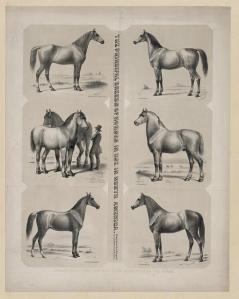
But free is fabulous and one of the best resources for free historical images has been the Library of Congress Prints and Photographs Catalog. A few times I’ve had to pay a modest amount for a HQ image that isn’t freely available online but they have a number of excellent images that are freely available in a publishing-friendly TIFF format. These are hardly just from American history: I’ve found Japanese and British images from the 19th century and earlier, both out of copyright and freely available for download and use from the Library’s collection. Let me tell you that I’ve felt pretty darned cunning at all the fabulous pictures I’ve discovered that will perfectly illustrate the historic elements we want to emphasize. Plus, others of the library’s free images are just plain fun such as this 1872 print of popular horse breeds!

Still, you should know that simply finding, licensing and serving up the illustrations isn’t the end of the story. Wherever you find your illustrations, make sure to scrupulously document the sources, credit information and terms of use so your publisher has all of that as they put the book together (which staggers me with all the work involved!). This isn’t so onerous when you’re using one or two illustrations but when you’re moving into the dozens or hundreds, it’s a daunting task. I’m fortunate to not be in this alone and I’ve sure learned a lot in helping to create a lavishly illustrated book but I’m not sorry that the next book is likely to ramp it down a few notches because image research and acquisition has been a major part of my working hours since the start of May. If we say that “A man who is his own lawyer has a fool for a client” a historian who is her own image researcher is sure to finish up as a tired and frazzled but hopefully satisfied scholar.

2 Comments

Filed under history, writing/editing

Star Wars and History

Star Wars and History cover

I can finally share the gorgeous cover for Star Wars and History that should be out in bookstores this November. A lot of talented people have contributed to this collection and you’re going to have such fun reading the histories as well as reviewing the illustrations drawn from historical and Lucasfilm images.

It’s been a lot of work (and there’s still some to go as we’re in the midst of copy edits) but so very rewarding. Fourteen-year-old me, who fell hard for Star Wars even before the film hit the theaters thanks to an early look at the novelization would have been so excited to know that someday I’d be working on this project.

9 Comments

Filed under history, pop culture, writing/editing

Unexpected Alignment

This week I’ve been working on a conference paper that I’ll be presenting at the end of the month, trawling through rafts of inquisitions post mortem and trial cases, looking for information about women’s interactions and women’s networking.

It’s going well, maybe even better than I’d expected, because I was reminded of a local colloquium paper I’d given in 2010 on the question of reputation in criminal trials and among the poor and dependent. That had seemed a bit of a dead-end at the time, interesting but there wasn’t quite enough information in and of itself to warrant an article. However, reputation combined with women’s networking starts to ring all sorts of bells. Women were often being called upon to attest for another’s character. Women accused at the Old Bailey needed someone to attest to their honesty and their virtue. When we’re dealing with unmarried women, it was even more critical for women to enjoy the support and testimony of other women.

And, yes, I know that reputation was important for men but not in the same way – their character as upright, honest men didn’t delve into the complexities of sexual reputation. A woman testifying to a man’s reputation seems unremarkable. I’m still waiting to find a case where a man attests to a woman’s reputation excepting in the case of an elderly widow.

This (re)discovery of this preliminary research and how it relates to my current work has cheered me up. I’ve been following my own advice to write early, write often but it’s even better when what I’ve written before adds to my current project.

2 Comments

Filed under history, writing/editing

Pinteresting Books

I’ve joined Pinterest so I have a place to brainstorm about course readings. Seriously: it’s turning out to be a great tool as I plan for the fall term by pinning all the possible texts.

It was easy to start – I requested an invitation and received it later that same day. Now I have a couple of “boards” (i.e. subtopics) to which I can add images & links. So? Meet my history books lineup: mostly a listing of possibilities for the Tudor/Stuart senior seminars I’ll be teaching in Fall/Winter with a few other notes, here and there adding in a few prospects for western civ and the grad historical methods classes.

It’s a great way to consider a bunch of options at a glance – I can add and add to my heart’s content but I won’t be overwhelmed by long and unwieldy lists I fail to properly track for each course. And aren’t all those covers pretty? (Or at least most of them!)

4 Comments

Filed under history, tech

Mary Broadbent: a London Life

Over at London Lives, my Biography of Mary Broadbent is live and full of the sad details I’ve shared earlier on this blog.

Two elements that made it into the biography I never mentioned here was how I pieced together her family background a bit more through the website Family Search. I found her parents’ marriage in 1712 and her father’s remarriage in 1724 after a little bit of sleuthing. Her mother was born in the same parish in 1681: Elizabet5h was 31 when she wed and not even 35 when she died.

Another fascinating tidbit that I uncovered when I asked myself “why might Mary Broadbent suddenly resort to the workhouse in the winter of 1763?” I stumbled upon mention of a particularly brutal winter which I was able to document by accessing some historical climate data for London preserved at Historical Weather Events. All of northern Europe was afflicted by a terrible cold snap and a poor singlewoman of London such as Mary would have been particularly vulnerable to the winter’s chill.

So go and check out the latest additions to London Lives – there’s a lot of new history that we’re uncovering every day.

2 Comments

Filed under history