Category Archives: teaching

Tutorial Tuning

My tutorials need a tune-up! In my eighty-student Ancient Near East survey this term, I’m having a problem with the tutorials. The task is document analysis and I know they’re good documents – a variety of literary, political and legal sources. Many of them I’ve used before to good effect. But this year, the discussions are painful! (My TA even remarked on that today after class was over.)

They know that the tutorial wraps up with a question that they need for their response paper due the following week. I think that most of them are sitting there, content to wait until the question appears.

It’s not as if they won’t speak up in class. This is a course with a presentation component – every student prepares to help open one class topic. And when they present, the vast majority of the students do an awesome job, sharing a polished, thoughtful response that helps lead everyone into tackling the day’s topic. However, the challenge of tutorial discussion seems a bit more daunting than an in-class presentation. Strange, I know, but there you are.

I tried opening them up to the challenge in today’s tutorial by projecting some sections of our tutorial text (Hammurabi’s Code) on the overhead and asking for volunteers to read individual passages, then posing a question for them on that self-same passage. It felt like pulling teeth. I got a very few comments. I might have gotten more if I’d waited them out longer, but we only have twenty minutes for the exercise, so that won’t work so well. (And I’d love to devote more time to these but given that we usually spend twenty minute on presentations at the start of class and there are only forty minutes left in the class period, time starts to run out for the rest of our activities.)

I realized, this afternoon, that one obvious solution is to open the tutorial session with the assignment question, itself, and then giving them a few minutes to ponder or review before venturing their approaches. I could turn our tutorial periods into brainstorming sessions where I give them the question and then sit back, only intervening when they get too stuck on one track and don’t consider other approaches.

In our next tutorial, I’m going to open with the question projected on the board and ask for someone to suggest a possible response strategy. I’ll let you know how that goes in another few weeks.

2 Comments

Filed under teaching

Snow Day: A Professor’s Perspective

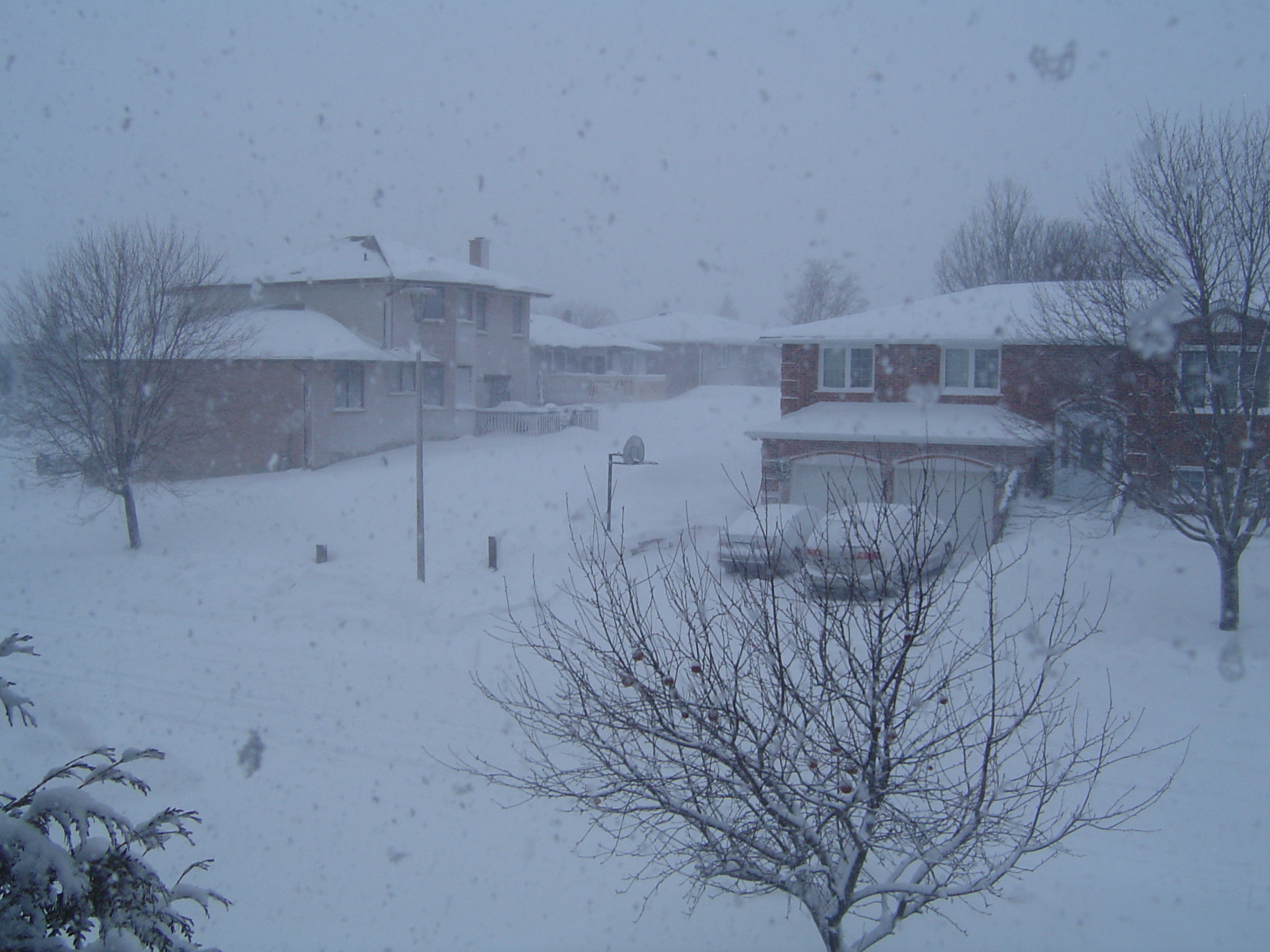
Woke up before dawn this morning and raced out of the bedroom to rouse my computer from sleep mode as I peered out the living room window to a discouraging scene. Winds roared from the south, racing up our street. In the dark distance of the corner where our street meets another, a car struggled fruitlessly to negotiate the unplowed turn until a neighbour popped out of his door to help the driver. The bus service website informed me that school buses were cancelled. The weather site’s alert switched from a “Snow Squall Watch” to “Snow Squall Warning” while I watched. Snow began to cling to the window.

So, reader, I cancelled class. All on my own. I wasn’t going to wait for the university to not do so (our “Inclement Weather Policy” is insanely cautious, based on the optimistic idea that everyone can get into university if they really try and many students live on campus anyway). Yours truly lives a five kilometer trek from campus up and down slippery hillsides featuring a laughable walking path for a small portion of the hike. And public transit in our city is a joke, especially in my neighbourhood, even though it’s located within spitting distance of a major road. Those pesky rock cuts and sheer drops mean there’s no easy way for feet to take you from here to there. But I digress. . . .

Unlike school kids, I don’t thrill to a cancellation. First off, I prepare mightily for a class. It’s much more work to have to do the origami of class reorganization when I cancel a class as it is to teach it. If something is on the syllabus, it’s important for the students’ learning and that means I need to try and find ways to cover at least part of the material. So now I’m splitting up a class on Bronze Age Mesopotamian religion and shoe-horning the bits into next week’s discussion of Mesopotamian social order and economies along with another section prefacing the Sargonids.

Secondly, it’s a fair bit of work to actually cancel a class. Trying to make the antiquated and annoying email options in our course management software actually get emails that anyone will receive? Worrisome. Trying to import a class list of emails into our regular campus email system? Frustrating as the system seems to cap somewhere around twenty BCCs. 80 students in the class, you do the math. (Obviously, I need to get all of them on a Facebook group or following a Twitter feed but you try herding undergraduates to an optional technology platform. It’s impossible.)

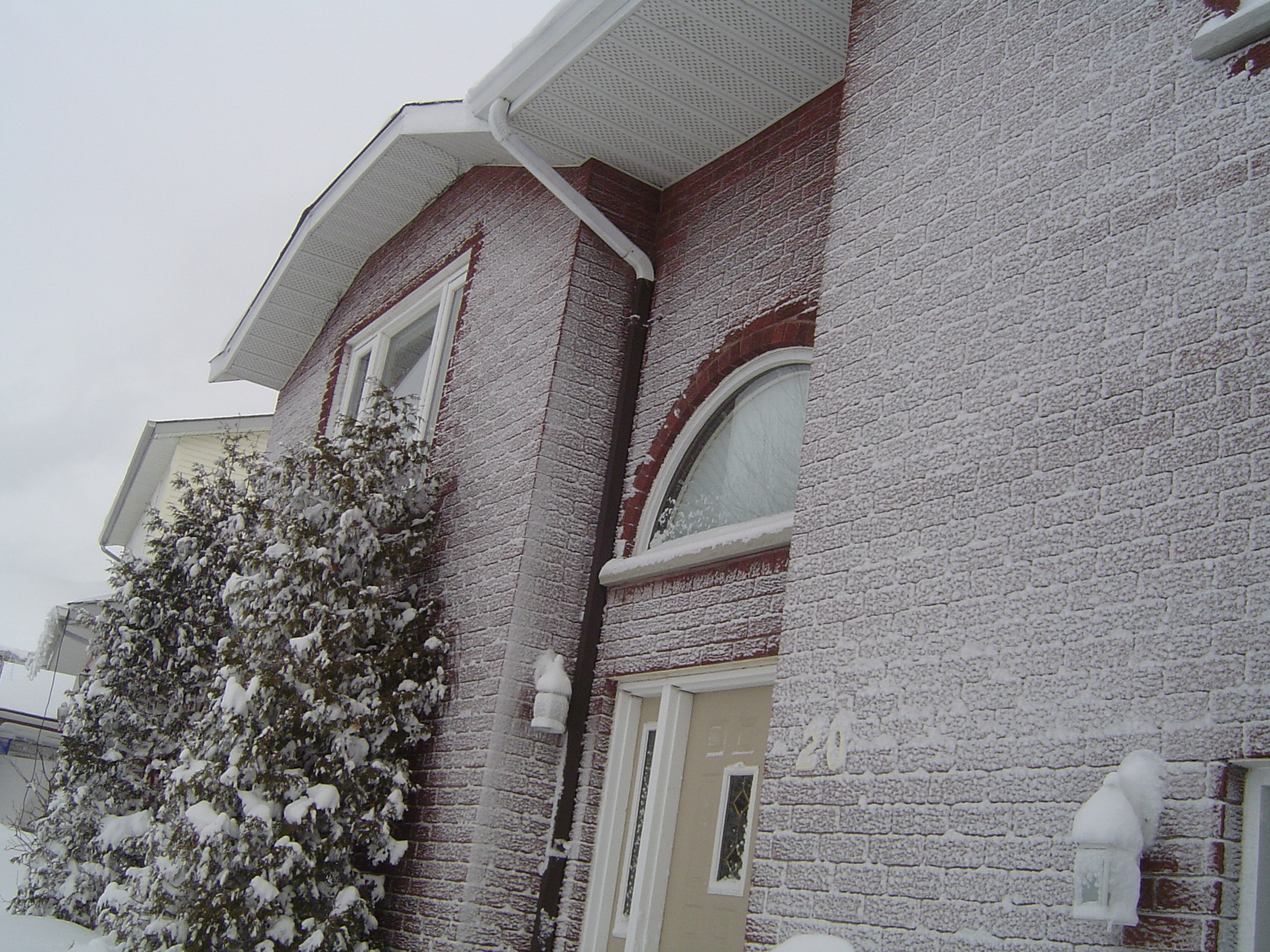
Our house, snow bedecked!Most annoying? I don’t get to sleep in. I don’t “take a day off”. I add in several hours worth of additional work with contacting students, answering queries, reorganizing material and then shoveling the damned stuff. (6-8 inches of new fall, drifts up to mid-thigh on me and I am not a short woman.) Mike and Eldest have also done more than their fair share of snow moving since the snow plows finally came by a bit before noon. He’ll have to go out for his evening shift at work. I’ll be home, swotting up on more course readings and prepared to shovel us out after the snowplows run through a second time.

6 Comments

Filed under academe, teaching

Return of the Term

It’s ba-ack! The term, that is. Run and hide in fear!

Actually, this term isn’t half so bad as last term. Half the classes, pretty much, and nearly down by half the enrollments. One class is brand-spanking new: a seminar on later medieval chronicles. However, since I’d planned and proposed this course several years ago as a logical extension of my existing seminar in early medieval chronicles, it feels familiar. The other undergraduate course is my survey of the ancient Near East and that course really is a well-oiled machine thanks to a fabulous textbook and a lot of planning in the past. It takes relatively little time to update material when it’s this well-organized. Finally, the graduate reading course appears like it will continue to be a rewarding class that I have two students working on overlapping material so they can support each other more readily.

The best part of this term, however? Not teaching five days a week. Really, if I’m going to be ramping up my research and publishing the way I’m supposed to do so, I need a day to step back and really get things done without interruption. Even if I leave myself copious “bread crumbs” in the form of notes, it takes some time to get the writing and research back on track. That’s why I’m loving Mondays, now!

Of course, Murphy’s Law meant that I had to make an unexpected trip into campus to ensure a student’s letter of recommendation got in on time. Oh, well. The day was still pretty darned productive as I simply zipped on and off campus as quickly as possible so I could get back to my revisions. I’m happy to report those are done and hopefully there will be many more productive Mondays in the weeks to come.

2 Comments

Filed under academe, teaching, writing/editing

Ask the Right Question

Last term I instituted a new scheme in my intermediate level courses: require short presentations on pre-assigned discussion questions from every student and recycle those questions as essay fodder for the tests and exams. It’s done a fair bit of what I want: ensure that even in a class of eighty, students were speaking every day without my resorting to picking faces out of the crowd. It also led to a lively culture on the discussion boards in our course software as part of the mark was not only for oral presentation, but for posting a polished version of that classroom comment and then responding to others.

I’ve had a lot of positive feedback from students who’ve appreciated this system, particularly that the questions are provided ahead of time so they can prepare for class with that opening theme in mind as well as know that can guide them in test preparation. I’m sure that there are others who’re not quite so happy, of course. I hope none of them are as disenchanted as this group of students at Utah Valley University but I do have tenure and a supportive administration behind me. (Of course, I accommodate students who can’t do oral presentations, say, for the student who has a nasty sore throat on the day – they can provide me a short paragraph, suitable to project via PowerPoint and I’ll share that in class with an invitation for the entire class to respond. But there were only 3 students who needed that accommodation in last term’s survey of eighty!)

I’m finding that the most difficult part of this is designing the best question that I can for each class session. I’m writing questions with the day’s reading in mind. Sometimes the text offers a great opening for interpretation and debate. Other times the ‘angle’ isn’t so obvious and I waffle for hours, reworking the question until I find something with which I’m happy. Because I’ve committed myself to not only using the questions in the class session, but also in the tests, they also have to be open for a broader, thematic analysis when it comes time for the quiz, midterm or semester final exam. So spending time on the questions pays off. That’s how I spent a great deal of time in the week leading up to course launch: tweaking with the discussion question list. Now it’s set in stone and I have a bunch of class sessions already full subscribed with students who’re excited to prepare for their turn.

They’re not magic tools but pre-circulated discussion questions with students presentations are definitely staying in my survey repetoire!

6 Comments

Filed under history, teaching

Once More Into the Breach

Classes start on Wednesday. I start teaching again on Thursday morning and I’m sort of, almost!, ready. My Desire2Learn shell is up and running for the second-year survey on the Ancient Near East and the course outline was in our admin’s hands well before term wrapped up. Preparing the online component of the course was a chore and a half. I realize I still have one assignment folder still to create: the discussions assignment since I’m continuing last term’s successful experiment in requiring discussions in a large-scale sophomore survey. I require every student in the class of eighty to present on the daily discussion question once during the term, post a refined version of their response and then respond to at least two others. That means that some days we can have five presentations! They’re all short (I advise students not to prepare more than a page of text to guide them) but I sweeten the pot by recycling the questions for essays on the tests so students have incentive to prepare and pay attention!

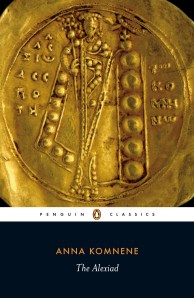
I’ve also finally figured out the intractable scheduling problem for the senior seminar: in order to spend two weeks on The Alexiad, we’re covering Villehardouin and Joinville in one week. Since the latter two are only in excerpts in our course custom reader, that’s okay in my book. I’m happily anticipating finally teaching this inaugural seminar on later medieval chronicles and that means taking some time with some sources (they’ll also read all of the Gesta Tancredi and The Chronicle of Bury St. Edmunds). We’re also going to start and finish the course with women authors: Anna Komnene and Margery Kempe – that has me excited!

However, I feel a little bit whip-lashed with term starting back up again so soon. I suspect my students will feel that even more as exams were scheduled right up until the 21st or 22nd. Everyone’s going to be tired and cranky when I head back to the office. We’re entering into the long, dark, bitterly cold heart of winter that doesn’t help one iota. January term is the cruelest term from that perspective!

How is the new year treating you?

4 Comments

Filed under teaching

Three Down, One to Go

I’ve submitted marks for three of my classes, now only the last group remains. It’s all down to how quickly I can plow through about seventy final exams. I don’t want to waste time counting them up: the total would be enough to make my cry in any case.

Once again, I will note my bemusement with the many students who have handed in not a single assignment for the course but still come in to write the final exam. Even when it’s worth 35% of the course mark, anyone should see that’s insufficient for a pass!

2 Comments

Filed under teaching

Grading Jail

It’s gotten to be that there’s so much end of term marking every December that I can no longer summon the energy to panic. I just mark as best I can, call it a day sometime around eleven at night and then get up too early in the morning to get the kids out the door before starting all over again.

Rubrics help: reducing my grading comments to focused feedback on the thesis and argumentation, the use of evidence, the proficiency of expression, etc. I’m telling students that if they want more detailed feedback, they’re encouraged to schedule a meeting or come by in office hours. Since so many students never pick up their final papers, I’ve finally realized that it’s a waste of my time to pour over all of the essays with a granular level of editing commentary.

So I’m in a zen state of marking as much as I can but not stressing too much about how much isn’t done. However, I’m not doing too much else that isn’t marking. I’m not watching TV (my DVR contains weeks of the one drama I would like to watch), reading any of my leisure books or I’ve only spent three hours (absolutely mandatory) on my own research in the past two weeks. I’m more than a little bit resentful about social obligations and meetings eating into my marking time, mind you – can’t we get together AFTER markings all done? But if you wonder why this blog is so quiet, my confinement to grading jail is a big part of that.

9 Comments

Filed under academe, teaching

You Can’t Alway Teach What You Want

It’s that time of year when we start nailing down next year’s course offerings. As our department has lost a boatload of faculty over the past few years (we’re down five full-time people and not down that many students), it’s a careful negotiation these days to figure out exactly what has to be offered so that students can finish their degrees and the minimum requirements for the program are maintained.

Practically, this means that a fair chunk of my teaching time is given over to obligatory courses. For the past several years, I’ve had to teach a term of western civ and a term of graduate methods. Even on my sabbatical years, I teach these as I only take one-term sabbaticals. So I begin to get a wee bit tired of the slog. The colleague who could relieve me on western civ has gotten a permanent position at a different campus. The colleagues who could relieve me of the graduate methods are teaching other obligatory courses or otherwise unavailable.

We all have some sort or another of obligatory course to teach in this brave new world of shrunken staffing levels. At least we have the prospect of hiring a few sessionals, albeit on a course-by-course basis. Excellence without money as Historiann would say! A few sessionals do not full-time faculty replace, however. When it comes to obligatory courses on methods, theory or both, all of which have been carefully designed to meet specific needs for majors in our curriculum, we’re wary of handing those off to outsiders. (And don’t get me started on how maddening it is to be short-staffed and only be able to offer course-by-course sessionals to other historians. The job crunch is real and alive at our campus, just as at others.)

That leaves me with three term courses in my regular full-year load. A lot to choose from, you’d think? Wrong! Two of those term courses have to be reserved for senior seminars. While teaching seniors can be a privilege, my senior seminars aren’t right up my research alley most years: they’re conceived of as appropriate capstones to popular electives that are on the books. For example, this year I have senior seminars on early and late medieval chronicles, building on students taking the early and late medieval surveys in the previous years. Next year, I’ll fill up the slots with seminars on Tudor and Stuart Britain (closer to my research focus).

If you’re keeping track at home, however, two senior seminars on whatever topic means I now have one term-long elective slot to offer. Argh! I have to choose wisely so it can be a useful support for whatever senior seminar I’m likely to offer in the year following. SO I’m slotting in a third-year elective on the Reformation and Counter-Reformation as I expect I’ll have seminars on gender and the life-cycle in early modern Europe for 2013-14.

Then, of course, there’s the obligatory graduate overload: for any graduate student I have (and there’ll be at least one), there’s a directed reading course (two terms in total). It comes with a nominal payment, mind you, so I’m not teaching it for free, but it is a LOT of work since the course has to be crafted to the graduate student’s interest (and the overlap between what my graduate students study and what I research is vanishingly small).

In an ideal world, we’d have enough faculty that we could cycle through the first year course options instead of offering the same two, year after year. That’d give me the occasional year off from western civ and the teaching space to throw in another elective from my many possible preps. The last time I taught my women’s history survey was when I was pregnant with Eldest. She’s in her third year of high school. There’s nothing more frustrating as an educator than having courses you want to teach but can’t.

For six years, now, another colleague and I have wistfully plotted out the possibility of team-teaching a survey course in pre-modern war. We designed the course and it’s occasionally taught on our other campus by a colleague. It’s never been taught here because slotting it in would require us to rejigger a number of obligatory courses so that we could pair it up with one of those to get our full teaching load for a term. But if we swap the obligatory course with another faculty member, that leaves us short in other areas. The house of cards collapses. The tetris blocks reach the top.

Maybe the year after next?

4 Comments

Filed under teaching

Droolworthy Digital Resources

Sharon Howard, at Early Modern Notes has alerted us to a new project in which she’s involved: Manuscripts Online: Written Culture from 1000 to 1500. Colour me excited!

She describes it as a kind of Connected Histories for medievalists. That’s also a fabulous resource for anyone working on British history circa 1500-1900. With resources such as this and my beloved materials linked via London Lives, 1690-1800 and the perennial favourite, Old Bailey Online, 1674-1913.

I tell my students they have little idea how fortunate they are. Digitization has revolutionized so much of the gruntwork of historical research. Whereas we were fortunate to have microfilms and microfiche of some manuscripts and many early books at my doctoral institution, a lot had to be taken on faith that the research trip to the other side of a continent or the other side of an ocean would pay off. Current students can get a good hard first look at a lot of research material online. Some of the digitization is of such high quality and so extensive (many of these sites are not only images, but include adeptly managed text conversion with connections to a searchable database) that you can use the material for so many digital humanities hacks.

I’m thinking that, if I have the time for next fall, to rejig part of my methods course for the grad students so that they practice with using and creating a small version of such a project. I’d have to identify a suitable source or set of sources and get an installation of Omeka, software to support elegant and extensible online exhibitions, up and running. Obviously, nothing I can tackle right now as I’m snowed under with marking, editing and writing, but definitely a goal for the near future.

Hrm. I wonder if this small digital humanities project might be suitable for an internal-to-the-university research grant?

Comments Off on Droolworthy Digital Resources

Filed under academe, history, teaching

Talking ‘Bout My Institution

Over at Historiann’s corral, there’s a great discussion underway, inspired by Tony Grafton’s review of a raft of books on the crisis in higher education. Historiann’s charged her regular commenters, including yours truly, to describe our institutions and what the problems look like from our vantage points. Keep in mind that, as a Canadian, my perspective may seem unusual. Scratch that, I know that what we have here is downright unique. At the same time, we’re facing a lot of the same problems that anyone in higher ed knows all too well today.

In a nutshell, I teach at a regional, remote and underestimated university that just passed the fifty year mark. We show up at the middle of the pack for Maclean’s 2011 University Rankings: Primarily Undergraduate. Our student body’s under 10,000, all told, with about 7000 full-time undergrads (as well as hundreds of grad students), studying in one of our two language streams, French and English. That bilingual aspect is rare, even in Canada, and it brings with it a particular challenge. It’s expensive to offer full programs in two language streams, especially when the French enrolments are often a fraction of the English but it’s part of what we need to do in a region that’s vibrantly bilingual (about 30% of the region identifies as francophone).

I’m sure that some bean-counters think of this bilingual element as waste. Certainly it’s expensive (and one reason why our university has the most spending per student in our ratings category) but there aren’t any short-cuts to providing the full program in both languages. Right now, my francophone colleagues number only three: three full-time faculty members to provide an entire undergraduate and M.A. program! We anglophones aren’t as numerous as we used to be, either: right now we’re at six, down two in the last year and with no word of new hires to replace the lost capacity. Having lost almost half a dozen faculty in the last few years in our department alone, we’re struggling just to provide what’s needed from classes to administrative functions and always, always!, that all-desirable research element. The key element is that bilingualism is an integral but resource-intensive part of our mission. Even if we share supervisions of senior theses and graduate work across the language stream, we still have to offer courses enough for anglophone and francophone students to complete their degrees. For the first time, we have more than one person teaching in an adjunct capacity on our main campus. We’re fortunate to have their expertise but we’re frustrated because it’s still not enough. We’ve been cut to the bone, even if our faculty complement is higher than it would be at a comparable-sized institution because we have more bones.

Another key factor? We see a lot of students whose families aren’t familiar with higher education. We teach a lot of first-generation university students: it makes sense when you realize that, despite a healthy international and specialist program recruitment, we’re still drawing students from a distinctly isolated region, far away from the Toronto megalopolis. (There’s one two-lane highway north/south and one two-lane highway east/west. When bad weather, an accident or a moose intervenes, those life-lines can be cut off for hours or even days. Not to mention the fact that a lot of people have to drive more than four hours to reach our urban area, let alone the further four to reach the megalopolis.) A lot of our students wouldn’t thrive in the big urban universities to the south where tens of thousands of undergraduates mingle with the millions of urbanites. Heck, I remember my own trepidation at starting grad school in that megalopolis and I had grown up with frequent trips to major Midwestern cities in my youth.

This fall, pretty much every program across the U was asked to come up with ‘savings’ – ways to offer the program with fewer resources in terms of faculty complement. We considered a lot of options: did we want to eliminate multiple course choices at the first year and go to one super-course? Should we reduce the number of electives choices at the second and third year level? How about fewer senior seminars? We opted for the latter choice, at least for this year. Who knows if next year we might be forced to revisit the request and cut yet more resources.

I believe that our administration, like so many others, would like to push distance education and cross-listing of courses from other departments as a solution to program resource problems. We’re wary of these, even though we’re proud of many of our distance ed courses. Even the best distance ed course often fails to serve students who aren’t experienced enough to pace themselves wisely and advocate for their own needs. Cross-listing is, ironically, more of a concern the more the university pushes majors and minors, new streams with lower course requirements than the conventional four-year degree with 60-credit program. If we cross-list courses with Political Science, Classical Studies and English, say, the number of History courses a history major takes may be very few, indeed.

We all know the curse, “May you live in interesting times.” I’ve been at this university for twenty years now (and I have the logo-bedecked pen to prove it!) and I’ve never seen a more interesting time than this one. Sadly, I’m sure times could be still more interesting, here and elsewhere! But whatever changes, from our faculty complement to how we define our program, some elements remain constant or so I hope, particularly our bilingual nature and our service for students who’re just starting out in higher education. These elements make me proud to have spent twenty years here and worries for their maintenance inspiring only a few nerves, given the prospect of twenty years more in the traces.

What are YOUR institutional or program points of pride or problem? Get in on the discussion here or at Historiann’s!

7 Comments

Filed under academe, teaching