So What (I’m Still a Rock Star)

I got a professional rejection today. Or, should I say, a rejection for a professional application: a research grant. The rejection itself wasn’t very professional. In fact, it was downright dismissive.

Now, I can take away some useful lessons from this, like, hrm, I need to work more on articulating what I’m doing in the grant and beefing up the bibliography. Some other lessons aren’t terribly useful because I can’t do anything about my research record until more of the pending articles and chapters get into print. I also suspect that I won’t get this group to fund anything to do with this line of research until it’s all but done because they really just don’t get it. So unless they see many related prior publications, they’re not going to see where this is going. These are all important lessons for the academic researcher. However, the best lesson was paying attention to my own emotional reaction.

I was a bit disappointed. That was all. I read the reasons for my rejection and chuckled at the heavy-handed rhetoric while retaining the useful elements.

Most important was what I didn’t feel. I wasn’t crushed. I wasn’t even angry. Irked, maybe, at the tone, but that was all. Honestly, the first words that sprung to my mind were “So what?”

Is this rejection really going to negatively effect my research plans for the next year? No. In fact, since all of my M.A. students are graduating, I’m short of prospects. I don’t have a grad student working with me in 2013-14 or even any seniors lined up for projects. I’d have a hard time finding a student to work on the project which involves reading a lot of seventeenth-century manuscripts: not a skill you can expect to build in every undergraduate who comes along.

Without the grant money and hiring concerns, I can scale back the project from communities in three counties to one and cover all the material myself. I won’t have to devote time to hiring and training: I can simply segue into this project when I’ve wrapped up the next chapter on my to-do list and that’s just what I’ll do.

So what? I’m still a research rock star (or maybe, more realistically, a wedding singer? Whatever!). I got my rock moves and I don’t need that grant.

So for all those other great academics who’ve also been rejected this grant season, P!nk says it better than I could:

5 Comments

Filed under academe

To Boldly Go: Historical Prospects of the Old Bailey Online

It’s ten years since The Old Bailey Online rolled out and what a glorious ten years it’s been. The Old Bailey Online (or OBO) provides, online, the complete texts of printed accounts dealing with criminal trials at London’s General Criminal Court circa 1674-1913. That’s almost 200,000 records!

I’ve been a fan since the very early days: looking back through my teaching dossier, I know that I stumbled upon the site in 2003 and began teaching with it that year. The website enabled students to run statistical searches and see, even tweak, the results immediately – a powerful tool when learning to do quantitative history. In the decade since, I’ve learned to love the site for much more than its awesome pedagogical power: it’s become a linchpin in my own historical research. Looking forward, I can’t see a time when I won’t find the OBO to be a vital historical resource. Why? The genius lies in the source’s searchability. Any trail you choose to blaze, you can follow!

The unsung heroes of historical research are those who provide finding aids. Whether they`re calendars of collections or indices or what-have-you, archives or even publications without some sort of search function are daunting piles to work through. A researcher can lose herself in the task of simply wading through dozens to hundreds of volumes, boxes or rolls. The early days of computerization gave researchers a few glimmers of hope but, even so, there was nothing easy about consulting one set of books to identify the catalogue number of the source you were interested in, another book to correlate the catalogue number with the microfilm reel number and then, only then, trot off to the microforms room to request the reel to run in the machine to read the book you originally wanted to consult.

The genius of the OBO is that, by integrating so many levels of searchability, almost any question you want to ask you can pursue in robust ways. Are you interested in a specific individual, whether as a scholar or a genealogist? The Old Bailey Online can be searched by name. Are you interested in seeing how many women were put on trial for breaking the peace in the nineteenth century? You can find that out. (There are 963 items returned when I search those parameters, 641 with guilty verdicts. Of course, some are duplicates as mu) Or let’s say that you’re interested in seeing how language changed in the time – great! The Old Bailey Online lets you search the entire text by keywords. There are place and map functions – do you want to track eighteenth-century criminal behaviour in the streets and by the parishes? Go right ahead!

The Old Bailey Online is more than just an excellent tool for historical research: it’s fostered an amazing community of scholars who’ve come together at conferences, who share their work online and whose publications citing the OBO add up to an amazing bibliography growing all the time.

Have I got you excited about the Old Bailey Online? Great: Click here to get started.
.

1 Comment

Filed under history

I Used To Believe in Renewal

I just saw another tweet scroll by commenting on how tenure-track jobs are scare because older profs are hanging onto their jobs. Whether that’s because they believe they need to (to build up their pensions, etc.) or simply because they can (people are staying healthier longer and mandatory retirement’s mostly disappeared) isn’t the issue, here. It’s the belief that if only these older professors retired that new jobs would open up that has me shaking my head because from what I’ve seen in the last seven or eight years, it’s simply not true. At least not at most institutions. Sure, some of the rich privates and elite publics have healthy endowments, but even they’re playing by new rules these days.

Don’t get me wrong: there used to be a time when departments and programs could count on faculty renewal. Professor A retires or departs, leaving the department short one [insert faculty specialty here]. Department files a request with the dean to conduct a search to hire a new [insert faculty specialty here] in order to sustain the program. Permission is granted, a job ad is drafted: applications are received, assessed, etc. Soon, Professor B is part of the department faculty and all is well. That’s a pattern that I saw operating for years, from my childhood days as a faculty brat right through into my own academic career.

These days, when a faculty member departs, all bets are off. Continue reading

8 Comments

Filed under academe

“The Feminine Mystique”: Fifty Years On

Can you believe it’s fifty years since “The Feminine Mystique” came out? I couldn’t and I’m almost as old as the book!

I’m not a modern historian or an American historian, so I’d never had cause to read the book before. I’d read selections from “The Feminine Mystique” over the years but never sat down to read the entire work until this 50th anniversary edition appeared. I was inspired by seeing Emily Bazelon’s post on her own reading at Doublex. The book is well worth digging into, particularly in this edition which includes multiple epilogues and introductory materials from earlier editions. They provide snapshots of how Friedan’s book was seen at launch, ten, twenty and many more years after. This reiterates the enormous impact that her book had on readers then and later on as well as upon her own life, including her work as a co-founder of NOW.

However, the meat of the book remains the text itself and “The Feminine Mystique” stands up well as a readable work, even half a century on. Friedan’s perceptiveness in describing ‘the problem without a name’ is bolstered by material from her own research, interviews and countless other contemporary sources. Where contemporary society encouraged men to pursue higher education, careers and grow in fulfilling ways, the mystique, bolstered by some cherry-picked elements from Freudian psychology and functionalist philosophies, urged women to subordinate all of those elements to their gender-mandated and absolutely certain fulfillment as a wife and mother. The problem was that so many women were driven to despair by the frustrations that they encountered in what was marketed to them as the ultimate in personal fulfillment and rewarding feminine duty. The mystique also contributed to a precipitous decline in the age of marriage across the American middle class. Higher education for women was condemned as counter to their natural and rewarding mission at home so that even women’s colleges began to step back from the academic programs they’d fought so hard to offer in favour of helping women prepare for their “Mrs.” degree path.

The book lays out a damning case for how the mystique ran counter to the previous trends in American middle class culture where women’s freedom and initiative had been celebrated. More damningly, Friedan shows how the mystique was endlessly useful to marketers in the burgeoning era of consumerism as well as their peers in the worlds of magazines, education and so on. Margaret Mead comes off rather badly for pushing the mystique’s key message to urge women to embrace domestic service to husband and children early and totally while she, herself, did no such thing.

The book is flawed in my mind by an excessive reliance upon psychoanalysis. Many chapters focus in detail on this subject beginning with a long background on Freud’s own problematic relationships with and understanding of women to page after page where Friedan uses psychoanalysis to diagnose problems in American housewives and their families all deriving from the toxic powers of the mystique. It is also relentlessly middle class: the world of the working class is almost non-existent except when evoked as servants!

I also couldn’t accept her dismissals of homosexuality, particularly in men, and autism in children as consequences of pathological mother-love run amuck or improperly applied but, as I read those sections, I knew that she was approaching these topics using the thinking of the time. It’s impossible to expect a book from 1963 to speak with the voice of 2013 all the time. The strength of “The Feminine Mystique” is that it evokes the past so vividly you’ll think you’re reading a modern history until you’re jolted back into reality by those occasional tone-deaf moments.

Occasionally you might feel a deep sense of depression as you read about the ways in which marketing heavily reinforced the mystique’s domestic mission. Friedan’s story about how many women attempted to fit the mold and failed is also sobering. No wonder the Stones did so well with “Mother’s Little Helper”!

If you want to understand the U.S. middle class culture of the 1950s and 1960s as how it played out in the media, medical, educational and marketing industries as well as in the personal stories of countless women, you should pick up Friedan’s book and get to reading! (And follow me at Goodreads where I’d initially posted a version of this review.)

Comments Off on “The Feminine Mystique”: Fifty Years On

Filed under history, review

Taking Time

Long time no blog – it’s another teaching term, I’m writing on three separate projects (not quite at the same time, but I jump from one into another). And there’s real life with some moments of profound sorrow, as when we said goodbye to Ozzie, our Staffordshire Bull Terrier, early in the new year. But the hardest thing I’ve been doing is trying to close the door on work some of the time.

Like many academics, I’ve been guilty of letting work take over my life or, more precisely, to succumb to the idea that I need to work all the time. With the last book, there were weeks when editorial tasks ate up so much time that it simply pushed my other work into the remaining hours and, whoopsie, there goes actually living life. You know, the parts like spending time with your kids, taking care of your health, stopping to smell the roses?

It’s scary how easy it is to fall back into those bad habits where work takes over your life – grading piles of papers, writing others, tackling course prep.

So, while I avoid new year’s resolutions, I’ve taken the new term as a cue to remember to take time for myself and my family as well as to pursue more healthy work-habits during the week. This op-ed piece from the New York Times, Relax! You’ll Be More Productive makes a strong argument that rest is essential to true productivity. The author cites studies that show a good 10 hours of sleep (Wow!) helped basketball players to score 9% more free throws and three-point shots. The particulars of their 90-minute personal cycle I haven’t tested, but knowing when to step away for a bit is essential for my productivity, not only on the macro scale of taking a day off each week, but also in the daily grind

The idea is also at odds with the prevailing work ethic in most companies, where downtime is typically viewed as time wasted. More than one-third of employees, for example, eat lunch at their desks on a regular basis. More than 50 percent assume they’ll work during their vacations.

In most workplaces, rewards still accrue to those who push the hardest and most continuously over time. But that doesn’t mean they’re the most productive.

Most of us know now that burning the midnight oil or being continuously ‘on’ is no way to get things done. The idea that you naturally work in cycles of on/off is appealing. It’s also the mantra of one of my favourite personal/home-care blogs: Unfuck Your Habitat, which advocates cleaning and chores carried out in waves of work. The common rhythm there is 20 minutes on/10 minutes off or, in their parlance, a 20/10; alternatively, 45/15. When my available blocks of time in a day vary between half an hour and two, some of these cycling schemes work very well.

And blogging totally counts as a break from work, doesn’t it?

Comments Off on Taking Time

Filed under personal

Dealing with Derailment

This morning I was all prepared to polish off the last course prep tasks for my winter classes when I got derailed. Pet health issues again: trying to figure out what was wrong, booking an appointment with the vet and dealing with the logistics of how to get there on a carless day with much snow? That ate up a big chunk of the morning.

Now it’s afternoon and I’ve just gotten back on track with compiling the last course materials. I couldn’t do it right away after dealing with all of the above. I was too flustered and high on adrenaline. Instead, I substituted a few low-stakes tasks into the rest of the morning. My range and kitchen counters sparkle, there’s laundry on the go and I’ve virtually filed away some teaching materials I won’t need in the new year.

When I’m derailed, I’ve learned to accept that this task, whatever it is!, has taken over my life for a short term. I throw myself into doing what has to be done to deal with it, deal with the issue as far as I can at that point (which may, in the case of a semi-distant crisis only be an acknowledgement of the problem), calm down and, only once I’m calm, get myself back on track. Which is where I’ve been for the last hour and where I’m heading back to as soon as I hit post!

Comments Off on Dealing with Derailment

Filed under personal, pets, writing/editing

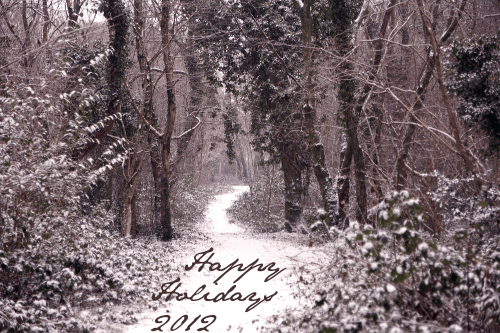
Holiday Wishes

Happy Holidays 2012
2012 has been a pretty good year hereabouts. We’ve weathered our storms (some quite literal while others were more figurative). There’s a beautiful new book to treasure in Star Wars and History and many other projects underway. Pet health crises have been weathered.

Marks are in, cookies have been baked and family members will soon arrive for a holiday visit. What more could we want?

Here’s hoping that your year ends as happily as ours.

Comments Off on Holiday Wishes

Filed under personal

Assignment Policies: They Matter

I opened up my email this evening to see yet another student email with the familiar attachment icon. Oh, joy: another unwanted emailed assignment.

You’d think I wouldn’t receive those since I have an across-the-board policy in all of my undergraduate classes that I do not accept assignments via email. Students may hand in a hard-copy at any time (there’s a late penalty that starts to accrue after the due date) or submit an electronic copy through our university’s online dropbox up to the due date. I will even, if there are special circumstances, open the dropbox to a later date for a student. I don’t want emailed assignments. I have a policy that clearly says that and, yet, every term, every year? I get emailed assignments.

Augh!

Emailed assignments are the hangnails of my academic life. They disrupt my well-oiled system to track and respond to assignments. They irk me enormously.

I can’t integrate emailed assignments into our dropbox. It only permits feedback for assignments submitted through the system. In fact, recent upgrades present me only those students who submitted online when I go into the grading mode for any given group of papers. That’s efficient but not adaptable to these emailed drop-ins.

I can’t integrate emailed assignments into my hard-copy marking unless I print them out. So now I have to track the student email until I’m able to print the paper. Considering how much I work on the road, that could be a good day or two. It’s really annoying to think at 11pm “Oh, yeah, now I have that paper to print that I didn’t ask to get via email” and go traipsing down the stairs to fire up the old printer.

How about I do it all on email? Now you’re asking me to set up a third system that I’ll have to manage. I have to make sure to save the emails, download the assignments, unzip the files, track them until I have time to mark them, mark them up as well as recording my additional comments, then save the lot. After that, I have to log back into email (let’s hope it’s up!), make sure I’m emailing the right student (which is a challenge in and of itself), and finally send them their marked-up assignment and the additional comments.

Worst of all is that these emailed assignments only come because the student missed the deadline. That’s the deadline they’ve had on the syllabus since the very first day of the term. These emails almost never are accompanied by an acknowledgement of that except a comment to the effect that “the dropbox was closed so here’s my assignment”. A student who emails me with an honest query “I tried to submit my paper online but the dropbox closed” will get a chance at sympathy and a link to the newly reopened dropbox. A student who emails the assignment? Gets my eternal irk. And is that what anyone wants at marking time? I think not.

Comments Off on Assignment Policies: They Matter

Filed under academe, teaching, tech

A Dog’s Life

This past month has been an exciting time professionally. Helping to get the news out about Star Wars and History has been great fun. But real life has a way of intruding. In this case, it came in the form of our aging but much-loved Staffie, Ozzie, seen here sacked out on the family room couch with our cat, Sisu. Dog and cat snoozing

Ozzie has health problems, which we’ve finally nailed down with a diagnosis of Cushing’s disease. (Sadly, nothing to do with the awesome Peter Cushing who artfully terrorized us all as Grand Moff Tarkin.) Now that we know what’s wrong, we can begin the course of treatment, medication, which should improve his quality of life. The diagnosis also comes with the news that he’s likely to only be with us for another year and a half or two. We live with pets on borrowed time but we’re hoping to squeeze as much as we can out in the next few years. There will be more indulgent naps on the couch and snuggle time, have no doubt!

6 Comments

Filed under personal, pets

And the winner is. . .

a fan of Chewbacca, the heroic Wookiee we all love, Jennelle Holland wins the Star Wars and History giveaway. Thanks to everyone who entered and, of course, may the Force be with you, always!

In the meantime, look for the book in stores near you. It’s out across North America now with a UK release next week. Let me know if you see it in the wild!

2 Comments

Filed under history, pop culture