Star Wars and History Giveaway

Star Wars and History in Hand Look what’s finally in my hands! Although the official release date is still a few days away, lots of people are reporting finding Star Wars and History in the bookstores or receiving it from an online retailer.

If you haven’t got your copy yet, now’s your time to score a copy of this awesome collection. I’m hosting a giveaway for a copy of Star Wars and History right here on this blog. All you have to do to enter is leave a comment on this post telling me who your favourite Star Wars character is and why. Contest is open worldwide. The deadline to enter is November 16, 2012, at noon EST (What time is that for me?).

45 Comments

Filed under history, pop culture

Black & Tans: A Reading Holiday

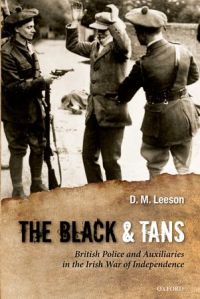
It’s the end of reading week and, surprise, surprise, I’m doing some non-work reading. Black & Tans book cover Specifically, I’m finally digging into a colleague’s recent book The Black & Tans: British Police and Auxiliaries in the Irish War of Independence.

It’s quite a good read, even for someone whose knowledge of modern Irish history comes and goes after the Gladstonian era. In many ways, it reminds me of Christopher Browning’s Ordinary Men: Reserve Police Battalion 101 and the Final Solution in Poland, not that the types of sources or particular situations are much the same, but insofar as both Browning and Leeson write with particular interest in how the situations put unique stress upon the men involved.

Black & Tans takes the conventional wisdom that the Royal Irish Constabulary was a motley group of thuggish WWI vets just looking to spill some blood and cause maximum mayhem (or, conversely, that they were the tools of thuggish English politicians determined to brutally oppress the Irish through terror tactics carried out by the police). His argument, is that it wasn’t a fatal flaw in the people but that the situation of trying to enforce impossible police directives in what was constantly hostile territory where the Black & Tans found themselves virtually under siege (and their challengers vice versa).

You come to see this argument emerging early on. Dr. Leeson’s not in any way an apologist for the forces, but he’s a dab hand with archival sources and elegant argumentation. I’m just over 100 pages into the book now and have a hard time putting it down as I’m encouraged to read just one more section as I learn about the Auxiliaries and their somewhat chequered as well as occasionally inglorious pasts.

I’m proud to call him a colleague and recommend the book which comes out in paperback next month.

Comments Off on Black & Tans: A Reading Holiday

Filed under history, review

In the Restricted Section

Over the summer and unbeknownst to me, my university library moved all the U, V and Z (Library of Congress classifications) books out of the general circulations stacks and into storage. Err, the first floor depository, they say. I call it “The Restricted Section”.

Harry wandered over to the Restricted Section. He had been wondering for a while if Flamel wasn’t somewhere in there. Unfortunately, you needed a specially signed note from one of the teachers to look in any of the restricted books, and he knew he’d never get one. These were the books containing powerful Dark Magic never taught at Hogwarts, and only read by older students studying advanced Defence Against the Dark Arts. (J. K. Rowling, Harry Potter and the Philosopher’s Stone)

Just imagine, wandering innocently into your library, in search of five books you need to check out for your class. You know they’re there. You check them out every year (it’s a small class of grad students – they can share the books over the last half of the term). But the books aren’t there. The whole circulating collection seemingly ends with the T classification for technology topics. But wander farther afield and there’s nothing. Not even a sign. I stumbled about the third floor for ten minutes, looking for where the books had gone to – I knew we had hundreds, if not thousands of titles in that range that had seemingly disappeared.

Only when I headed down to the circulation desk did I get an explanation – those books had been moved to the first floor, off limits to users – I’d have to ask a librarian to retrieve them for me. I presume (but I wasn’t told explicitly), that this was done to free up room upstairs in the circulating collection or ‘stacks’ – as new books are added, and a few are every year, they fill up the current ranges and threaten to overflow. Plus, goodness knows!, we can’t cut back on the study desks and comfy chairs that have filled in around the circulating books over the years.

Still, just wrap your heads around the situation with the books for a bit. Entire classifications of library books are gone. Sure, if you look at each individual catalogue listing, as I did later, you see a note after the call number that explains the book is located at the 1st Floor Depository. But imagine you’re an undergraduate – what does that mean? There’s no word of where that is or what you’ll need to do to see the book. How likely are you to go and ask for that? There’s not even a sign at the end of the range of books still available indicating that you need to go elsewhere and speak to someone. Even better: maybe you committed the call number to memory when you trotted off on your quick search after getting the information from the first page of the catalogue entries? If so, I bet you’ve forgotten it after a few minutes of fruitless searching.

Will you ask? will you wait? Or will you just give up? Remember, you’ve got to intuit that you have to ask someone specially for these books and then you have to wait for them to get them. We aren’t blessed with an overabundance of librarians – on weekends and into the evening, who’s going to be around to fulfil requests? Who’s going to ask if it seems even slightly daunting.

Now consider the role of shelf-browsing? How many of you have found wonderfully useful books just by running your fingers along the shelves, to see what’s there beside the book you came to get? How can you do that now that entire swathes of the library are off in storage. I’ll give you a hint – our catalogue doesn’t have that function anymore to browse a range of call numbers so you won’t.

90% of my students will give up if they think they might want one of these books. They’ll change their topic, make do with what’s online or simply pass the material by. And so the usage stats will drop even more and the library will feel justified in carting these and other books off to our local equivalent of the Restricted Section.

So much for consulting the bibliographies to direct you to other works in particular. Pay no attention to the vast scholarship in print on authorship, reading and publishing that also sits in this range – they’re all getting condemned to near uselessness by such a decision. So much for the many classic and current works of military history and scholarship – if they’re in the U category as opposed to particular national histories, they’re out of reach for ordinary library patrons at my institution.

I’m also afraid of what’s next – in any given year, for my teaching and research, I check out books from many different Library of Congress areas, particularly B, D, H, J, P and Z. What if they decide to shave off those lightly used A & B classifications into the depository next? How am I going to get my students to engage with the works of religious thinkers and the abundant scholarship we own in print of the same if the books are tucked away elsewhere.

Yes, this is a first world problem but it really irked me. I work hard enough to get our students to appreciate the range of books we have available at our library. When something like this happens, I’m filled with despair. What’s the point if our books are going to be consigned to the Restricted Section, willy-nilly?

7 Comments

Filed under academe, history, teaching

Be My Colleagues!

We’re hiring two tenure-track positions in the History/Histoire program at Laurentian.

(1) Un poste francophone menant à la permanence en histoire autochtone nord-américaine au rang de professeur(e) adjoint(e). Entrée en fonction: le 1er juillet 2013. Les tâches liées au poste comprennent l’enseignement en français aux niveaux du premier et du deuxième cycle, des travaux de recherche et des responsabilités administratives. Les qualifications requises consistent en un doctorat en histoire (ou alors presque terminé) et une excellence démontrée en recherche et en enseignement dans le ou les domaines de spécialisation. Les candidates et candidats sont priés de soumettre un exposé de leurs recherches actuelles et planifiées, un dossier d’enseignement, un curriculum vitae et trois lettres de recommandation.

(2) An English-language tenure-track appointment in North American Indigenous history at the rank of Assistant Professor, beginning July 1, 2013. Qualified candidates with expertise in the areas of northern, rural, or health history are especially encouraged to apply. The successful candidate will be expected to teach in English at the undergraduate level, and to participate in the M.A. program. Applicants must have a completed Ph.D. or be near to completion, with demonstrated research productivity and teaching experience. Candidates should submit a statement of current and prospective research, a teaching dossier, a curriculum vitae, and three letters of reference.

Continue reading

Comments Off on Be My Colleagues!

Filed under academe, history

Unsnarling My Prose

Yesterday I completed my own chapter draft for The Hobbit and History. Yes, rather like the cobbler’s children who go without shoes, the editor’s chapter is sometimes one of the last to be completed.

Today I printed out the draft after class. I celebrated with a wee second breakfast the serendipity of wrapping things up in time for Hobbit Day and Tolkien Week. And then I looked at what awaited me. Ugh! Some of my sentences were so wrapped up in themselves, they fell apart as soon as I tried to read them. I’ll be spending some time this week unsnarling my prose.

Part of this is an artifact of my write early, write often philosophy. I’ve been working on this chapter for well over a year now, although it stalled for many months just around 1600 words. But most of it is the reality that I write shitty first drafts (Thank you, Anne Lamott). It’s not the argument or evidence that’s at fault, it’s my prose style.

My first draft sentences will often start in the middle of an idea, roll out a clause or two, throw in a caveat or qualification and finish up with a key concept. You’d see a lot of similarly disorganized sentences in this draft, let me tell you! I also see too many weaselly or empty words such as “although” and “therefore” and “so too”, sometimes more than once in the same paragraph. I stare in horror at the vaguely grounded statements that claim certain behaviours “were expected” without indicating by whom or how that actually happened. Passive verbs litter the paper landscape. In a word? This draft sucks.

I want to cry. I don’t. Instead, I revise my work, step by laborious step, smoothing out the snarled phrases, eradicating the evasions and purging the overwhelming passive constructions. Editing your own work is just as important as writing. If you don’t allow time for revision, what you send off to the editors, reviewers or friendly members of your critique group can be so rough as to be unhelpful. I’d rather see their time spent getting me from 80% to 100% than from 60% to 80% which is what it will be if I ask them to read my shitty first draft. I can get that to respectability and then their feedback can help me turn it into something I’ll be proud of for years to come.

If you’re going to be a writer, you have to get over the instinctive flinching you experience when you review what you’ve written. (I can’t be the only one who felt that way, going back to when I was an undergrad.) Revising is just as important as writing. Yes, it takes some time, which is why I tell my students to try and have a complete draft several days before the assignment is due so they can review and edit! It also takes courage to face the truth that what you wrote isn’t nearly as clever as you imagined it was when you were writing it. But it pays off and can make the difference between a composition that’s published and one that’s not.

I’ll wrap up with a plug for a great writing opportunity. Jo VanEvery, who’s a font of wisdom on many matters academic, is running a Monday morning Meeting With Your Writing that, if it didn’t overlap with my Monday mid-day class, I’d be all over. If you’re working on getting your own writing or editing working within your schedule, check this out as a great value for not a lot of expense!

Comments Off on Unsnarling My Prose

Filed under writing/editing

On Again, Off Again Scheduling

This term I’m teaching three days a week: Monday, Wednesday and Friday. That leaves the other two days a week for research, writing and editing.

It’s been a while since I’ve had two days in a term that were out of the classroom, especially in my heavy term which isn’t as heavy as some have been. Only three courses in my official workload but there’s also one graduate directed readings meeting at a timeslot still TBA. Usually I’ve been lucky to have one non-teaching day in a week and that usually gets further complicated by being on a day when I have regular committee obligations. This year? Not yet. All may change when the T&P committee ramps up for actual meetings but if they’re slow to get started, that might wait until next term. For now, my Tuesdays and Thursdays seem safe.

I must say that I’m enjoying the on again, off again nature of my work this term. The format helps me to recharge my introvert batteries after a long day of teaching, for one thing. For another, even though I know I can write in small timeslots set aside during a busy day, I write best when I have at least two or three hours to pour into one project. Uninterrupted time allows me to better see how what I’m adding fits into the bigger picture.

The schedule also only works by making sure that teaching prep or, in a few weeks!, marking doesn’t eat up my research and writing time. I’ve found that the weekend is the best time to finalize my visuals and class plans for Western Civ (so that the files can be uploaded to our CMS in advance of Monday’s class) and to review the readings for the Tudor seminar which meets on Wednesday mornings. The grad students meet on Friday so I’ll go back through my discussion notes on Wednesday evening (after a veeery long day). Tuesday and Thursday? They’ll stay free. They have to or all of my fall writing plans fall apart.

So yes, I’m eating into my weekends in a big way this fall. It’s unsustainable to work full-out seven days a week all through the academic year, yet somehow so many of us do just that, right? But for a few short weeks I know that I can keep it going and reap the benefits of focused, productive time to research, write and edit on some days while devoting myself fully to teaching and campus contact duties on others.

I’ll see how the rotation holds up once I’m at the midterm point, just around the time I hie off to Potterfest. That’s when a boatload of marking lands on my desk and even with the able assistance of my GTA, I suspect I’ll have to give up a Tuesday here or a Thursday there but don’t let it get to be a habit. I’m fully booked up with writing, editing, revising and researching right through the first of November. After that, it all might fall apart but I’ll hope to sustain the schedule through the end of classes in early December.

What’s your term schedule looking like? Thumbs up or fingers in ears?

3 Comments

Filed under academe, teaching, writing/editing

Observations on the Start of Another Term

  • I hate starting teaching in the middle of the week. I understand why we’re starting on a Wednesday. My OCD tendencies just don’t like it. Ditto for the last day of term, the first Wednesday in December, being taught as a Monday to compensate for the Monday we’ll miss on Canadian Thanksgiving. It’s logical. It just doesn’t feel right. It also means that my Wednesday morningsenior seminar will wrap up on November 30.
  • Speaking of the seminar, which I’ll do frequently this fall, we’re currently standing at 36 enrolled. I’m printing out fold-over name cards for each student to set on their desks in hopes that it will not only help me remember all of their names more readily, but also encourage them to use each others’ names in the lively discussions I hope will ensue.
  • Why is discussion so difficult to inspire and maintain? Ah, that’s the million dollar question of academia, isn’t it? If it was easy, everyone would do it. I love what Dr. Virago posted about encouraging discussion earlier this week: that feigning ignorance or error inspires students to attempt their own explanations. It’s not so much the “lying to student” part of not giving them the answer that’s important, it’s how avoiding giving them the answer helps them to generate answers on their own, sometimes even more than we’d be able to give them as the ‘sage on the stage’. Reminder to self: silence is golden, patience is a virtue and the Socratic method still is pretty awesome.
  • Tuesdays and Thursdays will be writing and editing days. I’ll also be devoting a chunk of Monday mornings to writing and editing. And, given the daunting number of projects I have on the go and due in the near future, most of the weekends. Of course, the challenge is to not let administrivia, errands and other issues fill up these blocks of time. Already there’s a service task which is in the process of blowing up in my face (not through any wrongdoing on anyone’s part, it’s just when this particular committee gets called upon, it means Work and lots of it). I’m pretty well-resigned to some of that writing and editing time getting eaten up by the service task from beyond the grave but I can hope that the only time we can tackle that problem is sometime on Friday afternoon instead, when I know I’m too tired to do a good job of writing and editing and focus, instead, on less demanding occupations such as filing, emails and blogging.

And that reminds me, it’s off to Dame Eleanor’s for the weekly writing group check-in!

2 Comments

Filed under academe, personal, teaching, writing/editing

CFP: A Game of Thrones and History

We are seeking proposals for essays to be included in an edited collection with the working title of A Game of Thrones and History, to be published by Wiley in 2013 as a volume in its ‘Pop Culture and History’ series. We’re looking for essays that elaborate the historical context of G.R.R. Martin’s A Song of Ice and Fire series, examining individual characters or aspects of Westeros and other cultures against a historical backdrop, or analyzing how popular historical understandings inform the material.

The collection is aimed at a broader audience than is the case for many scholarly collections, and seeks to make visible for readers the underlying use of historical events and culture in A Game of Thrones. We welcome submissions from historians or those in cognate disciplines, including gender studies, medieval studies or cultural studies.

Possible topics include, but are not limited to: Continue reading

1 Comment

Filed under history, pop culture, writing/editing

The Importance of Being Kempt

Early modernist here so I can legitimately use the term “kempt” whereas those poor folks who don’t at least mentally reside for a good chunk of the year in premodern texts are stuck with only the inelegant “unkempt”. (Check out this fun explanation of the shift in the decline of kempt and the rise of unkempt.)

Bardiac posted about pre-semester rituals – hers include a hair cut which is top of my to-do list for Tuesday. Shaggy and Scooby I fail to get hair cuts during term time so if I don’t do this now, I’ll look a lot like Shaggy from Scooby-Doo within a month or two, minus the stubble, of course!

I don’t aspire to the fashionista heights of blogworthy professorial fashion but I do believe in the power of kempt. Whether you’re rocking the jeans and turtlenecks in the manner of the late Steve Jobs or something a bit more fashion-forward, it behooves a professor to have clothes that are clean and relatively tidy. I’ve culled the wardrobe this summer, ditching the threadbare jeans and shirts along with the items that just never worked (why did I think that pale tan was ever a good colour on me? It isn’t!). I added a few new tops and a skirt or two.

But the number one rule of being kempt? Forgoing those messy condiments during term-time lunches. No more soy sauce, ketchup or, heaven forbid!, mustard. Because there’s nothing more guaranteed to mess up your look than a mustard stain on your shirtfront.

How do you keep it together when in front of the classroom or out in the field?

6 Comments

Filed under academe, personal, teaching

One Week Out

Classes start next Wednesday and, oh!, I’m so not ready. Even with adopting new textbooks, I have the first-year course almost nailed down (just have to check a few dates against scheduled workshops and my conference travel), a senior syllabus that still has to have assignments finalized and a grad course syllabus that I haven’t even touched yet. At least the last is the easiest, seeing how much I loved last year’s iteration. Knowing I can apply the same formula with only a few changes is helpful. But there are still all the course shells to set up in our newly-updated Course Management Software.

*sobs discreetly*

But getting courses prepared is hardly the only thing I’m doing to get ready for the new term. There are graduating M.A. students whose final work has to be graded. There are various administrative duties and committees already raising their ugly heads. I’ve just finished proofing the index for the current book and editing another chapter for the next. Let’s not forget the research grant, my own writing and the vain hope of tidying my office in the wake of the Great Floor Waxing of the Summer of 2012.

What’s got you worried for Fall, 2012?

Comments Off on One Week Out

Filed under academe