Leading Questions

Now that my four outlines for the fall courses are finished, it’s time to get through all the assignment files and CMS set-up every course requires. Ya-ay? This includes the lists of discussion questions I circulate in advance for my undergraduate classes. As I explained in Teaching with Monographs, I find that providing discussion questions in advance helps students both focus their readings and have some confidence about how they can contribute to the class when we get started.

Over the years, I’ve honed my craft of questioning. Of course, we all know that leading questions are better than queries which are answered in short order with facts or yes/no responses. I’ve also come to value questions that are linked to the assigned readings for the day. Even if I don’t agree with the authors, perhaps especially when I’m at odds with them, it’s good to frame the question to encourage students to react to those same arguments and ideas.

This year, I’ve set myself an extra challenge by committing to reuse the discussion questions for both classes as essay questions on the exam. That’s going to be interesting: I normally formulate essay questions in western civilization that are more broadly comparative, asking students to compare social or religious elements over time or across places. Now I’m putting that model aside in hopes of enriching the discussion time in class as students perceive the value in answering these fully (because it’ll be “on the test”) as well as understanding that there are no “right answers” (so whatever answer they put forward needs to be well-supported).

We’ll see how that application works out. In the meantime, I’m tweaking my discussion questions and, as I’d promised a few weeks back, thought I’d share some of the current versions here. They’re relating very closely to the two books students will read for the course, Bucholz & Key’s Early Modern England and Barbara Donagan’s War in England, 1642-1649 but I hope they’ll still be genuinely interesting for the students. Any suggestions are still welcome as these examples are still in draft form only:

  • What is “affinity” and how was it important in the rise and fall of the Yorkist dynasty?

  • What were the three principles of medieval kingship that Henry VII revived and which do you think was the most important in cementing the new Tudor dynasty?

  • War, Catholic resistance, parliamentary grievance and noble unrest: which most transformed Elizabethan England?

  • Barbara Donagan considers the Civil War an ‘integrated war’. How did culture, technology and/or intelligence link British combatants?

  • Bucholz & Key describe the Commonwealth as “too conservative”, “too radical” and “too tolerant of the lower orders” – what do YOU think was its fatal flaw?

  • Characterize Britain in 1714: an ancien régime culture or a modern, middle-class society?

Now it’s my turn to ask you a question: what’s your advice for enlivening classroom discussion?

Comments Off on Leading Questions

Filed under teaching

Why Can’t a Woman?

Here’s a familiar sociological catch-22: Women are enjoined to be “more like a man” but will be condemned for being too “mannish” if they do so.

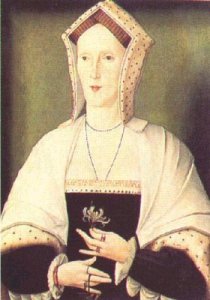
Pick any historically prominent woman and chances are you’ll encounter some version of this charge. Take for instance, one of the women I’ve researched: Margaret Pole. Daughter to George, the Duke of Clarence, Margaret survived the upheavals attendant upon her father’s suspicious death in the Tower as well as Henry VII’s rise to power. (Her brother Edward, wasn’t so lucky: held in custody by both Richard III and Henry Tudor, he accused of plotting an escape, attainted and executed in his turn for treason in 1499.

Margaret Pole Margaret was married off to a loyal follower of the Tudors. When her husband died, she and her children fell on hard times until Henry VIII’s coronation. Her young relative showered Margaret with honours: a title, lands and wealth became hers as the new countess of Salisbury. When Margaret and her family sided with Catherine of Aragon and the traditional church in Henry’s break with Rome, the writing was on the wall.

In 1538, Henry’s ministers focused on Pole’s family and circle as traitors supporting a foreign-supported invasion of England. Some of Margaret’s sons cracked under torture: confessing their complicity in a plot that brought in other noble families as well as their brother, Cardinal Reginald Pole. Margaret resisted all accusations of treason in a grueling series of interrogations, as her weary examiners explained in a letter to Thomas Cromwell. “We have dealid with such a one as men have not dealid with to fore us, Wee may call hyr rather a strong and custaunt man than a woman.”1 It didn’t help. Thomas Cromwell trumped up charges against Margaret that led to her attainder and eventual execution.

Sounds all too familiar, doesn’t it? What other historical women do you know have been accused of being too much like a man?

Notes:

  1. William Fitzwilliam, earl of Southampton and Thomas, bishop of Ely to Cromwell, 16 November, 1538, Letters and Papers XIII (2), no. 855.

2 Comments

Filed under history, pop culture

The Joy of Reading

Fresh off of another writing jag, I set another monograph down on the end table. It’s a good read and I’m reluctant to put it down, but there was dinner to be made and family to enjoy.

I have a lot of books on the go. There are five inter-library loan books, four other academic books borrowed from the university library, two academic ebooks I’ve been reading on the library website, four paperbacks I picked up at the used bookstore the other weekend and still about a half dozen waiting to be read on my Kindle. I have a university office that’s got three walls filled with shelves and those shelves filled with books. And, yes, I’ve read pretty much all of them except for a few newcomers and a few gifted books I’ve yet to read. In my bedroom closet, three further stacks of histories of medieval aristocracy and Byzantium patiently wait for me to finish with one pop culture and history chapter so I can start on the other chapter and read them.

I wonder, sometimes, how much my students read, even before it comes to textbooks and term time. Do they love reading? You’d think that history majors ought to be voracious readers because even if they don’t rely on printed sources, that’s still how we roll when it comes to the professional literature. But I wonder. Some of them are clearly readers: they respond eagerly when I mention a classic text they’ve read or allude to a piece of popular fiction that relates to our class topic. They pull their nose out of a book when it’s time for class to begin and dive back in when they’re out in the hallway. Others never drop a clue about their reading habits: they don’t carry books with them but, even more disturbing, they don’t want to discuss the readings, even on the most elementary of levels.

I eye the schedule for my classes with a chary eye. Surely seniors in a seminar won’t be gobsmacked when the weekly readings occasionally run up to eighty pages (small, Penguin Classics paperback pages at that)? A chapter a week in the freshman Western Civ survey isn’t too onerous, especially given how lucidly the textbook’s written and with the wealth of illustrations to liven the tedium any might find in the text. I prepare discussion questions to start off every class period that include “hooks” from the assigned readings, so students will see the connection between our time in class and their reading tasks outside of the eighty minute time block. It may not inspire a love of reading (I wish I could work that kind of miracle), but at least I hope it will make the reading relevant.

Now, if you’ll excuse me, I have a novel to finish reading!

Comments Off on The Joy of Reading

Filed under academe, personal

The Professor’s Wardrobe Unlock’d

As term approaches, I become serious about getting ready for teaching. I tweak my syllabi (four for this fall plus another reading course I’m going to have to map out with my new graduate student). I make a last stab at getting as much research and writing done as possible. I set aside a day to catch up on all the filing. Last but not least, I tackle the weighty concerns of wardrobe.

I’m not a fashionista. Not in any way, shape or form! (My colleagues who might be reading this blog will be nodding in heartfelt agreement at that characterization.) No, my interest in my wardrobe comes from the simple concern of not being the figure of fun I occasionally encountered in high school and university. You know the situation: if this is Tuesday, Professor X must be wearing green. If this is Thursday, we see the grey suit! (And we all know that if this is seen as charmingly eccentric on the part of a male professor, it’s seen as profoundly weird and incompetent on the part of a female academic.)

To this end, I pay attention to my clothing so that I rotate and refresh the wardrobe in such a way as to not become utterly predictable. Or so I hope. Every teaching day, I keep note of what I wore so that I’m not too closely repeating the same outfit when I’m back in the same class. Having a dozen different jackets means never having to say “I’m boring!”

Summer means culling the wardrobe of clothes that needs must be retired. Farewell, beloved boiled wool jacket, wearing out at the elbows. Au revoir, jeans with a nascent rip at the knee. Auf wiedersehen, black and white printed skirt that I never should have bought in the first place!

Summer is also a time for clothing repair and maintenance. I need to take my favourite pair of black winter boots to a shoe repair kiosk in town and get the leaky seams repaired. (This is not so much because I am cheap as because the boots fit remarkably well and have a helpful non-skid sole that’s saved my bacon more than once in winter.) I have a button to replace on a jacket, another on a pair of pants.

Summer also means shopping for new clothes. Since May, I’ve scored five tees, one pair of sandals, a pair of khakis, two skirts, two pairs of yoga pants and a funky print jacket. I have not found the right pair of replacement jeans, yet. My favourite store for dress pants is turning up nothing that fits. I’ve failed utterly in my attempt to find comfortable navy dress shoes. (I may have to retire that lovely pair of navy dress pants for want of suitable footwear. This is galling.)

It certainly doesn’t take as much brainpower as it does to wrangle a syllabus or design a new assignment, but it’s one more bit of preparation I don’t dare neglect. I can’t be the only one. How do you handle the back-to-school wardrobe situation?

6 Comments

Filed under personal

“Die and be damned”

In the fall of 1742, William Bird was tried for two murders although six women died on his watch one hellish July night. Bird’s trials provide an interesting insight into the lives of marginal women and the slightly less marginal men who assisted in the catch-as-catch-can aspects of justice as it was practiced in eighteenth century London.

As watchhouse keeper of the St Martin’s Round-House, Bird customarily acted as constable, receiving and housing prisoners who would later be examined by a magistrate but he lacked the official standing. Still, Bird and his wife appeared quite settled in their managing of the roundhouse and its transient occupants. Those who could pay were kept in comfort, even to the extent of hiring a bed. Others were less comfortably kept. Poor women might languish in a section of the building known as “The Hole” described in the testimony of one Robert Churchman, a carpenter:

. . . you go up four Stone Steps into the Round-House, and this Place is below these Steps: The Height of it is six Foot two Inches; the Length and Breadth six Foot six, by six Foot two; the Window is two Foot six, by one Foot six; there are some Iron Bars, but no Glass, there is a Shurter which puts up with three Slits, about a Quarter of an Inch wide, and about 18 Inches long 1

Between eleven o’clock and four a.m. over the night of the 16th of July, 1742, upwards of twenty women were crammed into “The Hole” which others at the Round-House attested, normally accommodated eight or nine. The unprecedented number was the work of Thomas de Veil, Court Justice (who set up shop on Bow Street and was the immediate predecessor of Sir Henry Fielding) who had ordered a round-up of vagrants in Westminster on the night of the 15th.2 Whatever the cause, the Hole was simply inadequate to house this many, as the testimony of Robert Bushel, the Beadle, made clear:

Q. Do you know how many People were put into the Hole that Night?

Bushel. I believe there was about twenty People in all?

Q. Do you remember three Women being put down into the Hole?

Bushel. I was ordered to put three Women into the Hole by the Prisoner at the Bar, it was about five o’Clock in the Morning, before the Constable went away. I opened the Door of the Hole, and saw the Hole was so full that I did not think it reasonable to put any more in: – There is no Lock to it, only two Bolts.

Q. What Condition were the People in then?

Bushel. They seemed to be pretty much crowded, but did not cry out: said I to Mr. Bird, if you put them in you will stifle them; but if you bolt the upper Door, and open the Door of the Hole, there will be room enough for them: Mr Bird ran down pretty hastily, and put them in; and when he came up again, he said, Bushel, I have put them in in a Minute, though you would not put them in.

Q. Did you think there was any Danger in doing it?

Bushel. I did it out of Compassion to these poor Creatures.3

In the two trials, Bird emerges as a legally savvy character who is well aware of the ins and outs of the court. In the first trial, he speaks familiarly of all the King’s Councillors, for instance, accounting their whereabouts and availability. He’s able wrangle consideration for his wife to attend the trial without any hindrance, for instance, and counters some of those who bring evidence (who he’s also requested be brought in one by one).

Bird’s darker side emerges with the testimony of several around him in the second trial:

Q. What is the general Character of the Prisoner?

Colclough. When he is sober, he is very civil to the Prisoners; but when he is in Liquor, he will swear, and curse, and rattle; when he is out of Liquor, he is very easy. – He is reckoned unkind with respect to beating them, damning them, and the like.4

In the first trial, one of the woman made the case all the more clearly about Bird’s uncaring attitude. Sarah Bland was the cousin of the murder victim mentioned in the first trial, Mary Maurice. When they were brought to the Round-House, Bird sent Bland to the Hole and Mary, who it was implied might have enjoyed the liberty of the main floor, at least for a while, asked to go with her cousin. Neither woman could have had an idea of the ordeal they were about to endure:

Bland. I begged for a little Air, and in order to get some, I told Mr Bird there was a Woman in Labour, and that some were in Fits, and that there were two a dying.

Q. What did he say to that?

Bland. He said they might die and be damned.

Bird. What Hour was that?

Bland. I believe it was not five o’Clock in the Morning.5

Bird’s callous comment was repeated several times over in the two trials. His further cruelty of closing the shutter on The Hole that reduced the airflow further, and refused the women water (claiming they only sought gin and if allowed that, would be insensate when brought before the magistrate) all seemed consistent testimony to a character totally divorced from the people in his care.

But was that enough to cast him as a murderer? In the first trial, no. The King’s Council’s careful explanation of what counted as murder might have been tailor-made to get Bird off: the jury returned a special verdict, saying that since Mary Maurice had requested to go down with her cousin Sarah, that Bird could not be charged with forcibly confining her there. So while he satisfied the other criteria laid out by the King’s Council at the trial’s outset, he failed on this count and the jury could not find him guilty.

In the second trial, for the murder of Phillis Wells, Bird was found guilty because he had been the one to commit her to the Hole where conditions were hellish because of his decisions as one Sarah Stark testified:

And we asked him for Water and Air, and he told us we should neither have Air nor Water. – I am positively sure of it. – I am sure he was the Man that made Answer so several times. There was one Shilling offered for a Pint of Water; we raised among ourselves four Shillings for a Gallon; he said we should not have any; there was one Woman he gave a Blow on her Head. – He struck her because she wanted to get up Stairs to have a drop of Wine or something to comfort her. – He said we should all suffer for her, and might die and be damned. – I cried out Fire and Murder. – Bird shut the Window the last Time. – He said twice that we might die and be damned, and we should stay till let out by the High-Constable; and the last Time he came down he struck a Woman, gave her a Kick, and pushed her away from him.6

To the end, Bird did his best to dispute the characterization most of the witnesses painted against him, especially the testimony about his response to the women’s piteous request for water. Again, from the second trial:

Bird. Did you hear any Expression ’tis said I made use of, of Die and be damned?

Malpas. I did not hear any such Words.

Bird. If I did, it was an inadvertent Expression of my Tongue, and did not come from my Heart.7

In the end, however, neither verdict was enough to see William Bird hang for the women’s deaths. His sentence was commuted to transportation for life in January of 1743.8 Was it because the jury found Bird sympathetic or was it something more convoluted? As Tim Hitchcock has pointed out in his article, “‘You bitches …die and be damned’: Gender, Authority and the Mob in St Martin’s Round-House Disaster of 1742”, Bird seems to have been set up to take the fall for this disaster.9

Thomas De Veil, the Trading Justice, appears to have been stricken with fear that the public outrage and legal blame would rest with him. Painting Bird as the callous, incompetent gaoler (not a difficult task, given the abundant evidence of his drunken cruelty) who had let these women suffer horribly would satisfy the public and any politically-minded folk who had an eye on the justice. One clear verdict was enough to satisfy the public. One commuted sentence might have been enough to ease de Veil’s conscience if it was ever involved in the process.

Notes:

  1. Old Bailey Proceedings Online (www.oldbaileyonline.org, version 6.0, 17 August 2011), September 1742, trial of William Bird (t17420909-37).

  2. Tim Hitchcock, Sharon Howard and Robert Shoemaker, “Vagrancy”, London Lives, 1690-1800 (www.londonlives.org, 17 August 2011). Also see Nicholas Rogers’ “Policing the Poor in Eighteenth-Century London: The Vagrancy Laws and Their Administration” Histoire sociale – Social History XXIV, 47 (May, 1991), 127-147. For more on Thomas de Veil, read Philip Sugden, ‘Veil, Sir Thomas de (1684–1746)’ Oxford Dictionary of National Biography (Oxford: Oxford University Press, 2004), http://www.oxforddnb.com/view/article/101038735.

  3. OBP September 1742, trial of William Bird (t17420909-37).

  4. Old Bailey Proceedings Online (www.oldbaileyonline.org, version 6.0, 17 August 2011), October 1742, trial of William Bird (t17421013-19).

  5. OBP September 1742, trial of William Bird (t17420909-37).

  6. OBP October 1742, trial of William Bird (t17421013-19).

  7. OBP October 1742, trial of William Bird (t17421013-19).

  8. Old Bailey Proceedings Online (www.oldbaileyonline.org, version 6.0, 17 August 2011), January 1743 (s17430114-1).

  9. Tim Hitchcock, “‘You bitches …die and be damned’: Gender, Authority and the Mob in St Martin’s Round-House Disaster of 1742”, Tim Hitchcock and Heather Shore, eds., The Streets of London: From the Great Fire to the Great Stink (London: Rivers Oram, 2003), 69-81.

Comments Off on “Die and be damned”

Filed under history

Building in Breathing Room

It’s been a crazy week and a half since the end of my vacation (which was supposed to end two days earlier but tell the weather system that shut down a whackload of flights out of JFK and pelted the rental car we eventually opted for with hailstones the size of walnuts). Every time I think I have a handle on matters? Life intervenes.

One kid’s gotten sick. One dog’s gotten sick. There was a student crisis to address. Those are just the tip of an iceberg that’s had me waking up in the middle of the night more often than not as well as running from pillar to post in our city of far-flung destinations. Colour me exhausted: a situation that’s rather scary considering the start of term is still three weeks off!

At the office, today, I chatted with a colleague about our summers and I was struck by his wisdom. With a busy family life, they’d not only opted to not travel (a choice that sounds delicious to me in retrospect) but they’d also taken a long hard look at a big home renovation issue they’d thought to tackle and said “Not right now.”

You’ve got to build in breathing room for those inevitable moments when life tackles you at the knees and brings you face-first to the ground. (By the way, the dirt tastes awful: it’s been a dry summer hereabouts.) I’m taking a look at my schedule and seeing what I can weed back out of it which isn’t much, but still: every little bit helps. Not just for the last few weeks of summer, leading up to term, but through the fall and winter, I’m going to remember to build in and protect some of that breathing room in my schedule.

I’m still keeping up with my Write Early, Write Often program and am happy to say that I got another four thousand words done on two projects over the last four days. I have two editorial projects to plow through by the end of the week. These need to be done now but does everything else? Not so much!

I’m not going to kill myself to get those course outlines finished this week when two weeks from today will do just fine. Breathing room: it’s important and worth protecting!

Comments Off on Building in Breathing Room

Filed under academe, personal

Teaching with Monographs

In my fall semester survey on early modern Britain, I’m mixing things up by teaching from just a textbook (Bucholz and Key’s 2nd edition of Early Modern England) and a monograph: Barbara Donagan’s War in England 1642-1649. The book is fabulously well-written, wide-ranging in its treatment of the experience of war in the era and just plain fun. It’s also quite reasonably priced in paperback! (We also have an electronic copy in the library collection so no student can use the excuse, “My student loan money isn’t in so I can’t buy the book!”)

It’s also an ambitious book to hand to many students who aren’t history majors or are only in the second year of their program, but I wanted to get back to teaching some secondary literature before the senior level. (Like many other premodernists, I spent a lot of classroom time working on the challenge of close reading primary sources.) This book appeared to me a good opportunity to do so.

However, now it’s August and I’m wrestling with my course plans for the fall. I have a term to get them up and running on major themes and events in early modern British history. I’ll try to achieve some of that by hammering home the need to do their textbook readings with pre-selected and circulated discussion questions on the textbook opening every single class session.

To build to the challenge of tackling the monograph, I need to get students working with another secondary source in the first half of the term. I think I’ll probably give them a short list of journals they can run through and choose one article relevant to our course to read and demonstrate some simple analytic ability. I’m planning an assignment that would require them to identify the article’s argument, key examples or evidence, and then relate it back to our textbook to see how the two treatments differ in any way.

With that achievement under their belt, we can begin reading the monograph. The course outline will include a reading schedule so that students know by what dates they ought to have read what parts of the book. I’ll also start leavening in some discussion questions that tackle the monograph’s early themes (such as the justification of war, military education and the concept of a citizen-soldier).

Then I need to craft the assignment scheme for the monograph. I’m leaning toward having students sign up for one chapter and carrying out either a compare/contrast analysis with one other work of scholarship on the same topic or use that as the basis for a more conventional research assignment. (You can see that my heart isn’t in the latter. I’m tired of reading badly plagiarized or clueless essays on randomly tweaked topics.)

One of my problems is that students at this level still have great difficulty in identifying appropriate scholarly sources. They tend to turn to the web first. To be honest, Google’s top five results probably provides the largest number of research sources for many student essays. A few of the more enterprising go with something from the top five results from Google Books. Another chunk just pick up something random from JSTOR or Historical Abstracts (failing, despite directions, to check off the box labelled “Peer-Reviewed”). So part of the challenge is to get them to identify a good scholarly source before we even get back to the analytic assignment!

Perhaps if I have them crowd-critique their choice of compare/contrast sources (which could be an article from a list of acceptable journals, a scholarly monograph or chapter in a scholarly collection) by requiring them to post their choices to the class’s discussion list by X date before the assignment is due (and comment on at least two other of the selections). Providing them with a clear list of criteria as to what constitutes an acceptable scholarly source will also be part of the solution.

The final capstone might be to have presentations of their work, either as files to the class website or in-class presentations. The latter would be preferable but given that I already have over fifty students signed up for the course, that’d take more than a week of class time to accomplish. Hmm. . . .

Finally, if I advise students that I’ll reuse the discussion questions for the exam, they also would have incentive to keep up with preparing for those. So I won’t have to pick up and mark discussion question responses (they can just work from their notes or what-have-you) which would be a daunting addition to the marking scheme.

I might have a plan here, but any suggestions you can provide for how to best teach from secondary sources like a monograph would be greatly appreciated. I have a few more weeks before this all has to be “nailed down” but I want the course plans done and out of the way as soon as possible, so I can keep up with my other writing and editing obligations.

4 Comments

Filed under teaching

Three Cleopatras

Age cannot wither her, nor custom stale
Her infinite variety. Other women cloy
The appetites they feed, but she makes me hungry
Where most she satisfies. – Antony and Cleopatra, Act 2, Scene 2

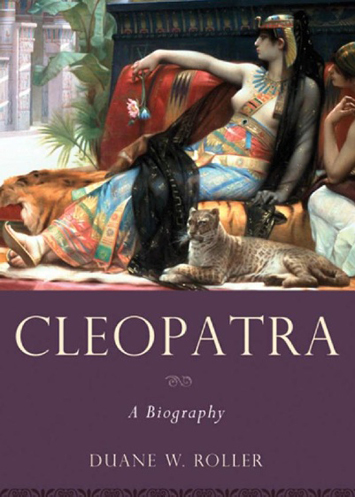
Roller's Cleopatra biography I’m working my way through three recent biographies of Cleopatra, the last Ptolemaic ruler of Egypt. As a specialist in early modern history, I’m struggling to get past my reliance on superficial readings I’d done long ago or the considerable cultural legacy she’s evoked. Yes, I know Shakespeare and Taylor’s version, but for this project, I need to leave that kind of distant imagining behind and try to approach her story more directly.

The first biography I snagged was Tyldesley’s from 2008. Cleopatra: Last Queen of Egypt is, not unexpectedly, very “Egypt-focused”. Coming from a scholar who’s published noteworthy books on Hatshepsut and Egyptian women, that was exactly what I hoped to discover. Tyldesley does a great job of putting Cleopatra’s rule into the perspective of Ptolemaic Egypt’s relatively open avenues for women to exercise economic and political power. She also does the best job of evoking the urban history of Alexandria, the great city that was her primary residence. This isn’t to say that the biography doesn’t also give a good sense of the Hellenistic dynasty of which the queen was a part. It’s simply that Tyldesley does the best job of highlighting the Egyptian as well as the Greek elements in her queenship.

The second biography I read was Stacey Schiff’s Cleopatra: A Life. Being as it’s marketed as a popular biography, I was a bit leery but Schiff has done a good job with her research in citing both classical and modern sources. Of course, she’s an accomplished biographer, so this was a flowing, easy read, full of dozens of pithy observations and commentaries from the author. That’s probably what struck me the most and not always for the best. As a historian, I remain just a bit suspect at her willingness to suggest motives for the various historical actors and come up with sweeping statements. But I have to admire her deft hand at taking the raw material (much of it out of Plutarch) and turning it into a compelling life story.

The last book, which I’m still halfway through, is Duane Roller’s Cleopatra: A Biography. Roller is a scholarly classicist and he uses his background in the Hellenistic period to paint a picture of a queen who’s part of this international, cutthroat politics. A few choices grate for anyone not steeped in the classics. For instance, his insistence on referring to Antonius instead of the more familiar modernization, Antony, will throw off some readers. (I know it’s classically correct, but so would be writing the work all in capital letters, with no spacing and so forth!) Despite my quibble, this thematically structured study of the queen is the most useful for my needs. It’s also, unmistakably, a work of a classicist who’s focused on the Hellenistic queen.

Am I done with Cleopatra? Not quite. I have a few other works on her life, reign and works still to consult for my project. But I’m amused that for all the sameness of key details, Shakespeare’s assertion about her infinite variety still holds true in the snapshot created by reading these three different studies. There’s as many Cleopatras, I suspect, as there are histories of her.

2 Comments

Filed under history, review

Histories of “bad” people

I often get asked how I can research historical personages who aren’t “nice people”. It began with my doctoral research focusing on such wonderful people as Henry VIII (he of the six wives and several executed advisers including Thomas More and Thomas Cromwell), Richard Morison (a rabidly self-promoting evangelical humanist) and other early sixteenth century figures who emerge from history, warts and all. Some of them are more appealing than others: I’ve argued that Jane Seymour gets a bump rap from modern culture that’s eager to embrace Anne Boleyn as the epitome of a liberated woman while condemning Jane as a mealy-mouthed lump. That said, I don’t think I would have liked to be a part of her court!

Let’s be honest: we spend a lot of time trying to get into the heads of our historical subjects. We attempt to read everything they wrote and everything written about them. If we’re able, we travel to places they knew well, visit their burial sites and try to catalogue their libraries and possessions.

There are days when I think I know some of my subjects better than my own relatives. I can tell you in great detail about Morison’s illegitimate children (and his provision for the same) as well as his marriage to Bridget Hussey. His widow’s subsequent two marriages and high-profile courtiership are some of the jumping-off points for my forthcoming book. She doesn’t seem to have been all that easy a person to love, either, mind you!

So, how can I spend so much time in the company of people I would never want to invite over for dinner let alone a Meeting of Minds? I suppose it’s the same way that we can sit, fascinated by the awful truths revealed on shows such as Celebrity Rehab or following the beach-bound crowd on Jersey Shore.

It can also be that there aren’t that many “nice people” to study. At least in terms of the surviving historical record, it’s more often the strivers and back-stabbers who make their mark. Even some saints strike me as people who were rather too focused on their faith to be comfortable company!

Truth be told, there may be an extra dollop of interesting to study a few of the “bad boys” and “bad women” of history. We’re eager to see if the reality of their lives measures up to the legend and how they came to terms with their actions. They track widely through the historic record and often leave a wealth of material to explore.

But the last thing that a good historian wants to do is to become so emotionally involved with the figures they’re studying that they lose perspective. I have few illusions about Henry and Richard, Jane and Bridget, but I still have a lot of questions to answer so it’s back to the sources I go!

10 Comments

Filed under history, writing/editing

Teaching to the Test

I’m pondering whether or not to run midterms in my freshman and sophomore level survey courses this fall (Western Civ and Early Modern Britain for topic areas). Tests seem easy to administer, giving a snapshot of student understanding and communication. But they can become a lot of work, even for the instructor. For instance, once classes reach a certain size, I’m certain to have students who’re injured, ill or bereaved on test dates, necessitating make-up tests. I’ve had eight or ten students needing to write make-ups during a particularly bad flu outbreak! That means writing new versions of the test and organizing the new test time. As my survey enrolments creep up toward the cap of 80, I’m pondering the pay-off.

In defense of midterms:

  1. They teach students how to take tests. Especially at the first year level, that’s a not inconsiderable skill. Learning how to write concise responses to short-answer questions, for instance, is a skill they’ll use over and over again, especially because. . . .
  2. We have mandatory “final instruments” which, for all intents and purposes in a larger class means a final exam. So if the students don’t learn how to write short identifications and practice extemporaneous essay answers before the final exam, how are they going to do well at the end of the term? I’m able to dispense with a final exam in my senior seminars where I require a portfolio of source analyses, peer review comments and other work they’ve crafted over a term, but I’m not sure how well I could do that in a lower level course with large numbers of students!
  3. Tests seem easier to grade than most equivalent assignments. I don’t feel it’s helpful to do more than highlight areas where the prose is so incomprehensible as to defy marking or scrawl “great!” beside a well-crafted argument. A four-page paper, say, even with a rubric that helps me to explain their outcome, still requires a lot of professorial response. Particularly with students in the early stages of their university career, you’ll often encounter essays that reveal problems in grammar, punctuation, expression, spelling, logic and organization. If you don’t help the student by at least identifying these problems at this stage, they’re not going to progress well at all!
  4. Midterms give students a good sense of how they’re progressing in otherwise essay-intensive classes. If you’re concentrating almost all of their marks in a big essay and final exam, how do you let students know how they’re progressing, otherwise. Sure, our university (and others, I assume), mandates that students receive feedback on one substantial assignment before the deadline to drop without a mark on the transcript. But if you just have a short essay early to cover that, maybe a proposal or annotated bibliography, a long essay and a final, that’s a lot piling up at the end of term for both students and instructors!

Against midterms:

  1. More trouble than they’re worth? Well, certainly more trouble than I like to think – from taking time in the classroom away from actually learning to the trouble associated with making up missed tests, one way or another.
  2. High anxiety: I know that tests induce a lot of anxiety in students and it’s difficult to design a test that will reveal their knowledge (requiring some sort of essay response) without evoking high anxiety. I circulate sample tests and finals from early on in the term. I provide review sheets (again, these take some effort to produce). I field many questions and queries about tests despite all of that, so I know testing weighs on them.
  3. What do tests really show? We don’t do multiple-choice tests in my department based on long-standing principle but the bigger the class, the more likely I am to retreat to simpler instruments of assessment: fill-in-the-blank questions for terms we’ve emphasized throughout the course, map identifications, short answers. They don’t demonstrate much about student learning beyond the regurgitation of certain facts and key points.

I will likely have one teaching assistant to help me out this year: an M.A. student who’s contracted for ten hours of work a week for the department (which means that I have to allot for the TA’s prep time and the chance that her or his labour might need to be shared a couple weeks out of the term). Grading schemes have to be made in the cold, hard calculation of labour availability.

So I put this out there in hopes that the wisdom of the community (the blogo-brain?) can help me figure out good strategies for these two courses. To midterm or not to midterm and, if I don’t, what’ll come next?

6 Comments

Filed under teaching