Preparing for the Unprepared

Fewer than a third of the thirty-five students enrolled in my senior seminar for the fall have taken what I’d consider to be the closest thing to a prerequisite. (We don’t actually ‘do’ prerequisites here in our department but I’m careful to offer courses in sequence so that students will have an opportunity to take a second or third-year course on a topic before enrolling in the seminar.) More of the students have taken another survey that might sound relevant as that particular class has been offered multiple times in the past three years but courses that begin after 1700 won’t give students much useful background for a class that wraps up circa 1600.

A bit over two-thirds are veterans of Western Civ but that’s not a big help. At best, if they were in class on the right days, they would have had about half an hour of class time that touched on our seminar’s subject of Tudor Britain. A little bit of class time and reading two or three years earlier hardly constitutes a sound basis to tackle the range of Tudor-era topics we’ll study over an entire term.

Knowing this, I’m paying careful attention to the background readings that I suggest. I’ll put two copies of the survey textbook (Newton & Key, 2e) on reserve in the library and point them to an array of other possibilities they can purchase if they so wish. However, given that I’m expecting them to read a hundred or more pages each week just for the class itself, I’m going to have to really push hard to get them to read even a couple of dozen more for background on a regular basis.

How do you encourage under-prepared students to catch up on the background? My first plan is to circulate the course outline and suggested background texts this week, along with the advice that if they haven’t taken the early modern British survey, they’ll really need to pay attention to the background readings.

I’m thinking of also preparing a one paragraph summary to post to the online discussion board each week. The post would highlight cool themes about that week’s background alongside links to a few amusing videos and intriguing primary sources. The thought is that this would be enough to ‘hook’ the students to read that little bit more which will help them to understand the assigned readings.

I’m wary, though. I don’t want to do a lot of extra preparation for this class if it will likely be wasted. I’m facing another very busy fall with three regular classes as well as two grad students to supervise and all of my writing to move along. So if anyone has a bright idea on how else I might get students lacking background courses up to speed, leave some advice in the comments, please!

Comments Off on Preparing for the Unprepared

Filed under teaching

Project Immersion

With just a few weeks left in the term I’m throwing myself wholeheartedly at another writing project that has to be wrapped up shortly, my own chapter for The Hobbit and History. To that end, I’ve pulled out my pile of books to which I’m referring, rifled through the articles I need to draw upon, reread The Hobbit and skimmed through the subsequent trilogy including the appendices as well as parts of the Silmarillion plus The Unfinished Tales. In other words, I’ve poured myself back into the world of Middle-earth.

Project immersion is the best way for me to get from skeleton outline to finished composition in a short time. I have to live and breathe the world I’m trying to recreate, whether its the story of 17th and early 18th century Londoners playing out at the Old Bailey or the adventures of people long ago in a galaxy far, far away. Along with that, I try to come to terms with the key scholarly themes – how can I ensure I’m relying on up-to-date and accurate assessments of what other practitioners are saying. This is just as important in my pop culture pieces where I will range wide and far in time and space, relying heavily on other historians to help me understand and assess many different cultures and scholarly treatments, as it is for my conventional academic writing where I need to engage with the most important and current interpretations.

As the immersion progresses, I start muttering to myself, hopefully sotto voce, testing out key themes or possible sub-headings. I drift off to sleep with important examples running through my brain. I wake up ruminating over key arguments. I peel potatoes and I ponder primary sources as yet untapped. I jot down a note about how to bridge two different sections in between errands.

And then? I write. The whole draft’s finished in just a few days but don’t be fooled. I couldn’t get my project done if it weren’t for the initial immersion.

What about you? How do you get revved up to write?

Comments Off on Project Immersion

Filed under writing/editing

The Galley Has Landed

Holding the galley for "Star Wars and History" It came today in the mail, my copy of the galley proof for Star Wars and History. And even though it’s still missing the colour inserts (oh, those’ll be gorgeous) and a few corrections we caught at the proof stage and the index and the back cover copy? It’s amazingly gorgeous!

I can’t wait for November!

6 Comments

Filed under history, pop culture, writing/editing

The Galleys are Coming

Just heard that the galleys for Star Wars and History are ready. Galleys are the perfect-bound pre-release versions of books (sometimes know as ARCs or Advanced Reader Copies). They’re pretty much the last step (besides finalizing the index and the jacket) as a book goes to press. Copies of the galleys go to publishers’ sales reps, reviewers and, in our case, other historians we’re hoping will write glowing blurbs to add to the jacket copy.

And I’ll be seeing a copy myself really soon which is a good thing to get me over the late summer hump with which I’m struggling. That’s nothing serious, just a combination of time-sucking tasks cluttering up my to-do list. Term starts in a month, eep!, and I’m so not ready but galleys? That’s energizing good news.

Comments Off on The Galleys are Coming

Filed under history, pop culture, writing/editing

I Love Course Planning

I have to confess, I love to prepare for my courses. It’s probably one of my favourite parts of working as a professor and, sadly, it’s a pleasure I’ve been denying myself for months as I focused on pressing issues of writing and editing.

Thursday, I finally broke down and opened up my word processor to get down to business. I’m starting with my senior seminar – I’m using three “new to teaching” monographs and one that I’ve taught with before (students will love/hate that book because it’s really engaging and opinionated but it’s also over 500 pages long). It was fun to pour out on paper the thoughts I’d been mulling over in my free time over the past few months: how many weeks for each subject area? What kinds of discussion questions to pose? Then I move onto the assignments and that opens up a new round of options. Will I be able to shoehorn in an essay proposal along with the essay itself? Do I ask for the essay in the second-to-last class meeting or at the very end of term?

A well-planned course is a thing of beauty. It clearly plays into the overall curriculum of the program, helping to build needed skills and guiding students clearly along their path to mastery. It lays out expectations for the overall class as well as each individual. It answers their questions about process and asks them questions about what they’ve learned.

A well-planned course is an awesome creation and even the best course can get better. That’s why, each year I toss my notes on what worked well and what didn’t into my course planning folder so that they’re right at hand when I’m back to teaching the course again. (Thank you, fabulous notes I left for myself in 2008 and 2011 to guide this fall’s revisions.) I eliminated some questions that weren’t really fruitful for my senior seminar and broke up another subtopic differently in light of how difficult it was to jump-start discussion the last go-round.

That’s the part I love about course-planning: playing with the possibilities of topics, readings, assignments and questions. A bit less fun, but just as engrossing? Tweaking the flow of the course over the meeting dates. It’s a lot of work to track exactly which days we meet in the term when the university’s calendar only shows start/end dates for the term along with holidays. (I’d kill for a calendar that included, you know, an actual calendar so I could see the dates each class is meeting instead of having to remember that if my class is a Wednesday-only class that we don’t meet the final Wednesday of term which is, instead, a make-up date for Thanksgiving Monday.)

I’ve put the planning aside again after this initial rough-in. Why? Because I know I’d spend too much valuable writing and editing time on the course planning work, tweaking and testing and twiddling some more. I don’t have to have the outlines ready for reproduction until very late in August so I will keep my hands off, as much as possible, in order to focus on the other work that needs to be done now.

But it’s soooo tempting. Ah well!

Please tell me I’m not the only one who likes some aspect of course-planning and, if you enjoy some part of it, what’s your favourite?

8 Comments

Filed under teaching

In Praise of Vacations

If absence makes the heart grow fonder, then leaving work behind for a few days, even a few weeks, can help you love your work again.

I’ve been on vacation since the first of the month and much of that has been a real vacation away with family in a tropical paradise where I avoided connections to the internet as much as possible in order to keep my mind off of work. Since coming home last week, I’ve picked up a few pieces of work – tweaking a text I’ll give my seminar students to work with in September, starting to read through the two, late M.A. essays for which I’m on the committee, doing the final bits of proofreading on Star Wars and History.

I’ve been a wee bit grudging about most of this because, dude!, I’m still on vacation!, but almost everything I touched involved extremely pressing deadlines so I couldn’t put them aside for the full two weeks I’d officially ‘be off’. I suppose that I could have avoided my email inbox for the full fourteen days but the consequences would have been much more stressful come Monday that I’d prefer not to do so. Instead, I’m slowly ramping back up to full-out work mode.

To be honest, I’m looking forward to a lot of what’s ahead for the rest of the summer. I love my job and the last few years I’ve pursued some fascinating new paths in my career. I’m eager to start working on my teaching prep for the fall as I want to tweak two of the courses with some fabulous new elements (I’m planning mini-Prezi walkthroughs of key skill-building exercises for my first year class, for instance). I have an article draft to polish some more and a research plan to flesh out as well as another chapter to write from scratch as I edit the dozen others in the volume.

The nice part is that I’m coming back to these other projects feeling fresh, well-rested and armed with some new ideas that came to me during the vacation break. So I’ll be ready to dive back in on Monday, or once I finish the proofreading and essay-commenting as well as squeezing one last bit of vacation fun with my family here at home, that is!

Comments Off on In Praise of Vacations

Filed under personal

Summertime, panic time

We’re officially into summer by both of my measures: the calendar and the girls’ high school schedule. Their last courses met today and while they both have exams early next week, that’s hardly anything. What stretches ahead of me, except for two weeks’ vacation I have clearly booked off, is two months of not enough time to get everything I need done before term starts up again in September. And I’m not even talking about the staggering list of things to do at home and with family (at least for the latter part, I’m talking mostly recreational pursuits including a long-awaited family vacation far, far away from here). No, it’s the professional deadlines that had me atwitter.

Tick-tock, tick-tock. Can you hear it? That’s the sound of deadlines looming!

When the girls were younger, the end of their school year was a painful moment, professionally speaking: even with a few weeks of summer camp and family visits, here or there, it’s a lot of time when they’re at loose ends and I’m still trying to work. Autistic youngest manages much better these days with a routine that includes regular trips to the local park and board games played with her family members.

Now that they’re both teens, summertime parenting is not nearly so stressful as it used to feel. I’m less an entertainment machine and chauffeur, particularly since Eldest got her driver’s license, and more the keeper of collective memories and deadlines. Thank goodness for my Google calendar with handy reminders that pop up not only on my netbook but also on my smart phone and the large-format Mom’s Family Calendar that hangs in the kitchen and provides us with a column for each family member’s schedule and even one for the pets.

Still, that doesn’t mean that I don’t acutely feel time slipping away. Don’t get me wrong, I know that I’m accomplishing loads, but there’s so much more that I’d like to do: get this article drafted more quickly, get my next chapter written, edit another chapter for that next collection, refine my next research plan, get my teaching all organized for the fall, start in on my keynote for the October conference, etc., etc., etc. Yikes!

But when the panic started to set in as it did yesterday, I stopped, breathed and refocused. What good is there in panic? How is that going to help me get things done?

I’ve been fortunate this summer to work with a fabulous career coach, Jo VanEvery who’s helped me to clarify my goals, my game plan and my ways of working so that I accomplish what’s important to me and avoid getting bogged down in details, guilt or fears. Thanks to her advice, I realize that my reaction to summertime isn’t helping me, professionally or personally. I need to turn off that nasty clock, pounding in the background of my mind, and reiterate what’s important to me, personally and professionally.

So I’m off to the park with Youngest – I’ll read a book for pleasure while she sees how high she can get the swing to go this time. There’s work to be done, but it won’t be any better for taking up all my waking hours (nor will I be better off for that). I’ll come back to it tomorrow.

Good luck to the rest of you facing down your summer and try not to let the panic take hold!

7 Comments

Filed under academe, personal

In the Details

As we’re heading down to the wire to wrap up Star Wars and History, we’re dealing with all the small snafus (“This image’s not high-resolution enough to reproduce properly – we need a high-quality version or replacement!”) and final bits of tweaking with captions and other elements before we even get to the proofs. It’s a surprising amount of work from our end and much more, I’m sure, from the publisher’s. We have spreadsheets tracking contributors, chapters, artwork and edits: almost more detail than I can track. Even then, I have nightmares that I’ve missed something vitally important.

However, it’s less those errors than might or might not be than the omissions that I know have been made that leave me almost sleepless at night. There are so many fabulous historical elements that could have been in the collection, even in my articles, but didn’t make the cut. Like young Victoria’s challenges facing the expectations of queenship, a story that I deleted earlier, there were many fascinating historical women whose stories could have been shared in my chapters on teen queens and women resistance leaders.

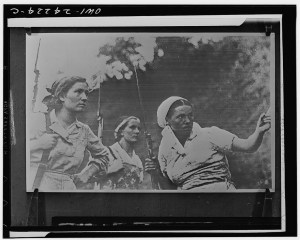
I’m attempting to avoid second-guessing my choices but it’s difficult. Just this week I stumbled upon this fabulous historical image and sent it to my co-author for the chapter on women resistance leaders whining that I wished we could’ve used it. She calmly pointed out that we’d had to draw the line on some historical examples and Soviet women in World War II had been one of the examples we’d cut in favour of the clear parallels with some of the French resistance leaders.

Which is wise and true but, oh!, not always easy to accept. Ah, well. I’m going to try. Tomorrow there will be more images to wrangle and more details to clarify. I’ll try not to fret over the details that have already been dealt with. Wish me luck!

Comments Off on In the Details

Filed under pop culture, writing/editing

Picture (Im)perfect

I’m working on a book that is going to be lavishly illustrated. That’s publisher-speak for having lots and lots of illustrations. Which is neat and nothing I have any experience of before because when I’ve written articles that’ve been illustrated, that’s been on the order of one or two images. Sure, I had to pay the Royal Collections for a photo to illustrate my chapter on the posthumous image of Queen Jane Seymour (as well as the right to reproduce that work in the modest print run it required) and I suggested the wonderful picture of an infant Prince Edward to illustrate my piece on Richard Morison. But it wasn’t until I worked on this book that I began to understand how much work and how much money can be sunk into illustrations.

First off, there’s licensing. If an image is in copyright, of course you’ll need to license it. With the various copyright extensions, this goes back a ways: in the U.S. copyright covers a wide swathe of twentieth century history. Some recent works are released under Creative Commons licensing and other strictures that obviate the need for sometimes costly licensing. But even much older works – a nineteenth century painting, a seventeenth century watercolour – might need to be licensed if the high quality image you need to provide your publisher is only available for a few from the museum, private collection or agent with whom you’ll have to treat.

Also, it’s important to note that those large and lovely pictures you stumble upon online are rarely suitable for use as an illustration. Web graphics are standardized at 72-75 dpi (dots per inch) while graphics for publishing need to be 300 dpi. Even a photograph that appears bigger than your laptop screen will rarely be up to the task of serving as a print illustration unless you’re happy with teeny-tiny pictures. You need a TIFF or other image file of really impressive quality: in which case, you pretty much need to turn to a handful of specialized websites.

If you go with some of the commercial outfits that mostly cater to textbook and major media outlets, you’ll see costs quickly running into the hundreds of dollars for one image for five to ten years. Are you publishing in one country or worldwide? Ebook as well as print? English only or are translations envisioned? All of those add to the tally!

Now, if you’re writing a textbook that will be superseded by the next edition in three to five years, that may not seem like a bad deal. When your publisher’s talking about having this on their backlist for years to come, that kind of economics gives you pause. Not every one of the commercial sources are quite so problematic. I’ve found that the Bridgeman Art Library is both more reasonable in pricing and rich in all sorts of sources a historian might want to employ.

Non-commercial image resources abound: I’ve had good experiences with the national libraries and archives of several countries. Many have contracted outside companies to manage their digital libraries but you can quickly arrange for reproductions that they’ll deliver by FTP. Most of these charge a very reasonable fee for their services: I’ve been paying on the order of $20 to $40 for such images and rights.

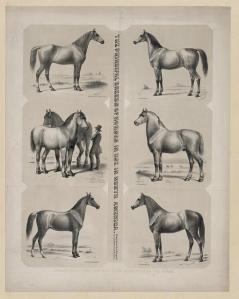
But free is fabulous and one of the best resources for free historical images has been the Library of Congress Prints and Photographs Catalog. A few times I’ve had to pay a modest amount for a HQ image that isn’t freely available online but they have a number of excellent images that are freely available in a publishing-friendly TIFF format. These are hardly just from American history: I’ve found Japanese and British images from the 19th century and earlier, both out of copyright and freely available for download and use from the Library’s collection. Let me tell you that I’ve felt pretty darned cunning at all the fabulous pictures I’ve discovered that will perfectly illustrate the historic elements we want to emphasize. Plus, others of the library’s free images are just plain fun such as this 1872 print of popular horse breeds!

Still, you should know that simply finding, licensing and serving up the illustrations isn’t the end of the story. Wherever you find your illustrations, make sure to scrupulously document the sources, credit information and terms of use so your publisher has all of that as they put the book together (which staggers me with all the work involved!). This isn’t so onerous when you’re using one or two illustrations but when you’re moving into the dozens or hundreds, it’s a daunting task. I’m fortunate to not be in this alone and I’ve sure learned a lot in helping to create a lavishly illustrated book but I’m not sorry that the next book is likely to ramp it down a few notches because image research and acquisition has been a major part of my working hours since the start of May. If we say that “A man who is his own lawyer has a fool for a client” a historian who is her own image researcher is sure to finish up as a tired and frazzled but hopefully satisfied scholar.

2 Comments

Filed under history, writing/editing

Summer Meme

Even though it feels like anything but with the last few days of grey and rainy, let’s welcome summer in with a meme borrowed from Sisyphus at Academic Cog”

1. What is your favorite part of summer?

Sleeping in – which only starts once the kids are out of school.

2. What’s your favorite quintessentially summer food? Least favorite?

Cold salads are my favourites whether they’re with potatoes, pasta, fruits or veggies galore. Oh, and gazpacho but it’s a chore to make myself. Worst food for the summer? Scorched stuff off of the barbecue. I like my food without blackened blisters on it!

3. Best beverage to beat the summer heat:

Frozen lemonade or, if that’s too solid. Lemonade.

4. Least favorite/most annoying thing related to summer?

Lawnmowers and long queues in the hot sun.

5. Pick one: the lake /the beach. Why?

Who needs to pick? We have a couple of beaches on the lakes hereabouts. To get to an ocean beach would be a huge effort so that makes me appreciate the lakeshore all the more, though one we’ll visit an ocean beach this summer.

6. Most amusing summer vacation trip you’ve ever taken?

I took the train one summer to visit my sister who was in grad school. I did the train “old school” with dainty heels, an oxford-cloth dress and a hat, of course. So much fun!

7. Most ridiculous/cringe-inducing/blush-provoking summer outfit you have seen? (Bonus points if you yourself were wearing it!)

It was the late 70s – I had a white, terry-cloth romper with a diagonal rainbow stripe across the bodice. *shudders*

8. Your absolute dream summer afternoon would be:

A quiet, bug-free seat on our shady back porch where I could read something for the sheer pleasure of it. Maybe next month!

2 Comments

Filed under personal