Day Tripper

Friday morning I awoke well before dawn. I had a scholarship board meeting in Toronto which is a four hour drive south (if you’re lucky and an accident hasn’t closed the two-lane section of the only road, necessitating a four-hour detour). Fortunately, there’s an alternative: flying. If you leave at a godawful hour, you can make the drive from our house to the airport in 20 minutes (half the time it takes during the busy times of day). And my flight took me in and out of the Toronto Island airport, a few minutes ferry and shuttle from Union Station. What’s not to like about that (extra bonus points for not flying into Toronto’s main airport with Air Canada which was shut down by a wildcat strike Friday morning.

So I flew down and back for the day, just as I’d done for our November meeting. Day Tripper, yeah! This time, all I took was my purse which is large enough to accommodate my netbook where I’d downloaded all the documents I’d need for the meeting and my ereader to pass the time. For take-off and landing I brought along a plain old paper notebook and managed to draft out about 800 words on a new writing project by putting pen to paper.

I have to admit that I loved being able to breeze through security or take an easy walk over to Yonge Street to window-shop once all of our business was wrapped up. No briefcase, backpack or other bag. What a great way to travel!


The Beatles – Day Tripper
3 Comments

Filed under academe, pop culture

The Siege of Washington

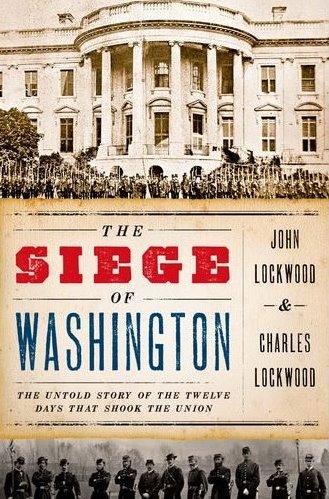
Cover of The Siege of Washington Even though I’ve been buried so deeply in work that I can barely breathe, I stole some free hours to read this book. Correction: nearly devour. Even though the authors employ an annoying strategy of drawing out the slow, chronological progress (so that hours sometime read as if they were days and the actual days of story’s timeline read even longer), The Siege of Washington remains a good history, superbly grounded in both historical research and engaging narrative.

I’m not that much of an American Civil War buff. Most American history leaves me yawning: likely a result of over-exposure in my childhood and youth. But this narrowly defined topic was entirely new to me: the history of Washington’s perilous experience between the fall of Fort Sumter and the arrival of volunteer troops sufficient to defend the capital, all within a few days in April, 1861. The authors, John and Charles Lockwood, paint a picture of the divided city and its people at Lincoln’s inauguration. The juxtaposition of disgruntled supporters of the Confederacy with eager suppliants to the new Lincoln White House makes for an interesting backdrop. This crisis creeps up almost unseen on a city in the midst of transition from one presidency to another, given the wealth of patronage appointments.

The Lockwoods do a good job of setting 1861 Washington into a broader context of regional politics and economics. I’ll never look at Baltimore the same way after reading about its “Mob City” moniker and the ways in which its citizens reacted to the passage through of Union volunteer troops. The first battle may have come some months later, but the first deaths of the war occurred right there with troops attacked by townspeople.

The book is overflowing with delicious anecdotes, from the surly troops in the Capitol who were bayoneting Jeff Davis’s desk (until chided for destroying government property) to the story of Clara Barton’s life as a government clerk before she founded the Red Cross when she saw the need in the injured volunteers from her home state of Massachusetts. The newspaper reports and eyewitness accounts give the history a lively sense of urgency and depth.

The only annoying part of The Siege of Washington was the authors’ conceit that Washington would possibly, maybe, oh-wait-and-keep-reading! fall. I knew enough of the history to know that was a non-starter and I expect almost every reader will be similarly unsurprised. That said, their final chapter, tackling the variety of “what ifs” and “if only”s put forward by contemporaries at the time or soon after makes for fascinating historical reading. To see how people of the time recognized this as a key moment in their history was a clincher for me and something I expect others would equally enjoy.

2 Comments

Filed under history, review

My Love Letter to a Press

Oh, University of Chicago Press, let me count the ways in which I love thee. . . . Ah, scratch the pseudo-archaism. I love this press for many reasons but the one I’m blogging about today is their embrace of the digital. UCPress rocks the ebook world and other presses should be following suit. Here are three key reasons why they’re awesome. You might even say that I’ve gone ‘ape’ for their ebook policies. Maybe you’d be right!

  1. Availability: The press isn’t only making new releases available in electronic format, it’s tackling some of its backlist. I’ve been able to grab a number of books that were useful to me and choose from all the major electronic formats, including a short-term rental option. You can even browse their ebook listing separately from their regular catalogue with just a click of a radio button (upper left part of the History Catalogue web page.
  2. Pricing: You can rent most any digital title from the University of Chicago Press for only $7USD. You can purchase a lot of fabulous titles even more cheaply. Germano’s Getting It Published (2e) only set me back $5.13 via Amazon. Booth, Colomb & Williams The Craft of Research (3e) runs even less. And every month? They offer a new ebook for free.
  3. Essentials: Chief among the Press’s electronic offerings are a number of key reference titles, especially those aimed at students and junior scholars. Booth et al., Becker’s Writing for Social Scientists, Lipson’s Cite Right (2e) and other reference works abound on their ebook list. When you’re comfortable with annotating and searching digital texts, going digital isn’t only cheaper, it can be much more efficient!

Of course, while the University of Chicago Press has won my admiration, I’m not ready to be monogamous. I’m happily enjoying ebooks from other academic presses: Oxford University Press recently had a great deal on the Lockwoods’ The Siege of Washington so I know they’re reaching out to the ebook readers. Sad to say, though, they don’t seem to be nearly so digitally-savvy as Chicago, at least not yet – there’s no easy way to find their ebook catalogue nor do they seem to have a sustained digital pricing policy.

What press is your favourite these days and why?

3 Comments

Filed under tech

Old Books: Old Friends, False Friends?

I’ve been re-reading Jocelin of Brakelond’s Chronicle of the Abbey of Bury St. Edmunds (also available in an out-of-copyright edition at the Internet Medieval Sourcebook), preparatory to leading my seminar students in a discussion of the work. This will be the fourth time I’ve read the book (twice in the last four months, alone).

Every time I re-read a book, I discover new elements or rediscover new aspects to deepen my understanding. Some are wonderful tidbits to crow over and collect for my mental memory-book. Others are realizations to ponder. It’s not so far-fetched to say that old books are old friends but sometimes they’re not all that familiar.

Much as I love the humble and human level of story-telling in Jocelin’s account of his Abbey’s high-flying leader, Samson, and the community’s role in the Angevin world, it’s not entirely an easy read. Bringing the book to my senior seminar the other week, I asked them to unravel some of anti-Semitism in the chronicle. My last review before teaching had made that element stand out all the more to me. I elucidated the context of stories such as “Little Sir Hugh” for them so they understood how some of the references you could easily gloss over in Jocelin were part of the virulent and hateful attitude. They agreed with me that it was a disturbing reality check in their otherwise comfortable chronicle reading.

Thinking all of this through makes my smile dim as I put Jocelin back on the bookshelf beside my desk. I still admire the book but I don’t know how much I can enjoy it even if I enjoy teaching it all the more for using the Chronicle as a way to approach such an important subject. It’s a useful book but I’m struck, anew, by how the past is not a place I’d have wanted to inhabit more than my own time.

Have you ever had to negotiate this same unsettling realization in your reading or teaching?

Extra bonus: Steeleye Span performing “Little Sir Hugh”

2 Comments

Filed under history

Seeking Historian of Science

My department is seeking a historian of science (or an extremely capable scholar of western intellectual history) to administer a distance education course this summer (May-July) and next fall/winter (September-April) in the history of science that surveys the field from antiquity through the twentieth century.

HIST 3905 History of Science (A study of the rise of science in relation to the development of Western society) has been prepared with an excellent, comprehensive course manual that students will read along with the assigned textbooks: Ede, A. and Cormack, L. B., A History of Science in Society: From Philosophy to Utility (2004), Larson, E. J., Evolution: The Remarkable History of a Scientific Theory (2006). The course structure has been set but it will still require someone who’s familiar with the field to administer successfully and to assess student assignments.

HIST 3905 is offered via our Envision program and is conducted online.

Interested applicants should send to the Department Chair, Dr. Sara Burke, a letter of application, a current curriculum vitae, a current teaching dossier and any relevant supporting documentation.

Department of History
Laurentian University
935 Ramsey Lake Road
Sudbury, Ontario
P3E 2C6

Consult the Laurentian University 2011-14 Collective Agreement (for rates of pay) and see the terms of the last posting here. The closing date is now 6 March, 2012.

Please circulate widely!

Comments Off on Seeking Historian of Science

Filed under history

With a Little Help from my (Writing Group) Friends

I finished up the emergency chapter draft on Sunday of last week, hooray! 5200 words in less than a week was one heck of a challenge. Now I’m editing after conferring with my co-author but I’m also moving onto the next projects.

A lot of this progress I credit to the support and accountability that comes from participating in an online writing group. This go-round’s being hosted by Dame Eleanor Hull who’s been fabulous about doling out advice as well as reminding us to keep on track.

For all that writing can be quite a solitary activity, it’s better when you have that support system to both keep you honest and give you some feedback, even if it’s not about your writing in particular so much as your progress. As a couple of other members in this writing group have commented, knowing that someone’s expecting to hear how you did, you push to squeeze in a bit more writing time. You make it a priority because you know that someone outside of yourself and your institutional colleagues will care about what you’re doing. You know that they will commiserate when you detail the week’s tragedies and cheer for the week’s triumphs.

Now, if you’ll pardon me, I’ve got some more writing to do!

2 Comments

Filed under writing/editing

The Most Frustrating Day of My Life

That would be today. You may call it Valentine’s Day. I’d call it the day that I attempted to get three bureaucratic entities to give me one piece of paper only to be stonewalled again and again.

Three and a half hours after starting out on the short errand, I finally had the correct material clutched in my tear-stained hands.

I should have been prepared because anything that involves the provincial government’s bureaucracy is particularly problematic. This was precisely what I experienced only multiplied because it involved a vague and confused phone rep at the insurance company and a blithely uncommunicative soul at a local business. I had websites, an office and people on the phone giving unclear and conflicting information that sent me here and there, then back here and then over there and, finally, finally, to tbe office where someone could take my money and actually provide me with the correct piece of paper.

*sigh*

Nothing should ever be this frustrating. Let’s just hope that I’ve hit my quota of Kafka-esque moments because the next two days hold the prospect for further breakdowns as I finish off today’s insurance task and then tackle an entirely different one on Thursday.

6 Comments

Filed under personal

Just a Marking Machine

The chapter draft is done. I’m pretty impressed with myself. It took less than a week to come up with a chapter of just over five thousand words, most of it dealing with historical parallels far afield of my early modern British ‘comfort zone’. Thankfully, my magpie ways of research and the speedy services of our inter-library loan system gave me lots of great material to work with for the subject.

Now I can pick up the pieces of my life, aka get back to marking. It’s amazing how quickly this backs up. I get a feeling that term-time marking is rather like “I Love Lucy” on a factory line. One bobble and instant disaster.


Poor Lucy! Only, hey, at least it’s candy, not papers!

Bring on the rubrics and polish up the red pen. Tomorrow I’m going to try and get through the backlog of tutorial responses. Once those are done, maybe I can whittle down the pile of quizzes that still have short essays to be assessed. I hate it when the turnaround is more than a week for small assignments such as these but that’s what happens when a writing project is suddenly thrust upon you!

Stay tuned for the week of the 20th when I hammer out a grant proposal.

2 Comments

Filed under academe, teaching

Writing Midterm

Not writing a midterm exam, but writing in the midst of a term. I have a new and urgent project to complete this week so it’s nose to the grindstone and all that. Three observations as an academic author:

  1. Though shalt not fiddle: to make this miracle occur I went to minimal mode with regards to my teaching. I have great preps from the last time I taught the Ancient Near East survey so I’m not revising any of the preps for next week’s classes. I’m also not going to get their quizzes back for Thursday, even though my TA’s helped with marking everything but the essay part. My seniors need their paper proposals back on Friday but other than that, marking waits for the end of the weekend.
  2. Though shalt not be distracted: During Thursday’s office hours, my door will be closed and a sign will invite visitors to please knock. Otherwise, I know I’ll be distracted by the noisy passage of hundreds up and down the busy hallway. I’m also not paying any attention to extraneous emails. If you’re not mission-critical, you’re waiting until Monday!
  3. Though shalt not blog (much!): Of course, the final, rueful truth: blogging will continue to languish. Hope you don’t hold it against me. I will return.

7 Comments

Filed under writing/editing

Tutorial Tuning

My tutorials need a tune-up! In my eighty-student Ancient Near East survey this term, I’m having a problem with the tutorials. The task is document analysis and I know they’re good documents – a variety of literary, political and legal sources. Many of them I’ve used before to good effect. But this year, the discussions are painful! (My TA even remarked on that today after class was over.)

They know that the tutorial wraps up with a question that they need for their response paper due the following week. I think that most of them are sitting there, content to wait until the question appears.

It’s not as if they won’t speak up in class. This is a course with a presentation component – every student prepares to help open one class topic. And when they present, the vast majority of the students do an awesome job, sharing a polished, thoughtful response that helps lead everyone into tackling the day’s topic. However, the challenge of tutorial discussion seems a bit more daunting than an in-class presentation. Strange, I know, but there you are.

I tried opening them up to the challenge in today’s tutorial by projecting some sections of our tutorial text (Hammurabi’s Code) on the overhead and asking for volunteers to read individual passages, then posing a question for them on that self-same passage. It felt like pulling teeth. I got a very few comments. I might have gotten more if I’d waited them out longer, but we only have twenty minutes for the exercise, so that won’t work so well. (And I’d love to devote more time to these but given that we usually spend twenty minute on presentations at the start of class and there are only forty minutes left in the class period, time starts to run out for the rest of our activities.)

I realized, this afternoon, that one obvious solution is to open the tutorial session with the assignment question, itself, and then giving them a few minutes to ponder or review before venturing their approaches. I could turn our tutorial periods into brainstorming sessions where I give them the question and then sit back, only intervening when they get too stuck on one track and don’t consider other approaches.

In our next tutorial, I’m going to open with the question projected on the board and ask for someone to suggest a possible response strategy. I’ll let you know how that goes in another few weeks.

2 Comments

Filed under teaching