What About Workspace?

Last year I got an ergonomic redesign of my university office. It didn’t go smoothly at first but after getting them to move the keyboard shelf to the orientation I’d originally requested and then moving the desk to the other side of my office, I made it work. I now have a pretty good modus operandi at the university, although I’d love to get rid of the filing cabinet that eats up too much floor space. (Sadly, there are many papers I have to keep, including an entire drawer full of exams and unclaimed course papers that must be retained for twelve months.)

What’s important for my workspace to feel, well, workable? Here’s a short list of my must-haves:

  • I have to SEE you: I can get really engrossed in my reading and writing. A quiet visitor stepping in, with my back turned toward them? Freaks me the heck out. Not to mention that some visitors will then proceed across the room to read the paper I’m marking or the text on my computer screen. So my desk has to face the door. It does increase the distraction level as my office is on a very busy hallway, but it’s a worthwhile pay-off to eliminate the paranoia.
  • I need a blank slate: For many years, I worked with piles of papers abounding. I cleared all of that out about six years ago and immediately wondered what had taken me so long. A clean desk invites possibilities. You can spread everything out to plan out a new project or you can leave it empty to limit distractions. Sadly, I haven’t been able to entirely banish piles of paper from my office, as I currently have over a metre high pile of outdated student exams and other confidential paperwork that need to be shredded. As the old shredder died in the flood of August 2010 and there’s no money in the department budget for the mandatory shredding, these have been piling up in my office for over a year, now. So not impressed
  • I love my toys: Well, yes, there is a Starbuck action figure hanging out in my office. But more than that, I find a few good tools help make the work environment better. Isn’t Levenger one of the best things ever? I have a bookstand from there which is a wonderful aid for note-taking and transcription. I also find my keyboard shelf and external keyboard great once I went through the hassle of getting them properly arranged.

What makes your workspace work for you? What are your dealbreakers?

Comments Off on What About Workspace?

Filed under academe, tech

Being a Pop Culture Historian

I got my hands on copies of Harry Potter and History (Amazon.com) just the other day. As you can see, I’m very pleased, not only because I have two chapters in the collection, but also because I have a whackload of new fun reading to zip through.

Professional Pride: In writing for a pop culture project, a scholar needs to do right by their field. You don’t spin stories out of nothing or rely on tertiary sources if you want to grab readers’ attention and paint a compelling picture of how the fictional world they know relates to history. So you dig for hooks (I used Virginia Woolf’s A Room of One’s Own to explain the roles and limits of British women in real world history for “Witches vs. Women: What Muggles Could Learn from Wizarding History”). You’ll also find quotes from primary sources as well as insights credited to dozens of historians whose books, chapters, articles and scholarly encyclopedia entries filling the end notes for my chapter. Many historians are also mentioned by name in the body of the text.

Fandom Lore: A pop culture historian also has to know the pop culture source. This doesn’t mean just popping in a DVD and watching the movie version: it means reading the texts (if they exist) and critically exploring the story world. I’m a self-confessed fan of many books and shows. I have been “into” fandom for a long time. When you sign on to write about a pop culture topic, you have to develop or refresh your knowledge of that source material. So, yes, I’ve read all of the Twilight books now (more than once) as well as all of Rowling’s Harry Potter books (including the ancillary Quidditch Through The Ages, Fantastic Beasts and the Tales of Beedle the Bard). I also had repeatedly watched every episode of Battlestar Galactica that had yet aired before “The Battle for History in Battlestar Galactica” went off to the editors of Space and Time: Essays on Visions of History in Science Fiction and Fantasy Television. (Yes, I know I’ve been “Jossed” but the final edits were done before the last half of season four aired.)

Respect for the Reader: Writing for a popular audience is often described as “dumbing down” a subject. I believe that it’s a true test of scholarly mettle to communicate clearly to a non-specialist. Someone who’s inspired to pick up your book, whether at the bookstore or online, and browse through it is giving you a chance to show them why they should care and what they can get from a little time spent reading on the subject. They may not have your specialist knowledge of history, but they may remember arcane details of the pop culture source in great detail. Why not use that knowledge for your own advantage and let the pop culture material lead readers to real historical learning that they’re likely to retain since it relates to another well-developed interest? You may also find that you learn something from the well-established fans, as well.

1 Comment

Filed under history, pop culture

The E-readers Excellency

A New Poste Wherin are divers Admirable Workes Wrought With Pixels. (and with acknowledgement to John Taylor’s Needles Excellency of 1631 as well as my esteemed blogger-friend, Historiann, who holds an opposing viewpoint on e-readers.)

E-readers, tablets, smartphones, e-books – the practice of reading is shifting in the electronic age. Not for the first time (consider how much the practice and use of journalism has changed in the past twenty years!) and not for the last. The book as we know it in the modern era (a bound volume of printed text) is apparently under threat as Amazon trumpets that its ebook sales have outstripped those of hard copies. Should we panic? Should we bar the barbarians from our fair citadel of Academe?

I say nay, partly out of principle, but partly out of the pragmatic realization that the barbarians (e-reader users) are well-ensconced in many parts of the citadel. We have met the enemy and he is us, to quote Walt Kelly. Well, to be honest, I’m your enemy if you’re opposed to e-readers and those who use them. But I don’t want to be anyone’s enemy: I simply want to share my perspective on the value of e-readers as a codex-loving scholar.

  • E-readers and Citations: Even historians can breathe easy as more e-books support pagination. The Kindle began to do so in February. The change is still rolling out so it isn’t universal, but I’m seeing more books with this when I look. If you have a Kindle book, you can see the ISBN of the print edition for which this holds. So it’s possible to provide a fully robust Chicago style citation for your e-reader texts although there is some talk about coming up with new models for e-book citations
  • E-readers and Costs: Yes, e-book prices aren’t consistent (either in ratio to print editions or within a genre). Some e-books are less expensive than either hardback or paperback versions (check out the prices for Jeanne de Jussie’s Short Chronicle which I’ll be teaching with in the fall$9.99 for the Kindle e-book, $25 for the paperback and $55 for the hardback). Other e-books are priced in-between the two (or just below a hardback version where no paperback exists). Still other e-books prices outstrip that of any new-in-print version. Sometimes the pricing is untenable (I’m interested in seeing the effect of Apple’s 30% price-grab on sales through apps. It’s already caused one e-book app, iFlow, to pull out of the Apple marketplace. academics are well-accustomed to dealing with whimsical and autocratic book-selling venues where pricing bears no reality to the costs of production or marketing: university bookstores! I’m not suggesting you buy e-books at any cost – I certainly don’t! But we can let publishers and distributors know what we’ll pay and what we won’t, both by our choices in the marketplace and our feedback to them as textbook adopters and frequent book-buyers. We all know what our personal price points are – time to let the business people in on the secret!
  • E-readers and Convenience: What sold me on my Kindle was the prospect of lugging around lots of books with a lot less weight and bulk. I spend a fair bit of time driving into the hinterlands of the north for family sports activities. While I’ve done some grading during the downtime, my preferred pastime is reading. With my e-reader, I bring a boatload of books with me everywhere and the prospect of more (3G connectivity has saved me more than once when I’ve run out of books to read while miles away from bookstores, work and home). I’m also accumulating e-reader versions of many teaching texts – not the big textbooks, mind you (their publishers seem to be lagging behind more conventional academic presses and trade publishers in making electronic versions widely available). I also download public domain ebooks from Project Gutenberg and other online archives. Lots of books, anytime, anywhere? It works for me. I can also convert documents that I have on hand into e-book format with
    Calibre – E-book conversion and management software. Literally, I have more to read on my Kindle than I have time to read. Just like my print bookshelves!

Yes, there are drawbacks and downsides to e-readers and e-books. Digital Rights Management (DRM) is a major concern – do we really own our books? When proprietary systems interfere with your purchases, break down or are simply no longer supported, the results can be catastrophic. But for many readers, this may not be the galvanizing issue it is for the bibliophiles of the world and when your e-books are backed up at your distributors (as my Kindle purchases are), this may be enough to comfort many. Even with DRM, e-books are opening up to lending, whether privately by individuals or publicly through libraries. An e-reader can even break down but is print perfect? Hardly! You may think that print books are immune, but you didn’t see the effects of last summer’s flood in our university building!

I don’t know any serious academic who’s saying “Away with print!” There might be a few who’re doing it for show. But most academics can see an e-reader as an adjunct to their print library, especially as we grow to rely more and more on digitized content. It’s not going to be a requirement any time soon, though. I’m not ready to write the codices’ obituary quite yet and neither should you.


Don’t worry. There will always be tech support!

Comments Off on The E-readers Excellency

Filed under academe, tech

Teaching from Obscure Sources

Cover of de Jussie This fall, my Western Civ students will be reading Jeanne de Jussie’s Short Chronicle for their research skills-building assignments and analytic essay. I chose this book for several reasons: it’s short, it’s a clear narrative account with an excellent introduction, the author has a clearly discernible viewpoint and the story involves religious, social, political and even military elements that can appeal to a variety of students. Most of all, though, I chose The Short Chronicle because it’s obscure.

In the age of Google, great teachable classics such as Machiavelli’s The Prince are simply fodder for essay mill retreads and Wikipedia cut-and-pasting. Twenty years ago, when I started teaching my own version of Western Civ, I used to give students free rein from a long list of possible topics and sources to use, hoping their own interests would drive the process of developing a great research question and an enlightening research journey. Nowadays, such an assignment is a sure invitation for a subset of essays copied pretty much wholesale the night before or, only slightly better!, written from a random assortment of websites that show up in the top ten returns from their search queries.

So it’s a joy to take a relatively unknown primary source that they won’t believe they “know” already and plan out ways that students can build their successful steps toward an analytic essay without being lulled into a false sense of security by the wealth of information they can tap about it on the web. Last year I taught with Galateo, asking students to read the work according to a set schedule, then following our in-class coverage of the era and a research workshop, analyze how any one chapter related to the historical values of the Renaissance. This fall, I’m going to stretch out the assignment with a few more defined steps: after the in-class discussion and research workshop, they’ll have to complete some research preparation assignments (practice source analysis techniques on shorter selections from the textbook, identify a topic relating to the book that they want to analyze, locate a book in our library collection relevant to that subject, locate an article from our library databases relevant to that subject and so on).

In interests of not overburdening either the students or myself, I’ll get rid of some other marked elements along the way. Certainly there will be only one essay, with a term’s worth of skill-building steps building up to it, instead of two essays as I’ve used in the past. I don’t want to give up the journals responding to daily questions in class (collected and marked for use three times during the term). Maybe I’ll get rid of the midterm? It’s a real hassle with all the make-ups I have to offer for students who’re ill or who experience family emergencies (always a few in a class of 80 or more).

3 Comments

Filed under teaching

Seeking Sessionals in Sudbury

Please spread the word

Of interest to ABDs and Ph.D.s in Canada or with Canadian residency/citizenship who can consider relocating for a term or two to Sudbury, Ontario for sessional work (that’s course-by-course pay to a maximum of 12 credits, no limited term appointments). My department is advertising the following courses for fall/winter 2011-2012 (September-December, January-April).

HIST 1406E – Canadian History: Pre-Confederation (Fall 3cr)
HIST 1407E – Canadian History: Post-Confederation (Winter 3cr)
HIST 2136E – A History of French Canada (Winter 3cr)
HIST 2406E – Early Modern British History (Fall 3cr)
HIST 2557F – L’Europe à la fin de l’ère pré-industrielle (Automne 3cr)
HIST 2567E – European History Since World War II (Winter 3cr)
HIST 3106E – History of the Canadian Family (Fall 3cr)
HIST 3196F – Le Canada depuis l’industrialisation: choix de thèmes (Hiver 3cr)
HIST 3256E – History of Ontario: Selected Topics (Fall 3cr)
HIST 4225E – Canadian Social History: Selected Themes (Fall-Winter 6cr)

If you’re interested, email me for the detailed posting information of various courses. The rate of pay is listed in the LUFA-APUL Collective Agreement, 2008-2011.

The closing date for most of these is June 3, 2011 but a few close sooner.

Comments Off on Seeking Sessionals in Sudbury

Filed under history

Meet Odo

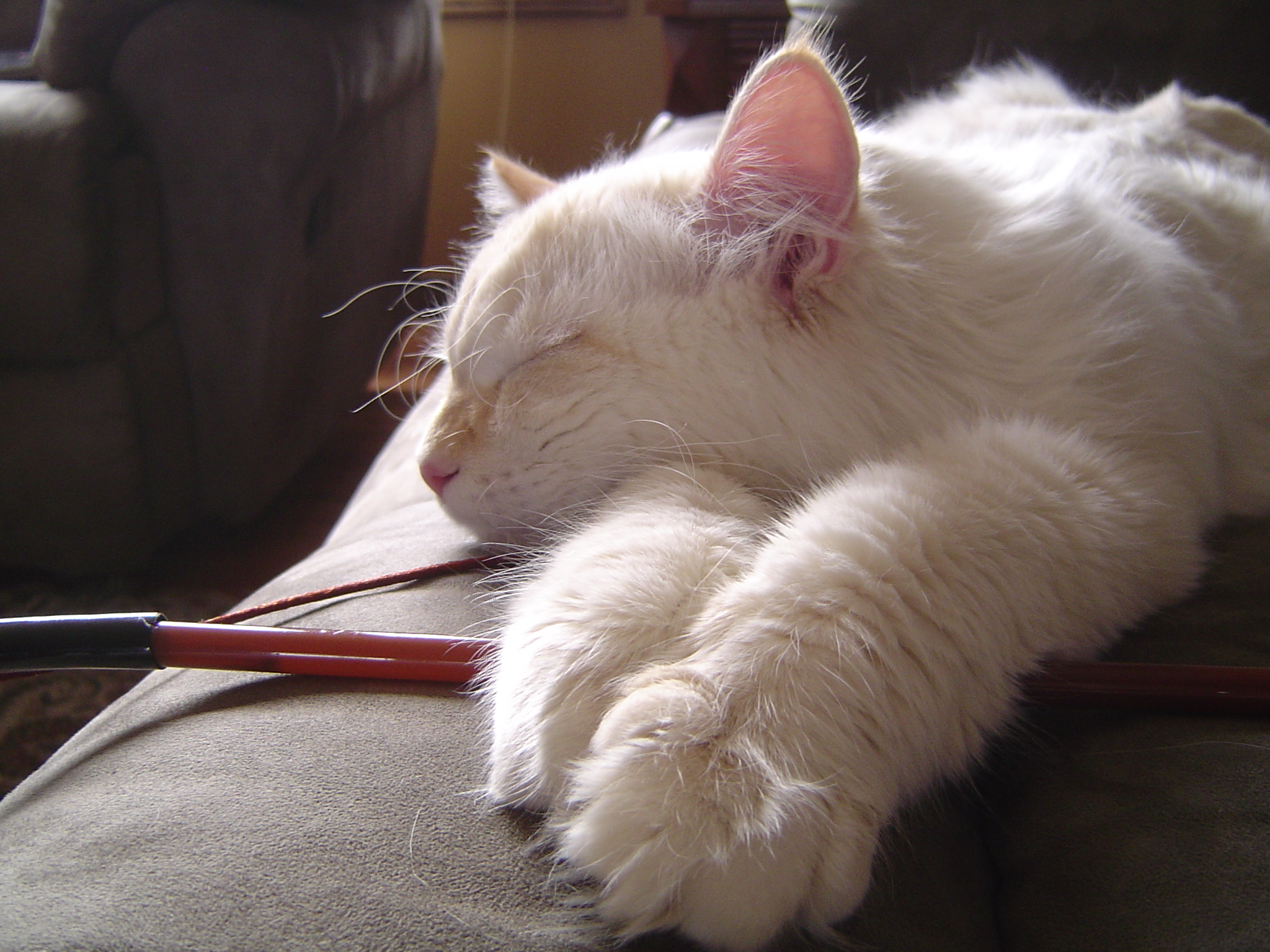
Sleeping Cat

Our menagerie has grown! Odo (in honour of Odo of Bayeux but also with a nod to Odo of Star Trek fame) is a Siberian cat. Ironically, despite his luxurious fur, he is essentially non-allergenic. He’s also a clown of a cat, prone to knocking items off of tables, shoving himself inside any cardboard box or book bag and stalking the pigeons that frequent the bird feeder outside our window. He gets along famously with the dogs and amuses me greatly. (Click to enlarge the picture.)

2 Comments

Filed under pets

Sabbatical Update #2: What’s Added

Sabbaticals set up a different rhythm of work and life. As you shed the schedule of classrooms and meetings, you make room for the creative endeavours of scholarship. (And if you don’t think that scholarship is creative, you’re wrong, wrong, wrong!) I’ve spent the past four months and a bit engrossed in scholarship, my own sources and writing.

Immersion in Scholarship: In the normal course of the term, I try to keep semi-current by reading one scholarly article a week relating to anything in my teaching and research portfolio. Since I teach 5500 years of history touching on three continents with occasional forays into a fourth, that’s a lot of possibilities (and probably a good explanation for why I seem to know a bit about an awful lot of historical periods). During my sabbatical, I’ve immersed myself in the scholarship of a few particular elements and topics. This time around it’s been gender and the English family in the long seventeenth century along with some forays into medieval aristocratic households and the culture of Byzantium from the 11th century onwards. (Yes, for me? This is actually fairly focused. And it’s for two different projects, anyway!)

Getting back into the discourse of a field you’ve only been following superficially for several months or longer? It takes time. Even though I started right into my neatly accumulated pile of books and stash of PDFs on the Monday after New Year’s Day, it took me a while to re-orient myself to what was going on in the field and how my own ideas fit into place.

I take a lot of notes and am still experimenting on integrating this with Zotero as my bibliographic management software. My “old school” system isn’t too crafty: I start a new file in my word processor that’s stuffed full of transcriptions, notes and commentary from sources along with a full Chicago Manual of Style citation for the piece.

Immersion in Sources: More than reading what others are writing about your subject, delving into the actual material of study is sabbatical challenge #1. I’ve learned that it takes me a good week to ramp up to true productivity in my primary source research, especially if the material is not in modern English and/or is in manuscript form. People say you never forget how to ride a bicycle, but you can sure get rusty over a year or two away. It’s even worse with deciphering a particularly crabby form of secretarial hand in a sixteenth century inventory or decoding the formulaic Latin of a semi-literate and presumably un-engaged medieval clerk. The problem of teaching a lot outside my field of expertise is that it takes me that much longer to get back “into” my research. (Don’t suggest I just teach more “in my field” as that’s untenable when I’m the only premodernist teaching in English in my department so if students need any history before 1700, it’s my job.)

In contrast to previous sabbaticals, I’ve spent much less time breathing in the dust of distant archives and much less money on travel. My research was planned around a number of documents I’d already reviewed as well as others that I could obtain digitally. The Old Bailey Online website rolled out a fantastic new workspace for users which allowed me to shift my research from a series of bookmarked searches and records to a more synthetic and comparative analysis of the trials and Ordinary’s Accounts.

Mass Quantities of Writing: I write during the regular term, of course, but my sabbatical plan was to ramp this up with a presentation text that’s the nucleus of an article and a chapter for another project. I naively thought that I’d be pouring out words in print as soon as my sabbatical started. It never happens that way, of course. My writing began as note-taking, proceeded into a rambling outline for the first paper, and then took advantage of the computer’s cut-and-paste functionality to drop in bits and pieces, rearrange them and rewrite entire sections as needed.

One lesson I’ve re-learned in writing the four chapters I’ve had come out in print this past year: start anywhere in the text you plan to produce. Like my own students and my grad student self, I can spend forever fixated on the first line, the starting point, the opening, whereas the body of the paper contains many elements I can visualize clearly before the entire argument’s fully realized. So I started in the middle, wrote a bit, threw in some background, moved things around and kept adding until I had another complete chapter. I set it aside, read it back through (the second most painful point in the writing process: revising!), found the holes and weaknesses that had to be addressed. Then I did just that.

Comments Off on Sabbatical Update #2: What’s Added

Filed under academe

Sabbatical Update #1: What’s Missing

My sabbatical started on January 1st and it’s nearly over. How can that be? I opted for a half-year sabbatical instead of a full year off at reduced salary. Since I can’t uproot the family, especially autistic youngest, to explore the archives of the world, a longer sabbatical at a lower salary isn’t what I wanted.

What’s my sabbatical experience been this time around? I’ll focus here on what I was able to step back from my normal routine, i.e. “what’s missing.”

Teaching: I’ve had six months of release from teaching, except for ongoing supervision of my senior thesis student and graduate students. The supervisions have been a constant concern, especially the senior thesis student’s work. There was a lot of editing involved on an early deadline (all the work had to be completed by early April) but it was a successful and satisfying project. I’ve got a good grad student prospect for the fall, now!

So I wasn’t disengaged from teaching for the sabbatical but it was a big difference from a normal academic term. If you were to take a sabbatical while supervising more students, especially those who were in the final stages of a research project, essay or thesis? You definitely wouldn’t feel a difference in these responsibilities.

What I really noticed was the relief of six months away from the classroom, except for one special appearance when I gave a workshop on facilitating discussions in large classes. A term without worry about designing courses, updating course preparations, reviewing assigned readings, holding office hours, providing feedback in-class and out, marking, writing midterms and exams, writing special midterms and exams, accommodating students with illness and crises, tracking down late papers, filling out endless paperwork for grade submissions, incompletes and the like? Priceless.

Administration: Six months away from meetings (mostly) and administrative responsibilities (almost entirely): that was pretty wonderful except for the few times I got called back in for meetings I “couldn’t miss”. There were real and compelling reasons for my attendance at those meetings, but one of the benefits of a sabbatical is to be truly disengaged from the stress and management of the regular term. Every time they pulled me back in, I could feel my blood pressure rising.

Being on a short sabbatical means that I’m already knee-deep in book orders for the fall term as well as having to engage with the crisis that is our fall/winter schedule. Even as a selfish sabbaticant, these issues directly concern me and I have to address them. But I’m trying to minimize this as much as possible, especially because the clock is ticking on the last six weeks of my sabbatical release!

Next up? I’ll tell you about the cool things I’ve added into my schedule beyond attempting to raise my high score on Scramble!

Comments Off on Sabbatical Update #1: What’s Missing

Filed under academe

Relaunched

Missed me? What I thought would be a brief hiatus in blogging due to some technical problems with my old host turned into a months-long silence due to problems with their version of WordPress. The entire academic year has gone by without a blog post from yours truly: what a tragedy, no? Well, not really, but I’ve missed it.

Twitter was a bit of a lifeline: check me out at Twitter if you’re on there, too. I also have to thank Historiann, Another Damned Medievalist, Bardiac, Dr. Crazy, Inktopia and many other bloggers for providing moral support as well as a virtual place to hang out during my long hiatus.

Rather than futz around any longer, I’ve switched over to wordpress.com for my blog hosting needs. It’s a bargain when all you really want for your domain is blog hosting and a tiny bit of file-hosting as the only cost is your domain mapping with wordpress.com and registration elsewhere.

4 Comments

Filed under personal